
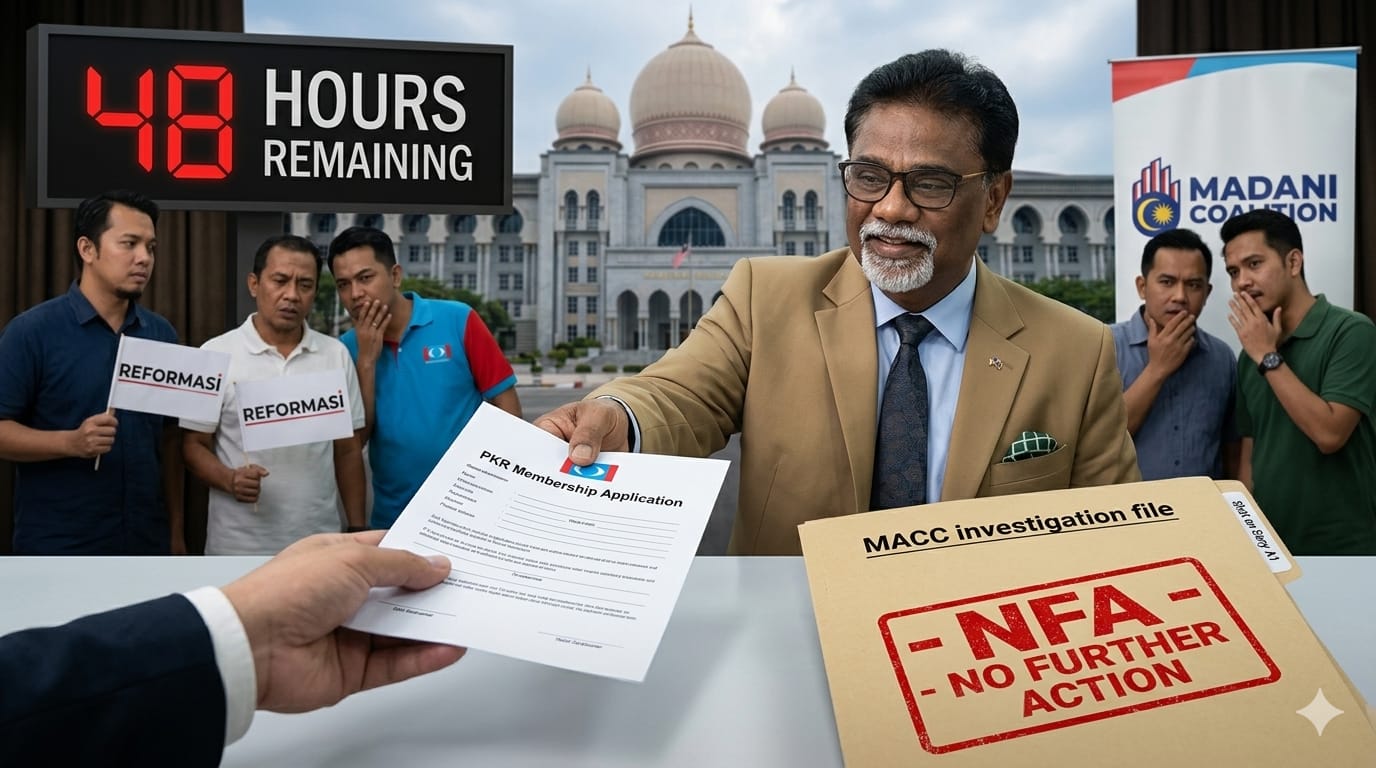
Welcome to Malaysia, where the political weather changes faster than a roadside cendol melts in the afternoon sun, and the legal system appears to run on 5G-speed political absolution. If you went to sleep on Sunday, August 16, 2026, and woke up later that week, you might be rubbing your eyes in absolute disbelief. The timeline of events playing out in Putrajaya reads like a script even Hollywood writers wouldn’t dare pitch. On Monday, August 17, former Minister Datuk Dr. Xavier Jayakumar made a grand, prodigal return to PKR. By Wednesday, August 19, the Malaysian Anti-Corruption Commission (MACC) dropped a bombshell: his 2021 graft investigation papers had been officially stamped No Further Action (NFA) due to "insufficient evidence." Fuh. Netizens are already joking that checking back into PKR has become the ultimate antivirus software one click, and all your legacy bugs are magically cleared.
Predictably, the authorities have moved quickly to pour cold water on the internet wildfire. In an official media release, the MACC stood firmly by its decision, clarifying that the Deputy Public Prosecutor had actually reached the internal decision to store the files earlier, and that the duration of any corruption probe depends entirely on the complexity of the case, not the calendar of political parties. They maintained that the inquiry was handled with absolute professionalism, transparency, and completely free from any external or political interference. PKR leadership has echoed this sentiment, framing Xavier's return as a matter of party reconciliation and moving forward to serve the rakyat, urging the public to stop spinning conspiracy theories and leave the past where it belongs.
But in politics, perception is reality. When a corruption file gets dusted off and closed right alongside a high-profile political homecoming, telling the public it is a mere coincidence is like telling a Malaysian that nasi lemak is a healthy salad; it technically has a slice of cucumber, but absolutely nobody is buying it. The timing has drawn sharp rebukes from veteran commentators. Prominent human rights advocate and former MP Kua Kia Soong publicly called out the glaring gaps, warning that a persistent "lack of explanation creates an accountability vacuum and raises questions about the credibility of institutions tasked with investigating corruption."
This transactional appearance is triggering a massive earthquake within PKR’s own grassroots. While the party hierarchy spins Xavier’s return as a tactical necessity to rebuild fractured support, the party faithful the ones who spent years standing under the blazing sun voting for a “New Malaysia” see a glaring double standard. This tension highlights a broader crisis facing the ruling coalition. As local political analysts writing for Aliran recently pointed out, reformist movements often suffer a form of "political death" through normalization: "This is where we see how the party survives and continues to hold seats... but it stops generating belief. Supporters defend it sometimes merely because the alternative seems worse rather than because the party represents something better."
Instead of institutional progress, we are treated to a proxy war of words that perfectly encapsulates the lopsided power dynamics of the current unity government. When UMNO Supreme Council Member Razlan Rafii recently fired a warning shot telling DAP to "be disciplined," stop making public demands for reforms, and keep quiet, it revealed who really holds the steering wheel. UMNO has far fewer seats, yet they command total leverage because they know the Madani coalition needs them to survive. Meanwhile, DAP, despite boasting the largest number of MPs in the ruling bloc, has been forced into a corner of strategic silence, mocked by voters as mere "seat warmers" who went from being the loudest voices for accountability to being told, "diam, bagi orang tua discuss" (shut up and let the elders talk).
If the Madani government wants to survive the next general election without permanently alienating its core progressive base, it must stop treating institutional integrity as a bargaining chip for elite survival. The defense of "procedural independence" will continue to wear thin until the government delivers on its most critical, long-delayed promise: the structural overhaul of our anti-graft architecture. The Malaysian Bar has repeatedly laid out the blueprint for real accountability chiefly, removing the MACC from the Prime Minister’s Department and placing it under direct parliamentary oversight, alongside completely separating the roles of the Attorney-General and the Public Prosecutor. True reform means building a system where no political alignment can guarantee a clean slate, and no opposition status can be used as a legal threat. Only by stripping the executive of its influence over the scales of justice can Putrajaya prove that Reformasi is an active mission, rather than a slogan left to die in the mortuary of political convenience.
Annan Vaithegi profoundly writes to the reader: “When those in power look at the law, they see a shield to protect themselves or a sword to cut down their rivals; but when the poor look at the law, they only see a wall they cannot climb.” True leadership is not about how cleverly you rearrange the chairs of power to survive today, but whether you have the courage to leave behind a system that outlasts your convenience.
Annan Vaithegi (annanvaithegi@icloud.com) is a content creator under the Newswav Creator programme, where you get to express yourself, be a citizen journalist, and at the same time monetize your content & reach millions of users on Newswav. Log in to creator.newswav.com and become a Newswav Creator now!
The User Content (as defined on Newswav Terms of Use) above including the views expressed and media (pictures, videos, citations etc) were submitted & posted by the author. Newswav is solely an aggregation platform that hosts the User Content. If you have any questions about the content, copyright or other issues of the work, please contact creator@newswav.com.
