
There is a peculiar theatrical rhythm to Malaysian politics, one where the volume of a leader’s voice often drowns out the heavy, unglamorous mechanics of actual governance. Few figures embody this paradox quite as vividly as Dr. Muhamad Akmal Saleh.
Fresh off securing a commanding victory in the Merlimau state election expanding his majority significantly from his 2021 outing Akmal stands as a fascinating study in political duality. He is a man who can roar with unsparing fury on the national stage, yet transform into the gentlest of figures when sitting across a village dining table.
To understand that duality is to understand the strange, looping reality of contemporary Malaysian politics where public outrage buys national headlines, but local kitchen-table grace wins the ballot box.
The Two Faces of the Megaphone
Consider the stark contrast in how Dr. Akmal operates.
On the national stage, he is the quintessential firebrand. When an upside-down flag incident erupted in a Penang hardware shop run by an elderly citizen, the reaction was thunderous. The megaphones came out, social media lit up with fiery accusations of a patriotism deficit, and the rhetoric stoked unnecessary communal tension. One could not help but wonder: what if, instead of a charged convoy blocked by police, the approach had been different? What if a quiet, respectful visit had taken place the next day to help raise the flag the right way? Such a gesture would have disarmed the tension, won the hearts of Malaysians across all races, and built a bridge instead of a barricade.
Yet, zoom in on Merlimau, and the character shifts entirely.
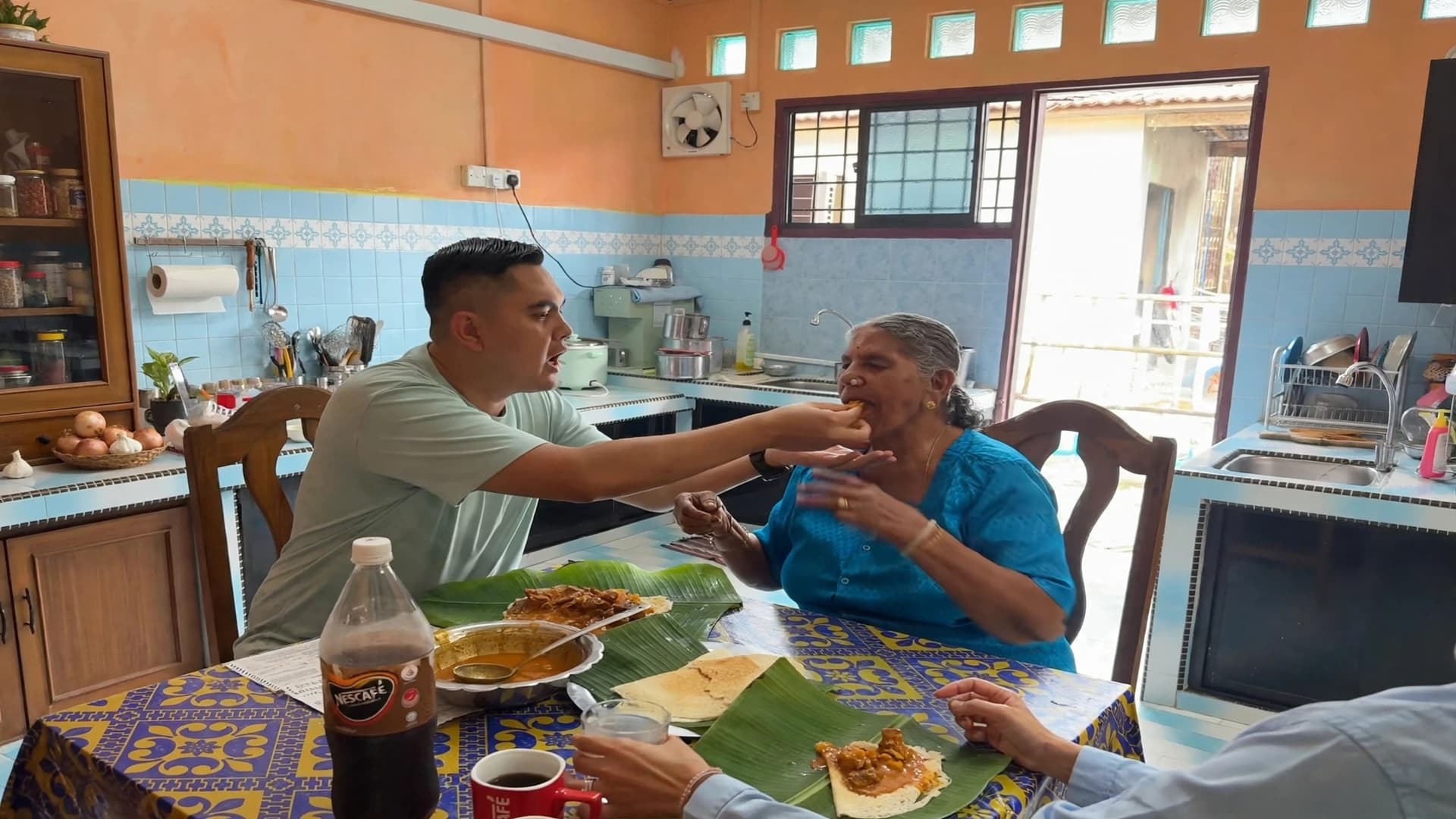
During the heat of the campaign trail, amidst high-stakes political chess and lingering legal shadows, Akmal was spotted visiting an elderly Indian grandmother during the Deepavali season. He sat down with her, shared a meal, and gently helped feed her. Looking into her eyes, he asked warmly, "How many sons do you have?" Before she could answer, he gently smiled and said, "Consider me another son to you." Touched by that sudden, profound human warmth, the elderly grandmother pulled him close and blessed him like her very own flesh and blood.
That genuine, unscripted moment repeated across countless quiet living rooms, Akka Coffee stalls, and Chinese coffee shops in his constituency reveals why he commands such deep multi-ethnic loyalty locally. In Merlimau, he is not a distant, screaming commentator on a screen; he is the attentive local representative who shows up, listens, and treats ordinary folks like family. Even among minority voters who heavily critiqued his national grandstanding, many local Indian and Chinese residents acknowledged that on the ground, his community service and personal accessibility were hard to fault.
It begs an unavoidable question: Is Dr. Akmal a local champion who listens in silence and serves with humility at home, only to transform into an aggressive brawler when punching outward at minority communities elsewhere? And if he possesses the capacity for such profound, borderless empathy in his own backyard, why expend so much national energy manufacturing division?
The Subtext of the Noise
To write off these theatrical outbursts as mere personal temperament, however, misses the wider political machinery at play. Much of the high-decibel posturing that dominated the headlines did not happen in a vacuum. It coincided heavily with high-stakes political maneuvering behind the scenes notably the intense negotiations surrounding house arrest appeals and legal pardons for figures like Najib Razak.
When high-level political bargaining hits roadblocks, when coalition partners push back, and when institutional friction slows down desired outcomes, the pressure valves on the ground open up. Loud public campaigns over cultural symbols and minority missteps often serve as convenient lightning rods useful distractions to rally a base, exert political leverage, and signal displeasure elsewhere in the unity government.
Today, the political landscape feels increasingly upside-down. Wrongdoing is frequently repackaged as loyalty, court sentences are absorbed or softened through endless legal loops, and those who apply political pressure are rewarded with renewed relevance. When a system operates this way, the public is left wondering: how can a nation anchored on such contradictions ever steer toward genuine institutional maturity?
The Lost Future of Melaka
Nowhere was this displacement of substance by spectacle more evident than in the very catalyst that forced early political realignments in Melaka. Let us not forget how fragile state stability has often been born from internal leadership fracturing, shifting alliances, and power struggles that risk paralyzing local administration.
Yet, throughout the campaign trail, did anyone hear a rigorous debate about Melaka’s economic future? Was there a deeply articulated plan for how a state born of maritime history will compete in the digital economy, retain its fleeing youth talent, or modernize its infrastructure for the next decade?
Scarcely. Instead of a battle of economic manifestos, much of the public arena was consumed by nationalized noise, identity posturing, and the defense of political survival.
The irony was sharpest when looking at the collateral damage of his recent legal hurdles. Finding oneself facing heavy defamation penalties to the point of dramatically offering to auction off personal assets like a beloved maxi-scooter or farmed tilapia fish struck many as political theater of its own. Critics rolled their eyes at the "wayang kulit" of playing the downtrodden victim, noting that accountability should be met with quiet dignity rather than a public sob story. If you break the rules of civil discourse, you pay the price; you do not pass around a collection tin to fund the consequences of an undisciplined tongue.
The Real Victory and the Real Test
And yet, despite all the noise, the petitions, and the legal storms, the people of Merlimau spoke. They looked past the national headlines, past the court judgments, and past the online storms, returning their assemblyman with an even larger majority.
That victory is a testament to grassroots connection. But it should not be mistaken for a blank check.
A larger majority does not fix a broken national discourse. It does not pay for institutional reform, and it certainly does not substitute for the hard, unglamorous work of building a multi-ethnic nation that respects its own laws and protects its own economy.
Dr. Akmal has proven he can win an election by tending to his garden in Merlimau. The true test of statesmanship, however, is whether he can stop burning down the fence next door just to keep himself warm.
A true leader does not need an enemy to prove his strength, nor a megaphone to validate his sincerity. - Annan Vaithegi
Annan Vaithegi (annanvaithegi@icloud.com) is a content creator under the Newswav Creator programme, where you get to express yourself, be a citizen journalist, and at the same time monetize your content & reach millions of users on Newswav. Log in to creator.newswav.com and become a Newswav Creator now!
The User Content (as defined on Newswav Terms of Use) above including the views expressed and media (pictures, videos, citations etc) were submitted & posted by the author. Newswav is solely an aggregation platform that hosts the User Content. If you have any questions about the content, copyright or other issues of the work, please contact creator@newswav.com.