
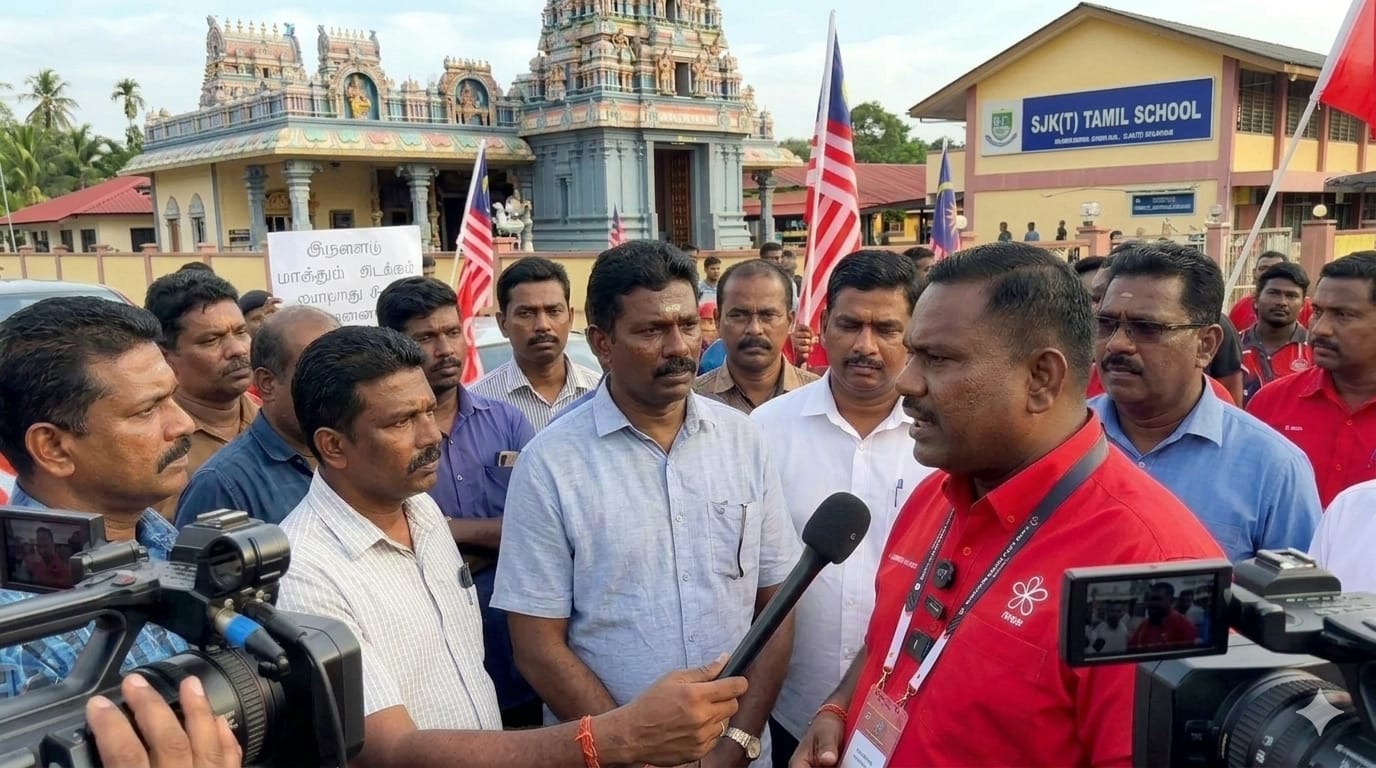
That day during the Johor election, PAS shared a logo with BN and claimed that whoever voted for BN was also their supporter. Today in Seremban, Bersatu and PSM appear in similar red-themed campaign colours, with only small differences in logos. It raises a familiar question among voters: when the colours and symbols blur, will each party later claim all the support for itself, regardless of the confusion created during campaigning?
The statement by Bersatu's Nilai candidate that campaigning among non-Malay voters is easier without PAS may be politically honest, but it also exposes a much deeper reality.
Winning back the Malaysian Indian community is no longer simply a matter of changing campaign strategies or adjusting who appears on the stage.
Trust, once broken, cannot be rebuilt overnight.
Beyond the Green Wave: Why Trust Cannot Be Negotiated
For years, many Malaysian Indians have watched a succession of racial rhetoric, insensitive remarks, and religious controversies emerge from different political actors. The issue is not confined to one party alone. PAS has often been criticised for statements that have caused concern among non-Muslim communities. UMNO has, at various times, also faced criticism over racial narratives. Bersatu, too, has not been immune.
Many within the Malaysian Indian community still remember the controversy surrounding the relocation of a Hindu temple in Taman Medan. Regardless of differing legal or planning perspectives, what many people expected from elected representatives was leadership that encouraged respectful dialogue, sensitivity, and confidence among all affected communities. Instead, many felt the episode left deep emotional scars and reinforced a perception that their concerns were secondary.
Politics is ultimately about perception as much as policy.
If communities repeatedly feel unheard or humiliated, rebuilding confidence requires much more than election-season visits.
Today, the Malaysian Indian community is changing.
The days when voters waited for a political leader to tell them which direction to take are fading.
Young Malaysians are building businesses, entering professional careers, pursuing higher education, mastering digital skills, and creating opportunities through their own effort. Parents are investing their life savings into their children's education. Entrepreneurs are creating jobs. Professionals are contributing to the nation's healthcare system, engineering sector, legal profession, aviation industry, education system, and technology economy.
The community is no longer waiting for a political saviour.
It is building its own future.
There is a beautiful Tamil metaphor that says even after the harshest drought, the soil still holds moisture beneath its surface. To the casual observer, the land may appear dry, cracked, and lifeless. Yet beneath that hardened earth remains the quiet strength that allows new life to emerge when the season changes.
The Malaysian Indian community is much like that soil.
For decades, politicians from different parties have arrived with promises of transformation, empowerment, and representation. Some delivered meaningful progress, while many others left behind disappointment. Racial rhetoric, insensitive remarks, religious controversies, and election manifestos that faded after polling day have slowly eroded political trust.
But they have not eroded the spirit of the community.
While political parties debated power, ordinary Malaysian Indians continued building their future. Parents sacrificed to educate their children. Young people pursued professional careers. Entrepreneurs started businesses. Workers laboured with dignity. Families invested in education because they understood that lasting progress would come through knowledge and hard work, not through dependence on any single political leader.
The soil never lost its moisture.
The strength was never in the politicians.
The strength has always been in the people themselves.
That does not mean politics has become irrelevant.
It means politics must finally catch up with a community that has already moved forward.
Today, the Malaysian Indian community is no longer asking, "Who will save us?"
It is asking every political party a much more difficult question:
"What value will you add to a community that is already working hard to build its own future?"
That is why empty promises no longer carry the same weight they once did.
Communities today ask practical questions.
If Bersatu is asking for support in Seremban home to one of Malaysia's largest Malaysian Indian populations then voters deserve detailed answers.
What is Bersatu's long-term economic plan specifically for the Malaysian Indian community in Seremban?
How will the promise of 50,000 high-income jobs translate into opportunities for local Indian youth?
What measurable programmes will ensure that Indian graduates and job seekers benefit from these opportunities?
What plans exist to strengthen Tamil schools, improve educational facilities, reduce dropout rates, and expand technical and vocational pathways?
How will small Indian-owned businesses gain access to financing, procurement opportunities, and entrepreneurship programmes?
What initiatives will address housing, skills development, youth employment, and community infrastructure?
These are not unreasonable questions.
They are the questions of taxpayers.
They are the questions of parents.
They are the questions of voters who want policies rather than slogans.
The Malaysian Indian community has contributed far more to this country than is often acknowledged. From the rubber estates that helped build the nation's early economy to today's doctors, teachers, engineers, entrepreneurs, pilots, civil servants, and front-line workers, generations have helped shape modern Malaysia through hard work rather than entitlement.
The community is not asking for special treatment.
It is asking for fair opportunities, consistent policies, respectful engagement, and accountability.
One reason that trust has become so difficult to rebuild is that perception extends beyond race and religion it also encompasses integrity and governance.
For many voters, particularly younger Malaysians, credibility is shaped not only by campaign promises but also by the political baggage a party carries. Bersatu continues to face questions arising from high-profile court proceedings involving several of its leaders and former office-bearers. Among the cases that attracted national attention was testimony in the Jana Wibawa trial alleging that RM19.5 million was donated to Bersatu in connection with an effort to secure a government project. Those proceedings remain matters for the courts, and it is for the judiciary not politicians or commentators to determine legal responsibility.
However, politics operates not only on legal outcomes but also on public confidence.
When Bersatu seeks a fresh mandate from voters, particularly in constituencies with significant Malaysian Indian populations such as Seremban and Nilai, it must recognise that many voters will inevitably ask difficult questions.
Is this election fundamentally about presenting a credible long-term vision for Negeri Sembilan and its diverse communities?
Or is it equally about restoring the party's political influence while major legal proceedings involving prominent party figures continue to unfold?
These are not accusations. They are legitimate questions that arise whenever a political party seeks public trust while simultaneously carrying unresolved integrity issues in the public eye.
That is why campaign slogans and ambitious announcements alone are no longer enough.
If Bersatu speaks of creating 50,000 high-income jobs and millions of ringgit in economic opportunities, the Malaysian Indian community deserves more than broad promises. They deserve to know how many of those opportunities will realistically benefit Indian youths in Seremban, what concrete plans exist to improve Tamil schools, how local Indian entrepreneurs will be supported, and what measurable commitments will be delivered within a fixed timeline.
The Malaysian Indian community is no longer asking, "Who will lead us?"
It is asking a far more important question:
"Why should we trust you?"
That is the election every political party not only Bersatu must now win.
“Communities do not lose faith because of one speech or one election. They lose faith when promises become routine and progress remains optional.” - Annan Vaithegi
Annan Vaithegi (annanvaithegi@icloud.com) is a content creator under the Newswav Creator programme, where you get to express yourself, be a citizen journalist, and at the same time monetize your content & reach millions of users on Newswav. Log in to creator.newswav.com and become a Newswav Creator now!
The User Content (as defined on Newswav Terms of Use) above including the views expressed and media (pictures, videos, citations etc) were submitted & posted by the author. Newswav is solely an aggregation platform that hosts the User Content. If you have any questions about the content, copyright or other issues of the work, please contact creator@newswav.com.