.jpg)
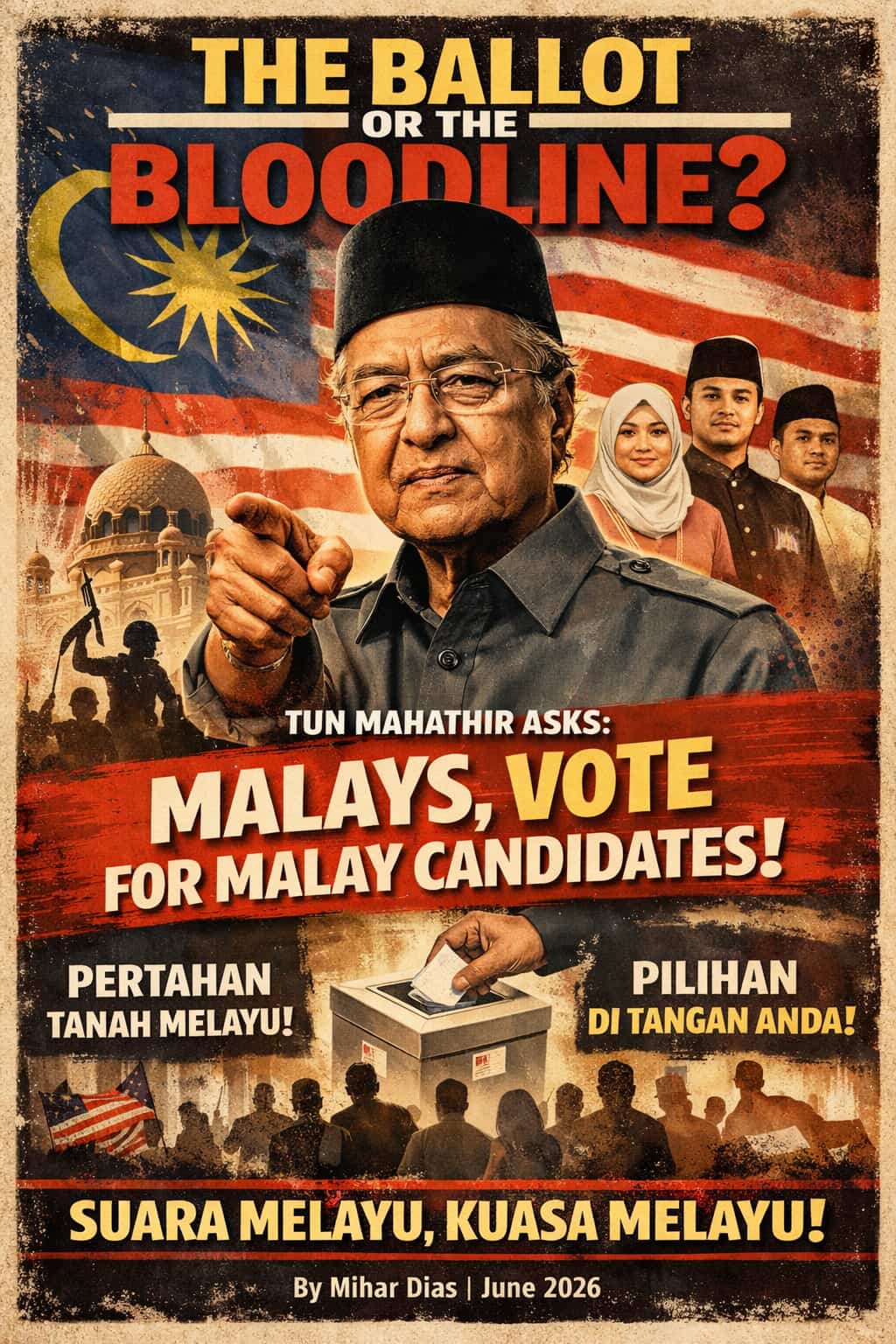
The Ballot or the Bloodline? Tun Mahathir Asks Malays to Vote for Malay Candidates
By Mihar Dias June 2026
There are few personalities in Malaysian politics who can still change the national conversation with a single Facebook post. Mahathir Mohamad remains one of them.
His latest appeal—that Malays should vote for Malay candidates rather than political parties if they wish to preserve "Tanah Melayu"—is vintage Mahathir. https://www.facebook.com/share/p/1EGd9NTCF2/
It is not merely an election message. It is an existential warning. The ballot paper becomes a survival kit.
Whether one agrees or disagrees, the statement deserves examination beyond the predictable chorus of applause and outrage.
Democracy asks a simple question: Who can govern best?
Ethnic politics asks a different one: Who looks most like me?
The two questions occasionally produce the same answer. Increasingly, they do not.
Malaysia's political history has long been built around ethnicity. Independence itself was negotiated through communal representation. Political parties were born from racial constituencies, and voters became accustomed to thinking of elections as demographic censuses rather than performance reviews.
Mahathir did not invent this political grammar. He mastered it.
Ironically, throughout his own long career he repeatedly urged Malays to become globally competitive, highly educated and economically resilient. He spoke of excellence, discipline and merit. Yet the latest appeal seems to suggest that, when election day arrives, competence should give way to communal identity.
That is a curious evolution.
A Malay candidate can be honest—or corrupt.
A Malay candidate can be visionary—or incompetent.
A Malay candidate can defend Malay interests—or merely defend his own interests while speaking loudly about Malay rights.
Race tells voters remarkably little about character.
History offers enough painful lessons. Nations rarely decline because too many people voted for the wrong ethnicity. They decline because too many people voted for poor leadership.
Identity may win elections.
Integrity governs countries.
The deeper irony is that Malaysia today faces problems which refuse to recognise race. Inflation charges every customer equally. Corruption steals from every taxpayer. Poor governance delays every project. Floods enter Malay, Chinese, Indian and indigenous homes without checking identity cards.
None of these problems asks who you voted for ethnically.
They merely ask whether those elected know what they are doing.
Of course, Mahathir's concerns resonate with many Malays who genuinely fear cultural erosion and changing political demographics. Those anxieties should not simply be dismissed. Democracies function best when legitimate fears can be discussed without ridicule.
But fear is a poor architect of public policy.
It narrows choices precisely when countries need broader thinking.
Malaysia's Constitution already provides a carefully negotiated framework recognising the special position of Malays and the natives of Sabah and Sarawak while also safeguarding the legitimate rights of other communities. The challenge has never been the absence of constitutional protection. The challenge has always been producing leaders worthy of those protections.
Perhaps the real loyalty Malays—and indeed all Malaysians—owe is neither to race nor party.
It is to good government.
Political parties deserve loyalty only when they earn it.
Politicians deserve votes only when they deserve them.
Ethnicity is inherited.
Leadership is demonstrated.
The ballot box should remain the place where citizens judge performance, honesty and vision—not merely ancestry. If democracy becomes an exercise in counting bloodlines instead of evaluating leadership, then elections cease to be competitions of ideas and become censuses with campaign posters.
Malaysia deserves better than that.
The future of the country will not be determined by whether candidates share our ethnicity.
It will be determined by whether they share our commitment to govern wisely after the campaign banners have come down.
Mihar Dias (mihardias@gmail.com) is a content creator under the Newswav Creator programme, where you get to express yourself, be a citizen journalist, and at the same time monetize your content & reach millions of users on Newswav. Log in to creator.newswav.com and become a Newswav Creator now!
The User Content (as defined on Newswav Terms of Use) above including the views expressed and media (pictures, videos, citations etc) were submitted & posted by the author. Newswav is solely an aggregation platform that hosts the User Content. If you have any questions about the content, copyright or other issues of the work, please contact creator@newswav.com.