.By Mihar Dias November 2026
When politicians celebrate election victories, ordinary Malaysians might reasonably ask: What exactly have we won?
There is something rather curious happening in Malaysian politics. The voters have been going to the ballot box, politicians have been counting their victories, and the rest of us have been wondering whether anybody has remembered to count our problems.
The latest Melaka state election has added another chapter to an increasingly curious political story.
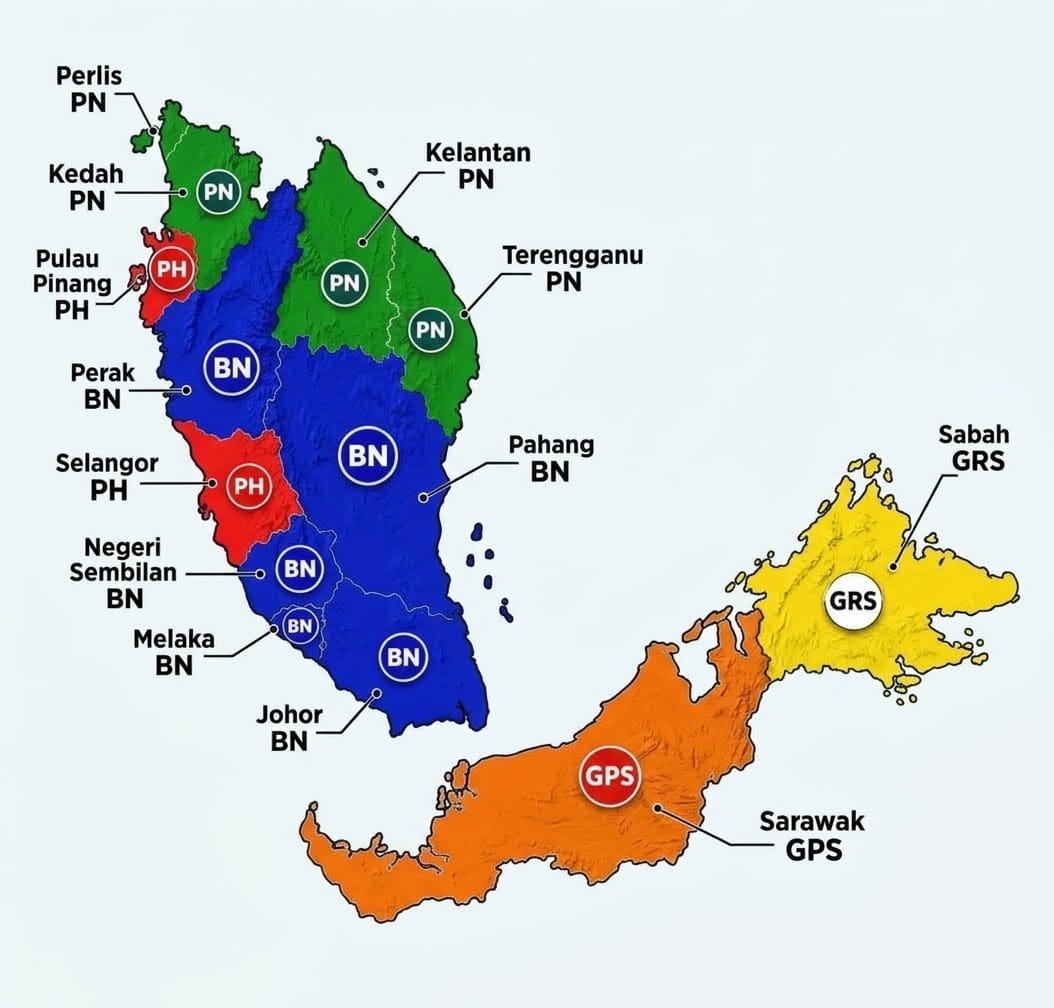
Barisan Nasional (BN) retained 21 of the 28 seats, Perikatan Nasional (PN) secured three, while Pakatan Harapan (PH) was reduced to just four. Together, BN and PN command 24 seats, comfortably above the two-thirds threshold.
This follows the results in Johor, where BN won 48 of 56 seats, and Negeri Sembilan, where BN secured 18 and PN seven out of 36 seats.
So, let us look at the political geography.
BN has consolidated its position in Johor and Melaka, while its electoral partnership with PN has displaced PH from Negeri Sembilan.
Three important state governments have gone in the direction of BN or the BN-PN partnership.
One could be forgiven for thinking that Malaysian politics has discovered a new arrangement: BN and PN competing against each other when convenient, cooperating when advantageous, and leaving PH to explain the difference between being a partner in Putrajaya and a competitor at the state level.
Politics, after all, is the art of making yesterday's enemy today's indispensable friend.
But there is a more important question than who gets to occupy the Menteri Besar's office.
What is in it for ordinary Malaysians?
For the man or woman trying to make ends meet, the difference between a BN, PN or PH administration is not necessarily reflected in the colour of the flag flying outside the state secretariat.
It is reflected in the cost of groceries, employment opportunities, housing affordability, public transport, healthcare, education and the quality of local government.
A voter in Melaka does not pay less for chicken simply because BN has retained 21 seats. A family in Johor does not automatically enjoy better housing affordability because BN has secured a two-thirds majority. And a resident of Negeri Sembilan does not receive a discount on electricity because BN and PN have discovered the benefits of political cooperation.
Election victories are political achievements. They are not economic achievements by themselves.
ANWAR: PRIME MINISTER, BUT FOR HOW LONG?
This brings us to Anwar Ibrahim.
He remains Prime Minister, but the electoral setbacks suffered by PH raise legitimate questions about the political sustainability of his coalition.
There is a distinction between losing state elections and losing the federal government. They are not the same thing.
Anwar's position ultimately depends on maintaining the confidence of a majority in the 222-member Dewan Rakyat. That requires at least 112 MPs, assuming a full-house simple majority. State election results do not automatically remove a Prime Minister from office.
But politics is rarely as simple as constitutional arithmetic.
A coalition can have sufficient parliamentary numbers and yet find itself increasingly uncomfortable with the political price of staying together.
UMNO has its own survival considerations. DAP has its electoral constituencies to answer to. PKR has its supporters and internal expectations. Amanah has its own political identity.
Everybody is in the same government, but everybody has a different audience to please.
That is the peculiar beauty of a unity government. Unity is the official product. Negotiation is the manufacturing process.
The question is whether Anwar can continue to keep these different political interests under one roof while the electoral ground beneath them changes.
The recent results make that an important question, not an established conclusion.
AND WHAT ABOUT SELANGOR?
Here is where things become particularly interesting.
Selangor remains PH's important stronghold. The current 56-seat assembly has 32 PH representatives, 22 from PN and two from BN.
But the arithmetic deserves attention.
An analysis published by The Edge has examined the possibility of BN and PN consolidating their electoral support against PH. Its scenario suggests that a combined BN-PN front could threaten several PH constituencies.
That scenario assumes complete vote transfer between BN and PN, something that cannot simply be taken for granted.
And there is another important distinction.
Selangor's next state election is not automatically decided by GE16. Its assembly has a separate electoral timetable, although the state poll could be coordinated with the general election.
Nevertheless, GE16 will provide an important indication of whether PH can maintain its support in the state.
For Anwar, Selangor is more than another state on the political map. It is an important test of PH's ability to retain its traditional electoral coalition.
If the party struggles to maintain that support, the implications will extend beyond Shah Alam.
THE POLITICAL LEADERSHIP QUESTION
Anwar has spent years pursuing the ambition of becoming Prime Minister. He finally achieved it in November 2022 after a general election that produced a hung Parliament.
He subsequently assembled a government that brought together political parties which had spent years attacking one another.
It was an extraordinary political arrangement.
But forming a government and sustaining public confidence in that government are two different exercises.
The challenge now is to demonstrate that the unity government is more than an arrangement for sharing ministerial portfolios and parliamentary numbers.
What is its common purpose?
What are the measurable improvements in the lives of ordinary Malaysians?
What reforms have been delivered, rather than merely announced?
And what will voters be able to point to when they are asked to renew the government's mandate?
These are questions that cannot be answered by another round of political speeches.
Nor can they be answered by telling Malaysians that the alternative might be worse. Governments should be judged by what they deliver, not merely by the shortcomings of their opponents.
The BN-PN partnership, meanwhile, must also demonstrate that its electoral cooperation can translate into effective administration. Winning seats together is one thing. Governing together, with potentially competing political interests, is another.
SO, WHAT SHOULD WE EXPECT FROM GE16?
The political landscape is changing, but nobody should assume that three state election results automatically determine the outcome of a general election.
National elections involve different constituencies, different issues and different political calculations.
BN and PN may discover that cooperation brings electoral advantages, but they will also have to negotiate leadership, seat allocation and the question of who gets to lead any future federal government.
PH, on the other hand, must address the challenge of retaining its supporters while making a stronger appeal to voters who have moved towards its competitors.
And Anwar must demonstrate that his coalition has a compelling reason to remain together beyond the fact that its members currently occupy government offices.
As for us ordinary Malaysians, perhaps we should make a modest request.
We are not particularly interested in whose photograph gets the biggest space on the election billboard, whose flag flies highest, or who gets to deliver the victory speech.
We would like cheaper food, better jobs, affordable homes, decent public services and a government that remembers why it was elected.
We have had enough political musical chairs. We would like to see some work being done while the music is playing.
Anwar has the constitutional authority to govern. BN has demonstrated its electoral strength in several states. PN has shown that it remains a significant political force.
But the real test of all these political arrangements is still waiting.
When GE16 comes, politicians will ask Malaysians for another mandate. Perhaps Malaysians should ask them for an account of the previous one.
After all, a ballot paper is not a loyalty card.
It does not come with lifetime membership.
And the customer, occasionally, has every right to change suppliers.
Mihar Dias (mihardias@gmail.com) is a content creator under the Newswav Creator programme, where you get to express yourself, be a citizen journalist, and at the same time monetize your content & reach millions of users on Newswav. Log in to creator.newswav.com and become a Newswav Creator now!
The User Content (as defined on Newswav Terms of Use) above including the views expressed and media (pictures, videos, citations etc) were submitted & posted by the author. Newswav is solely an aggregation platform that hosts the User Content. If you have any questions about the content, copyright or other issues of the work, please contact creator@newswav.com.