
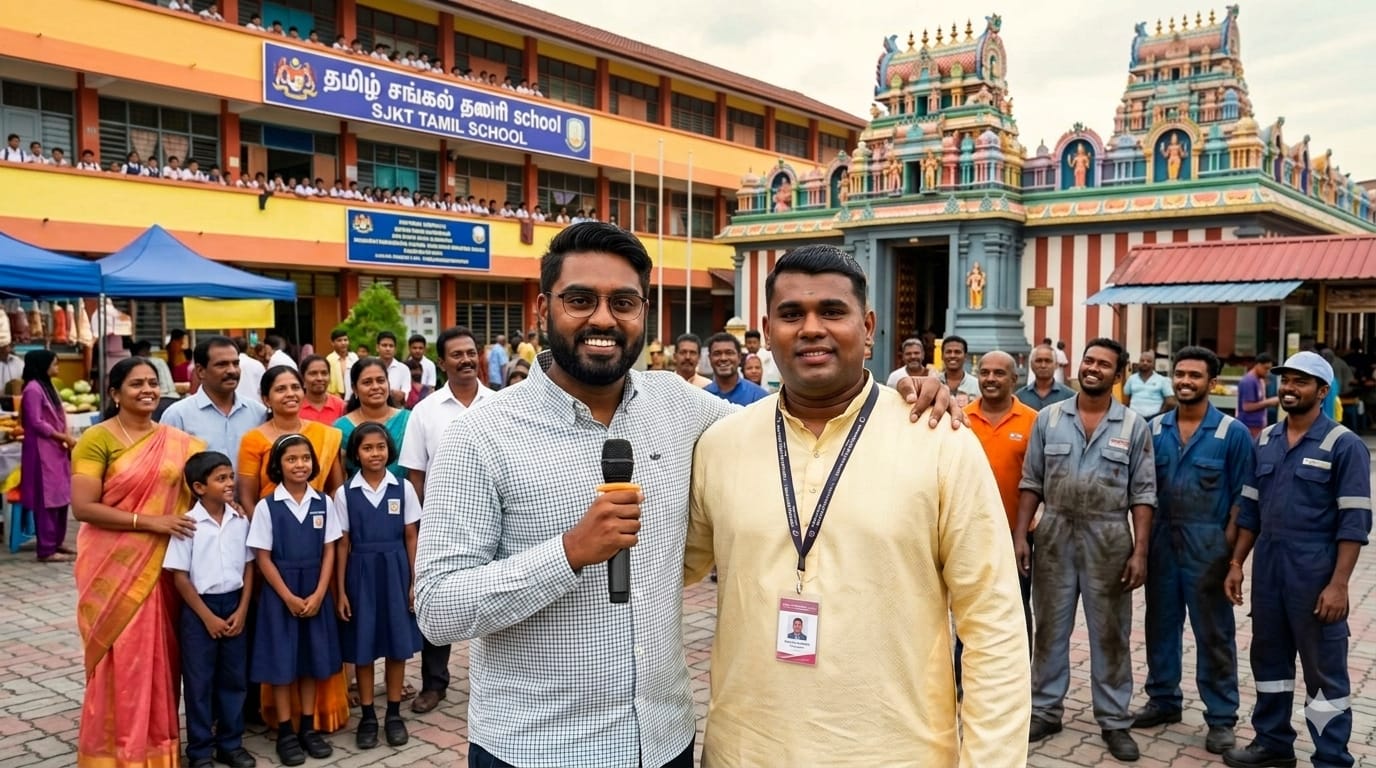
Politics in Malaysia is not a stage. It is a pressure chamber where ambition, identity, expectation, and history are compressed into a single moment of judgment called an election. For young Malaysian Indian leaders, that pressure is not only intensified it is inherited. They do not simply represent a party. They inherit a community shaped by decades of promises, partial progress, and unresolved structural challenges.
Every speech is measured. Every silence is interpreted. Every failure is magnified. Every success is questioned.
And yet, despite this weight, a new generation is stepping forward not cautiously, but directly into the fire.
A Community Measured by Struggle, Not Statistics
To understand Malaysian Indian politics today, one must move beyond policy papers and official statements. The real narrative is not located in Putrajaya. It is found in the lived realities of estates, low-cost flats, and urban working-class neighbourhoods where survival is not theoretical but daily.
Here, life is immediate rather than abstract.
A mechanic calculates whether spare parts will arrive before rent is due. A single mother weighs tuition fees against groceries. A graduate holds a degree that feels heavier in expectation than in opportunity. A young worker moves through gig jobs that provide income but not stability. A small shop owner watches foot traffic decline while costs rise quietly but relentlessly.
These are not isolated stories. They are recurring patterns that define a broader socioeconomic condition that has persisted across generations.
The Malaysian Indian community is often discussed in terms of averages and percentages. But lived reality does not operate in averages. It operates in pressure points where one missed payment can destabilise a household, where one illness can erase savings, where one lost job can shift a family’s trajectory for years.
The Three Pillars of Community Continuity
Within this reality, three institutions continue to carry disproportionate weight in sustaining identity and resilience: Tamil schools, Hindu temples, and economic mobility.
Tamil schools are not merely educational spaces. They function as identity institutions where language, memory, and cultural continuity are preserved. In many cases, they are the first environment where children are taught not only to read and write, but to understand who they are within a multicultural nation. Yet many continue to face ageing infrastructure, uneven resources, and declining enrolment in certain areas. Each missing facility is not just an administrative gap it is a slow accumulation of inequality that compounds over time.
Hindu temples carry an equally complex role. They are not only places of worship but also emotional anchors, welfare centres, and historical markers of community presence. In many neighbourhoods, they function as informal support systems helping families during funerals, organising food aid during crises, and providing a sense of continuity in rapidly changing urban landscapes. Yet they remain vulnerable to land disputes, redevelopment pressures, and bureaucratic uncertainty. When a temple is threatened, what is at stake is not only a structure, but continuity of memory and belonging.
A Generation Between Education and Uncertainty
The youth represent the most dynamic yet uncertain pillar.
They are more educated, more connected, and more globally aware than previous generations. They navigate digital economies, remote work platforms, and global cultural influences with ease. Yet the labour market does not always absorb their skills effectively. They are digitally fluent but economically constrained. Ambitious, but structurally limited.
Many are told to “work hard,” but they are also aware that hard work alone no longer guarantees stability. They are not asking for sympathy. They are asking for systems that function systems that reward effort with opportunity, not exhaustion.
This is the real foundation of Malaysian Indian politics today not rhetoric, but lived survival shaped by institutional gaps and uneven opportunity.
RM100 Million, RM150 Million, and the Question of Impact
MITRA has long stood at the intersection of expectation and frustration. It was designed as a bridge between policy intention and community outcome, yet it has often been criticised for inconsistency, fragmentation, and limited long-term visibility.
Under the MADANI administration, allocations increased from RM100 million to RM150 million.
On paper, this signals progress.
But in politics, numbers are only the beginning of the conversation.
The central question remains unchanged.
And what does it truly change in the lives of ordinary families?
Because funding, without transformation, becomes only a statistic. And statistics, without impact, become political language rather than social change.
Prabakaran: From Symbolic Youth to Administrative Responsibility
When P. Prabakaran won Batu at 22, his victory was seen as a generational breakthrough. He became proof that political ceilings could be broken, that youth could compete, and that entrenched expectations could be challenged.
But symbolism is only the beginning. Governance begins where symbolism ends.
As Chairman of MITRA’s Special Committee, Prabakaran now operates in a different reality one defined by execution rather than aspiration. Every programme must justify itself. Every allocation must show impact. Every initiative must survive scrutiny not only in Parliament, but in the lived experiences of the community it claims to serve.
From Allocation to Accountability
MITRA’s initiatives, including the Uyarvu MADANI Grant Programme offering up to RM50,000 for micro-entrepreneurs, have identified hundreds of small traders for support. For many recipients, such assistance is not abstract policy it is the difference between continuing a business or shutting it down.
But the deeper question is not distribution. It is sustainability.
How many businesses survive beyond the grant cycle?
How many evolve from micro-enterprises into stable SMEs?
How many still exist without assistance in five years, not because they failed, but because they no longer needed support?
This is the real measure of transformation.
Alongside entrepreneurship support, expansion into TVET and education pathways reflects a recognition that mobility cannot rely on short-term aid alone. Skills development, industry alignment, and structured pathways into employment remain essential if the community is to move beyond cyclical dependency.
Prabakaran’s challenge is not visibility. It is permanence.
To convert assistance into independence.
To convert funding into futures.
To ensure that policy does not end at announcement, but continues into outcome.
Leevineshwaraan: Entry Into a Multiracial Political Equation
If Prabakaran represents governance under pressure, Leevineshwaraan Murugan represents entry under scrutiny.
At 23, he contests Sri Tanjung (N33) in Negeri Sembilan as the youngest candidate in the race. His candidacy immediately draws attention not only because of his age, but because of what his age symbolises: a generational shift attempting to enter a highly competitive political landscape.
But youth alone does not win elections.
Sri Tanjung is multiracial. Malay voters form a decisive bloc, Chinese voters influence economic sentiment, and Indian voters provide foundational but not determining support. This creates a political environment where no single community can define victory alone.
Beyond Identity Politics
In such a constituency, identity appeal is insufficient.
A candidate must operate across communities, not within a single demographic comfort zone.
Can he be seen not only as an Indian candidate, but as a community candidate?
Can he engage Malay voters on cost of living, housing, and local governance without hesitation or distance?
Can he address Chinese voters on business stability, infrastructure, and economic confidence with credibility?
Can he remain grounded in Indian concerns education, temples, employment without being confined by them?
The answer to these questions will determine not only electoral success, but political maturity.
The Psychological Challenge
This is not only political. It is psychological.
Modern voters do not reward intention. They reward relevance.
And relevance must be proven repeatedly, across communities, not within one.
For a young candidate, this means constant exposure, constant listening, and constant adaptation. It means accepting that trust is not declared it is accumulated.
Two Leaders, One Political Reality
Prabakaran and Leevineshwaraan represent different stages of the same continuum, but both are shaped by the same truth.
One is inside the system, trying to reform it while being judged by outcomes.
The other is outside it, trying to enter while being judged by potential.
Yet both are bound by shared realities:
Courage is the entry requirement.
Consistency builds trust.
Politics is not a performance. It is a relationship built over time and broken quickly by distance.
The Hard Reflection Politics Demands
When campaigns fail, it is easy to look outward. To blame machinery, timing, or voter sentiment. But real political maturity demands harder questions.
Did you truly reach the people you claimed to represent?
Did you listen before speaking, or speak before understanding?
Were you present only during elections, or throughout their struggles?
Did you see communities or just votes?
Because communities rarely reject sincerity.
They reject distance.
And distance is not always physical. It is emotional, intellectual, and sometimes even linguistic. It is the gap between what leaders assume and what people actually experience.
Conclusion: The Arena Does Not Negotiate
Prabakaran’s journey shows that youth can break political ceilings, but sustaining that position requires consistency, delivery, and transformation from symbolism to substance. His challenge is no longer about proving capability it is about proving continuity.
Leevineshwaraan’s journey is still beginning. His challenge is whether he can build cross-communal trust in a political environment that often rewards narrow identity mobilisation. His success will depend not on how loudly he speaks, but on how widely he is heard.
Together, their paths raise a larger question for Malaysian Indian politics: can a new generation move beyond symbolic representation and deliver structural change that is felt in daily life?
Can allocations become outcomes?
Can identity politics evolve into inclusive service?
Can politics return to its core purpose service over self-preservation?
These questions will not be answered in speeches. They will be answered in classrooms, in temples, in small businesses, in hospital corridors, and in the everyday dignity of communities long waiting for change.
Because politics is not remembered for what it promises.
It is remembered for what it changes.
“In politics, courage opens the door but only service keeps it open.” - Annan Vaithegi
Annan Vaithegi (annanvaithegi@icloud.com) is a content creator under the Newswav Creator programme, where you get to express yourself, be a citizen journalist, and at the same time monetize your content & reach millions of users on Newswav. Log in to creator.newswav.com and become a Newswav Creator now!
The User Content (as defined on Newswav Terms of Use) above including the views expressed and media (pictures, videos, citations etc) were submitted & posted by the author. Newswav is solely an aggregation platform that hosts the User Content. If you have any questions about the content, copyright or other issues of the work, please contact creator@newswav.com.

