Political power in Malaysia is a strange, intoxicating currency it is fiercely fought for at the ballot box, only to be squandered in the smoke-filled backrooms of institutional hubris. For all of UMNO’s recent chest-thumping over hard-fought electoral gains and the fragile restoration of public trust, the party’s instinct for self-sabotage remains unmatched. Fresh from reclaiming political ground in Negeri Sembilan, the machine has managed to drag itself and the entire state into a medieval-scale constitutional crisis, culminating in an executive power-grab that treats the state constitution and traditional law as mere suggestions.
The Negeri Sembilan drama is no longer a mere political miscalculation; it has mutated into a full-blown institutional mutiny, laying bare how a political party can win an election and completely lose the moral compass of governance.
To understand the rot, one must examine the cynical, emotional playbook that brought these actors to power. During the intense heat of the recent electoral campaign, the political narrative was saturated with shrill, unyielding promises from both UMNO and its nationalist rivals to fiercely protect the Malay community, safeguard religion, and defend cultural supremacy. Voters were fed a steady diet of identity-first rhetoric and existential anxiety, deliberately deflecting attention away from actual socioeconomic development, institutional reforms, and the real-world management of the state. Race and religion were deployed as blunt-force instruments to secure ballots, while substantive plans for governance were pushed entirely off the table under the guise of ethnic guardianship.
Yet, the moment the ballots were tallied and power was secured, the mask slipped violently. The electorate was abruptly abandoned to the harsh reality that those who campaign on emotional slogans and racial protectionism are utterly incapable of delivering competent, lawful administration. Instead of focusing on the economic upliftment and administrative stability of Negeri Sembilan, the political machinery instantly reverted to type entangling itself in an unseemly, subterranean conspiracy to meddle with royal successions and unseat the rightful ruler, Tuanku Muhriz.
This crisis has deep, troubled roots. The state’s previous political instability and the forced early election were ostensibly brewed from friction regarding customary traditions, palace relations, and the uneasy coexistence between written constitutional law and centuries-old Adat Perpatih. The previous administration was targeted and destabilized precisely because its leaders refused to bend the knee to extra-constitutional maneuvering by customary power brokers. Yet, the moment a new Menteri Besar, Datuk Ismail Lasim, was installed under UMNO’s watch, the state apparatus became completely swallowed by that exact same controversy, only this time amplified to a terrifying degree.
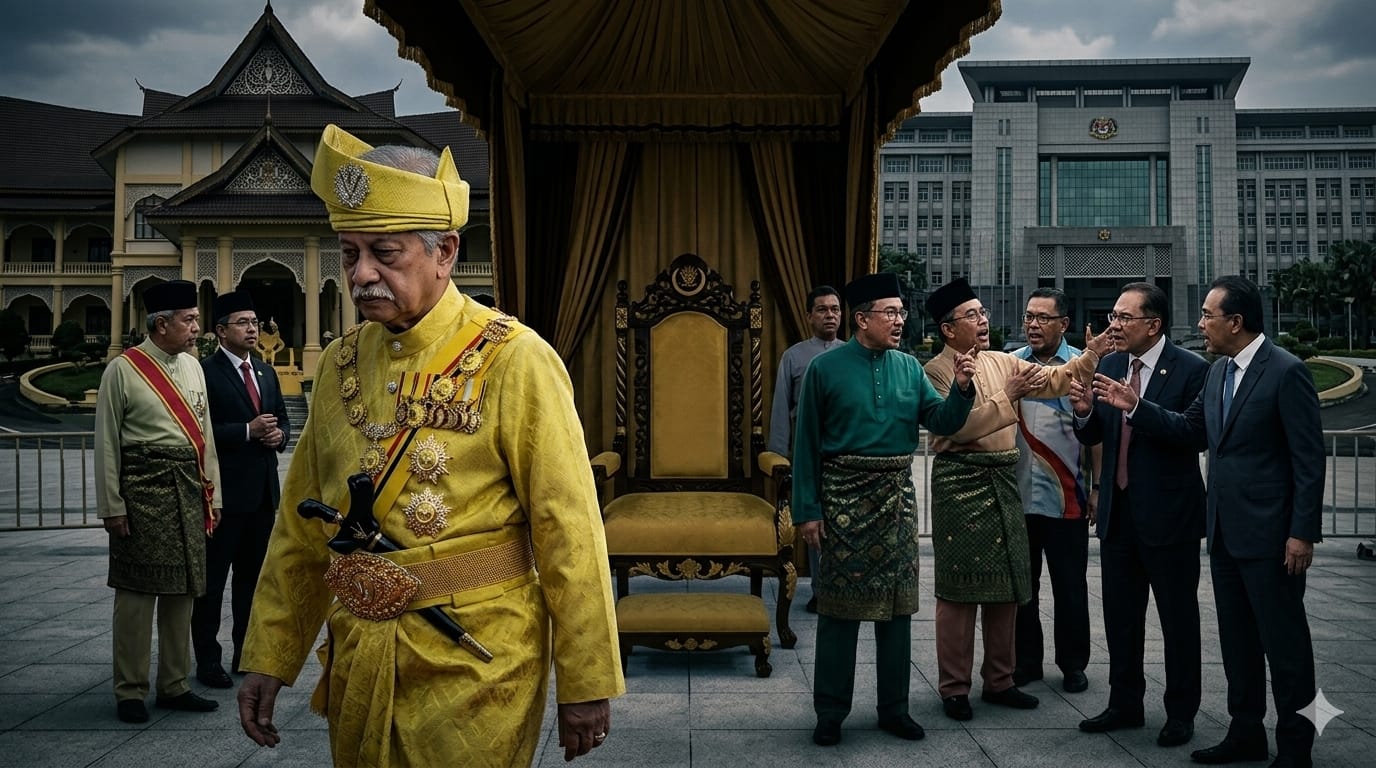
When the truth inevitably fractured the narrative, the fallout devolved into farce. Initially, facing mounting public outrage over a clandestine meeting with rebel Undang (territorial chieftains), the Menteri Besar executed a dizzying U-turn. He claimed that a proclamation endorsing the removal of the Yamtuan Besar signed on August 3 had been executed unwillingly and under duress, prompting him to file a police report after sitting on the terrifying secret for a month. But the plot thickened past the point of absurdity when the State Executive Council (Exco) stepped into the vacuum, issuing an official statement declaring the removal of Tuanku Muhriz valid and abruptly recognizing Tuanku Nadzaruddin as the new ruler.
This corporate maneuver by the Exco triggered immediate, severe pushback from constitutional experts, former leaders, and the Dewan Keadilan dan Undang (DKU). Legal minds and the Rembau Undang rightly pointed out a fundamental pillar of governance: an executive council meeting cannot override the state constitution or the supreme authority of customary ruling bodies. How can a state cabinet, sworn into office under Tuanku Muhriz himself, turn around and attempt to legislate a monarch out of existence? It is an act that reduces the sacred oath of office to a hollow formality and turns the executive branch into a rubber stamp for usurpers.
What kind of leaders sign away the constitutional stability of a state and attempt to rewrite royal successions through executive press statements? If a Menteri Besar claims he was forced to sign documents under duress, yet his own cabinet later corporately endorses that very removal, the administration loses every shred of moral and legal legitimacy. It reduces the highest office in the state to an instrument of chaos, transforming traditional honor and work ethic into cheap political commodities.
This provincial theater of the absurd stands in stark, mocking contrast to the high-minded rhetoric echoing from party headquarters. National leaders have recently taken to lecturing the public on moderation, self-reliance, and the rejection of radical politics, urging a centrist approach that respects all communities and preserves institutional stability. Yet, these grand pronouncements on political purity ring utterly hollow when the party’s actual behavior on the ground resembles a desperate, unprincipled scramble for absolute control, riding roughshod over foundational boundaries whenever it suits their political appetite. It is the classic paradox of wanting to swim without getting wet preaching clean, reformist governance while elbow-deep in old-school patronage politics.
Voters are not blind, nor are they amnesiacs. The cautious, centrist electorate that gave UMNO another chance did so hoping that the hard lessons of past systemic corruption and arrogance had finally been internalized. Instead, they are treated to the same old playbook: racial posturing during the polls, followed by denial, deflection, and the convenient invocation of victimhood once the administrative machinery breaks down. Leaders who act like omnipotent bosses during closed-door conclaves suddenly transform into helpless, coerced victims the moment public outrage erupts into the daylight.
This perpetual cycle of political turbulence does more than just damage a single political party; it poisons the well of democratic stability. It signals to the rakyat that no matter who wins an election, the real battle is never about public service, economic upliftment, or community welfare it is an endless, narcissistic war for dominance and patronage. When political actors spend millions of ringgit and months of campaigning preaching racial protectionism only to trap the state in medieval palace intrigues and executive overreach, they prove that they are stuck in the exact same management failures of the past.
Winning an election by weaponizing identity is merely the opening chapter; governance is the test that actually matters. If UMNO and its political peers cannot purge their ranks of opportunistic operators who treat the state as personal property and constitutional pillars as disposable chess pieces, all their electoral triumphs will amount to nothing. The public has a long memory for betrayal and a very short tolerance for clowns masquerading as statesmen.
True leadership is measured not by how many seats a party can capture through manufactured division and aggressive political maneuvering, but by the quiet restraint it exercises when it possesses the power to shatter the state's foundational boundaries and chooses instead to protect them. - Annan Vaithegi
Annan Vaithegi (annanvaithegi@icloud.com) is a content creator under the Newswav Creator programme, where you get to express yourself, be a citizen journalist, and at the same time monetize your content & reach millions of users on Newswav. Log in to creator.newswav.com and become a Newswav Creator now!
The User Content (as defined on Newswav Terms of Use) above including the views expressed and media (pictures, videos, citations etc) were submitted & posted by the author. Newswav is solely an aggregation platform that hosts the User Content. If you have any questions about the content, copyright or other issues of the work, please contact creator@newswav.com.