Malaysians are no strangers to economic blueprints being heralded as the "next big thing" only to watch them quietly accumulate dust or dissolve under the weight of administrative inertia. For decades, the collective national memory has been shaped by the slow-burning anxieties of structural middle-income traps, fluctuating ringgit valuations, and the constant fear that neighboring economic engines are outpacing the country. There is an ambient public fatigue with political theater that stalls national progress a sentiment that resonates deeply when grand promises face abrupt structural friction.
When the Johor-Singapore Special Economic Zone (JS-SEZ) was first conceived, it was positioned not just as a regional trade zone, but as a historic economic bridge across the Johor Straits. It promised to fuse Johor’s vast land assets and lower cost base with Singapore’s global financial muscle. Yet, the public back-and-forth between the federal government and Johor’s leadership has exposed deep structural fault lines. A framework designed to project administrative cohesion and economic certainty has instead transformed into a high-stakes debate over sovereignty, federal-state dynamics, and institutional timelines.
The Clash of Two Kingdoms: Putrajaya vs. Kota Iskandar
The current friction reached a flashpoint during intense campaigning for the July 11, 2026, Johor state elections. Johor Menteri Besar Datuk Onn Hafiz Ghazi publicly raised concerns over structural delays in launching the JS-SEZ Masterplan and Investment Blueprint. In a sharp public statement, Onn Hafiz revealed that the strategic blueprint originally slated for release at the end of 2025 and subsequently delayed to March 30, 2026 had encountered another round of postponements. He argued that the masterplan does not require the approval of the Singaporean government, as comprehensive bilateral consultation and feedback loops had already been finalized.
From the state's vantage point, the blueprint is a Malaysian-owned document that should be launched immediately to anchor market confidence and eliminate policy ambiguity for international businesses.
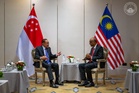
The federal leadership responded swiftly to reassert centralized control over the bilateral initiative. Prime Minister Datuk Seri Anwar Ibrahim countered the state’s criticisms by emphasizing that the JS-SEZ is fundamentally a federal project executed in close coordination with a foreign sovereign nation. Anwar advised local political actors against using the economic zone as campaign material, stating that official bilateral agreements and formal signings remain strictly within the purview of the prime ministers of Malaysia and Singapore.
Concurrently, Economy Minister Akmal Nasrullah Mohd Nasir clarified that the masterplan and investment blueprint are formally scheduled for a fourth-quarter 2026 rollout. The federal administration maintains that the Cabinet intentionally timed the release to coincide with the annual Singapore-Malaysia Leaders' Retreat to maximize international diplomatic and economic impact.
The Cost of Uncertainty in Global Markets
From an analytical standpoint, this public dispute is more than a localized electoral disagreement; it reflects a deeper operational disconnect within Malaysia's multi-tiered governance structure. In international market dynamics, capital gravitates toward legal and regulatory certainty. Institutional analysis suggests that when a state government and a federal administration project conflicting narratives regarding a primary development masterplan, it creates a visual of policy instability.
According to private sector assessments, foreign investors are not merely tracking political rhetoric; they are waiting for the formal gazetting of flagship zone boundaries, explicit tax subsidy qualification criteria, and definitive land-use zoning. While federal data shows that the initiative recorded RM76.98 billion in approved investments in 2025, these figures reflect corporate commitments rather than fully realized, operational capital expenditure.
The underlying risk of extended timeline shifts is the potential dampening of investor momentum. The Invest Malaysia Facilitation Centre Johor (IMFC-J) has actively processed over 1,000 investor enquiries and managed billions in potential project values. However, financial institutions require finalized legal blueprints to assess the long-term commercial viability of large-scale infrastructure projects. Without an officially gazetted masterplan, regional enterprises looking to implement "twinning" or "plus-one" corporate strategies leveraging Singapore’s financial compliance framework alongside Johor's industrial capacity face real operational friction.
Federal Jurisdiction vs. State Autonomy
This bureaucratic impasse highlights a long-standing structural theme in Malaysian governance: the constitutional division of power between federal authorities and state governments. Under the Federal Constitution, cross-border commerce, international treaties, and macro-economic policies fall under federal jurisdiction. Conversely, land administration, local zoning, and regional infrastructure execution are the constitutional domain of the individual states.
The JS-SEZ sits directly at the intersection of these overlapping jurisdictions. For the zone to function seamlessly, Putrajaya requires the state government to allocate land and streamline local municipal approvals. At the same time, Johor relies on federal ministries to approve special tax incentives, adjust immigration protocols, and manage bilateral relations with Singapore.
Sociopolitical analysis suggests that the current friction is exacerbated by the unique political dynamics of the federal unity government. While Pakatan Harapan (PH) and Barisan Nasional (BN) operate as partners at the federal level, they remain direct electoral competitors within the localized political ecosystem of Johor. Consequently, a strategic development project like the JS-SEZ can easily become a proxy battleground for broader debates over regional autonomy, administrative efficiency, and political credit.
Navigating the Cross-Border Reality
While the political debate continues in the public sphere, the actual physical and economic integration of the region moves forward on separate tracks. Private sector entities continue to adapt to changing cross-border dynamics. For instance, early logistical adjustments have yielded practical results, such as a 30% reduction in land cargo clearance times via paperless digital applications. Similarly, the multi-billion dollar Forest City Special Financial Zone (SFZ) has advanced its local wealth-management framework, approving its first batch of Single Family Office (SFO) vehicles under customized tax structures.
These operational milestones demonstrate that the underlying commercial demand for cross-border integration remains strong. The impending completion of the Johor Bahru-Singapore Rapid Transit System (RTS) Link, designed to transport up to 10,000 passengers per hour in each direction, underscores the inevitability of deeper economic integration. The core challenge is no longer whether integration will happen, but whether the domestic regulatory framework can be deployed fast enough to keep pace with market expectations.
The Path Forward for Malaysia's Economic Sovereignty
To ensure the long-term success of the JS-SEZ, the dialogue surrounding the initiative must evolve past localized political rhetoric. Institutional analysis indicates that an effective economic zone requires a unified regulatory voice. If international businesses continue to navigate mismatched directives regarding tax obligations, land usage, and employment compliance from different levels of government, the competitive edge of the corridor could be diluted.
The federal decision to synchronize the masterplan's release with a major bilateral summit reflects a strategic choice to maximize diplomatic leverage. However, the concerns raised by state leaders regarding market momentum highlight the real-world timelines that businesses operate under. The immediate priority for leadership at both the federal and state levels is to establish a synchronized, predictable administrative process that translates high-level policy documents into clear, actionable guidelines for the market.
What Do You Think? I’d Love to Hear Your Opinion in The Comments Section.
Ultimately, the debate over the JS-SEZ Masterplan serves as a reminder that economic progress is deeply intertwined with political and institutional clarity. For the average Malaysian citizen, the true measure of success for any economic zone lies in its tangible impact on the local community: the creation of high-value employment, the development of sustainable infrastructure, and the expansion of domestic business opportunities. The current discourse underscores the reality that building a competitive regional economy requires close, day-to-day coordination between all levels of government.
As the region moves toward the final quarters of the year, the focus will increasingly shift to the practical execution of these plans. The ability of Malaysia's leadership to manage complex federal-state dynamics while maintaining clear communication with international partners will be a key factor in determining whether the special economic zone achieves its full long-term potential.
AM World (tameer.work88@gmail.com) is a content creator under the Newswav Creator programme, where you get to express yourself, be a citizen journalist, and at the same time monetize your content & reach millions of users on Newswav. Log in to creator.newswav.com and become a Newswav Creator now!
The User Content (as defined on Newswav Terms of Use) above including the views expressed and media (pictures, videos, citations etc) were submitted & posted by the author. Newswav is solely an aggregation platform that hosts the User Content. If you have any questions about the content, copyright or other issues of the work, please contact creator@newswav.com.