
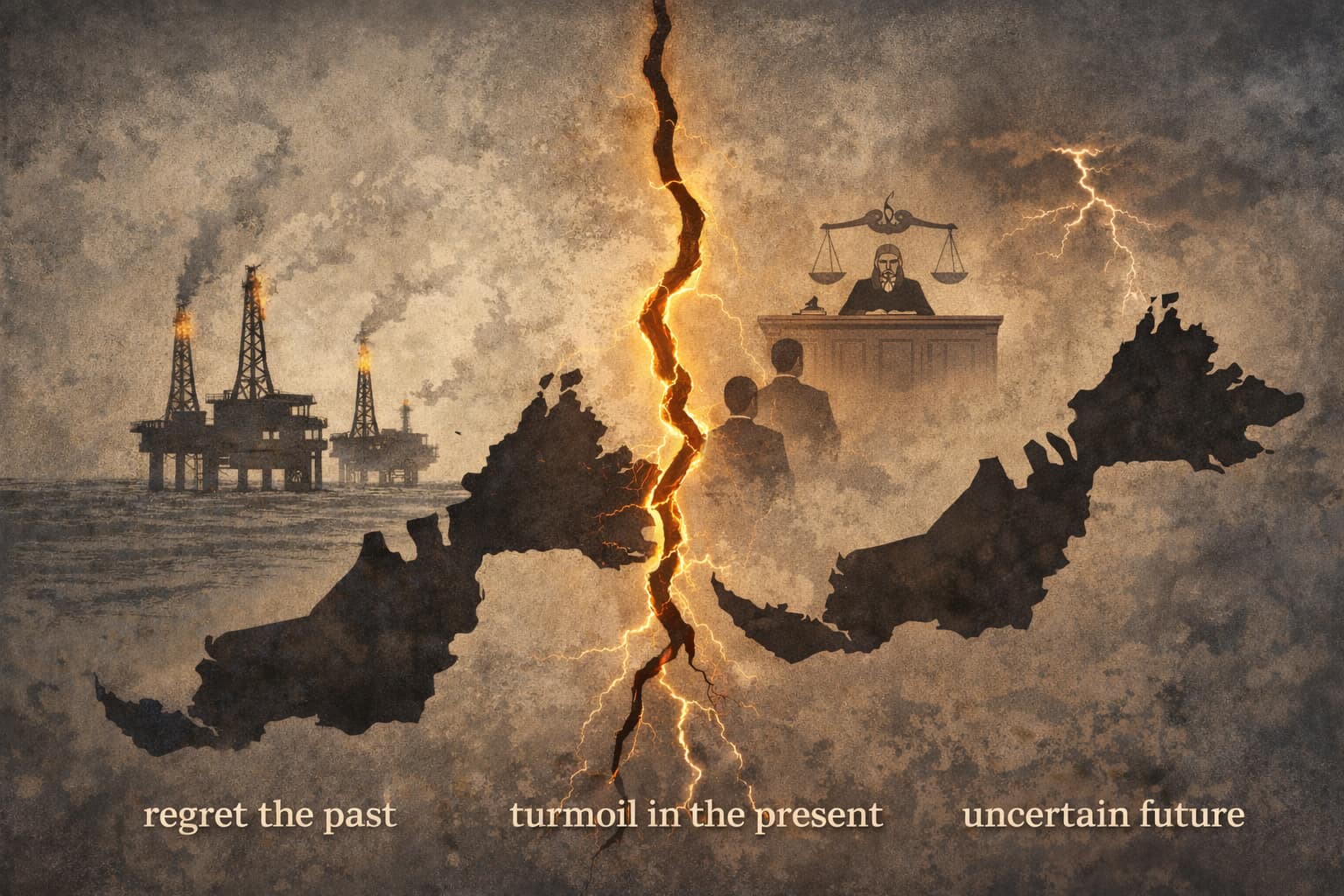
The federation is losing itself. It is, in other words, being worn down by the weight of its own existence.
If the federation were a person, it would be someone trapped in a life it no longer values. It would feel stuck in a condition it finds burdensome, unable to appreciate the way it spends its time, effort, attention and resources.
When it experiences the present, it would feel weary and frustrated.
When it looks at the past, it would suspect that something had gone wrong somewhere along the way.
When it imagines the future, it is burdened by a sense of foreboding as to what awaits.
And yet, despite not valuing the experience of being itself, it is still condemned to remain itself — to carry indefinitely the regret, frustration, and anxiety that accompany its existence.
If this were an individual, such a psychological state would often precede drastic decisions. A person who feels trapped, resentful, and hopeless does not remain still forever. Eventually, something gives. Like the last straw that breaks the proverbial camels back, they might arrive at a point of madness, a small event might trigger a huge reaction, and turn things to a point of no return.
Following that line of logic, we may have to confront an uncomfortable possibility: the federation itself may be approaching such a moment.
The Signs of Strain
There are already signs.
The increasingly intractable partisan, racial, and religious tensions in the peninsula are one indication. Political discourse has hardened. Mutual suspicion has deepened. Compromise feels like capitulation. Trust feels naïve.
But even more telling than the troubles in the peninsula is the growing agitation in East Malaysia.
The most visible manifestation of this strain is the oil and gas dispute between Sarawak and the federal government in Putrajaya.
The Sarawak government has most recently petitioned to challenge three federal petroleum laws linked to its dispute with Petronas over its oil and gas rights in the federal government.
On the surface, this can be interpreted as entirely legitimate. Some would say that taking a dispute to court is simply a civilised and constitutional way of resolving long-standing disagreements. In a mature federation, legal mechanisms exist precisely for such purposes.
But there is another way to read the situation.
From a different perspective, what Sarawak has done through its court challenge is akin to a spouse packing their bags and announcing that they are moving into a motel after months of sleeping in the guest bedroom.
It signals that the relationship has reached — or is dangerously close to reaching — the point of no return.
When one partner seeks legal adjudication rather than mutual negotiation, it suggests that trust has eroded. The issue is no longer merely about revenue sharing or regulatory authority. It becomes about dignity, autonomy, and respect.
If the other party does not respond with urgency — if there is no visible effort to repair the bond — then silence itself becomes an answer. It becomes an implicit acknowledgment that perhaps the relationship is no longer worth saving.
Why the Courtroom Changes Everything
Regardless of how the courts decide, something fundamental has already shifted.
Why?
Because if a relationship still had sufficient goodwill, it would not have reached the courtroom.
The very act of litigation formalises mistrust. It transforms political negotiation into legal confrontation. It turns partners into opposing parties.
That soon after Sarawak initiated legal proceedings, discussions began emerging about Sabah and Sarawak forming a Borneo bloc — a political consolidation based on shared regional interests rather than federal loyalty -is not a good sign.
This development is not insignificant. It signals that the emotional centre of gravity may be shifting away from the federation.
Whatever the judicial outcome, it is difficult to imagine that the decision will not provoke strong reactions. If the ruling favours the federal government, Sarawak may feel aggrieved. If it favours Sarawak, federal authorities and peninsula-based actors may feel challenged or resentful.
In either scenario, there is a risk of an outpouring of anger, bitterness, betrayal, or accusations of ingratitude.
The Dangerous Narrative
If these sentiments spill over into the upcoming Sarawak state election, they may crystallise into something more dangerous than temporary dissatisfaction.
They may solidify into a belief.
The belief that perhaps the federation is better off broken apart — that each region might be happier on its own than condemned to perpetual dissatisfaction together.
Once such a belief takes root, it becomes extraordinarily difficult to reverse. Political separation often begins not with declarations of independence, but with emotional disengagement.
When enough people conclude that coexistence is a burden rather than a blessing, unity becomes a technical arrangement rather than a shared aspiration.
And technical arrangements do not survive sustained emotional withdrawal.
The Cusp of a Decision
We may not yet be at the point of rupture. Federations are resilient structures. They endure conflict, litigation, and political theatre.
But resilience is not infinite.
A federation survives not merely on constitutional documents or court rulings, but on a shared sense of purpose — a mutual willingness to endure friction because the whole is seen as more valuable than the sum of its parts.
If that valuation disappears, if enough actors begin to see the federation as a source of regret rather than opportunity, then drastic decisions become not radical but logical.
The danger is not that separation will happen tomorrow.
The danger is that it may begin to feel, slowly and quietly, like common sense.
And once that feeling spreads widely enough, it is hard to see how the federation does not eventually come apart.
TheRealNehruism (nehru.sathiamoorthy@gmail.com) is a content creator under the Newswav Creator programme, where you get to express yourself, be a citizen journalist, and at the same time monetize your content & reach millions of users on Newswav. Log in to creator.newswav.com and become a Newswav Creator now!
The User Content (as defined on Newswav Terms of Use) above including the views expressed and media (pictures, videos, citations etc) were submitted & posted by the author. Newswav is solely an aggregation platform that hosts the User Content. If you have any questions about the content, copyright or other issues of the work, please contact creator@newswav.com.

