
A few years ago, every political ceramah seemed to have the same magic words.
Transparency. Accountability. Institutional reform.
If you listened long enough, you would have thought Malaysia was about to become the Scandinavian country of Southeast Asia. Every problem had one answer: open the books, tell the truth and let the people judge.
There is an old saying in Malaysia: harapkan pagar, pagar makan padi.
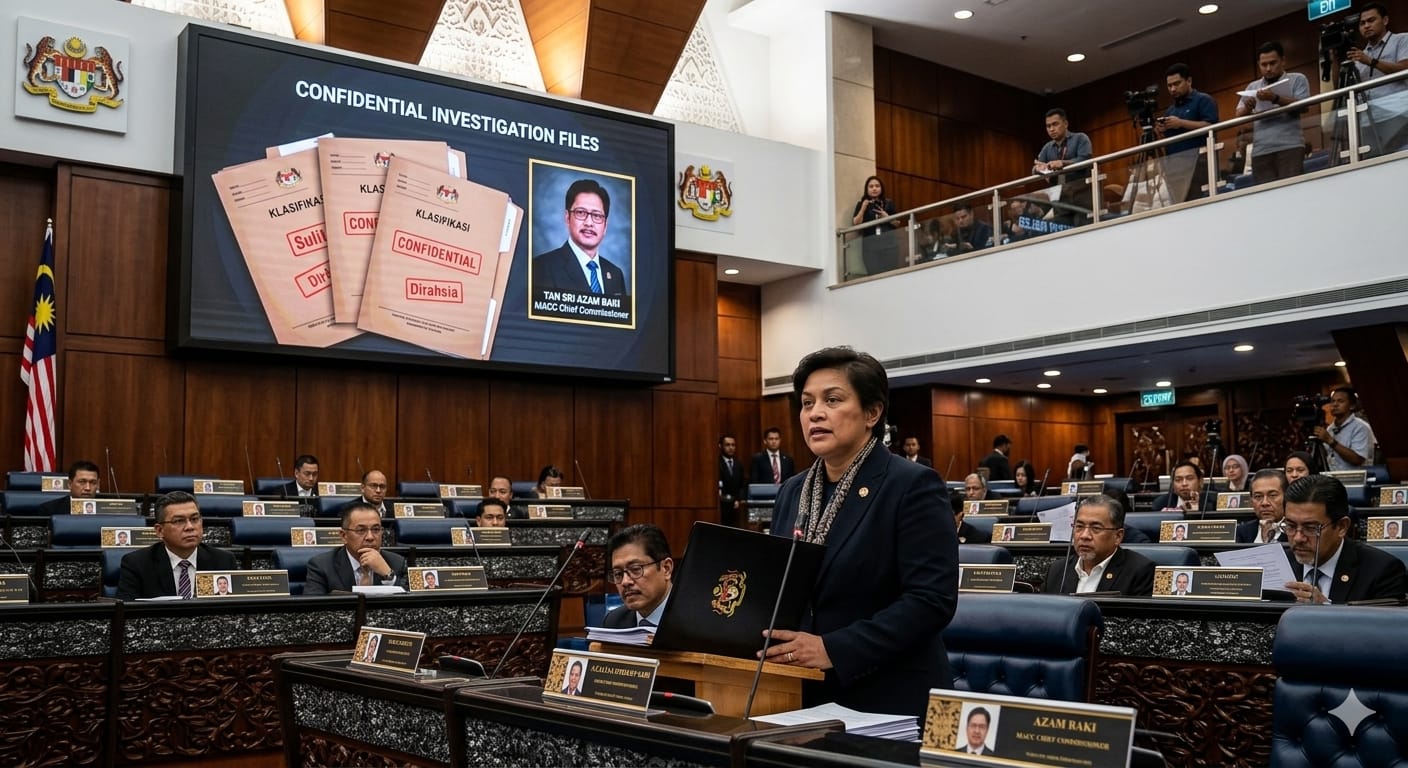
Today, that proverb feels uncomfortably relevant not because of one individual, but because of a larger question confronting our democracy. The government says it cannot disclose the shareholding details of former MACC chief Azam Baki because they form part of protected investigation documents and personal asset declarations.
The public hears something different.
"If everything has been investigated, why can't we know enough to restore confidence?"
And that is the real story.
This is no longer merely about shares.
It is about trust.
Malaysia has arrived at an unusual crossroads where the government insists it is protecting the law, while an increasing number of Malaysians believe the law is being used to protect confidence from scrutiny.
Whether that perception is fair or not is almost beside the point.
Because in public institutions, perception eventually becomes part of reality.
The Law Minister may well be legally correct. Certain investigation papers, asset declarations and personal information are indeed protected under existing laws.
But democracies are not judged only by legal correctness.
They are judged by whether justice can be seen to be done.
That is why the debate refuses to disappear.
Walk into almost any anneh stall in the morning.
One uncle folds his newspaper.
Another watches a political podcast on his phone.
Someone asks,
"Eh... so cannot disclose again?"
Nobody at the table starts discussing legal provisions.
Instead, someone asks a much simpler question.
"If everything is clean, why does everything remain secret?"
That question captures today's public mood far better than any parliamentary reply.
People are no longer arguing over technical procedures.
They are asking whether transparency has become the exception instead of the expectation.
The irony is that transparency is often misunderstood.
Transparency is not about satisfying public curiosity.
It is about rebuilding public confidence.
There is a significant difference.
No reasonable person expects every page of an investigation file to be uploaded onto the internet.
No reasonable person expects confidential information to become political entertainment.
But when the country's highest anti-corruption officer becomes the subject of prolonged public scrutiny, extraordinary office inevitably carries extraordinary expectations.
The MACC Chief is not an ordinary civil servant.
The office represents integrity itself.
And integrity depends not only on being clean.
It depends on being seen to be clean.
That is why many Malaysians remain unconvinced by assurances alone. For some, the issue is no longer the investigation itself but the absence of sufficient transparency to understand why they should simply accept the official conclusion.
The comments circulating online reveal something deeper than anger.
They reveal disbelief.
Some readers acknowledge that the records may be confidential under the law, yet still ask why the government cannot at least state clearly whether any public service rules were breached. Others argue that refusing disclosure only encourages the public to imagine the worst.
Whether those suspicions are justified is almost secondary.
Trust works differently.
Once confidence weakens, every silence becomes suspicious.
Every delay becomes another headline.
Every refusal becomes another withdrawal from the nation's confidence account.
Public trust behaves very much like a bank account.
Every unanswered question is a withdrawal.
Every transparent explanation is a deposit.
Governments rarely lose public confidence because of one controversy.
They lose it because withdrawals continue while deposits become increasingly rare.
That is why confidentiality carries a cost.
Not necessarily a legal cost.
A political cost.
An institutional cost.
An economic cost.
Some argue that Malaysians should simply trust the investigation.
But trust is not something governments can request indefinitely.
It is something institutions must continually earn.
This is particularly true today, when foreign investors are assessing not only Malaysia's tax incentives and economic policies but also the credibility of its institutions.
Integrity is no longer separate from economic growth.
Integrity is part of the investment climate.
A country where accountability appears opaque becomes a country where governance risk is priced into investment decisions.
Transparency is therefore no longer merely a democratic virtue.
It is an economic asset.
Perhaps this episode also presents Parliament with an opportunity.
Rather than debating personalities, lawmakers should ask a more enduring question.
Do Malaysia's confidentiality laws adequately balance legitimate privacy with legitimate public accountability for holders of the nation's highest public offices?
That conversation is bigger than Azam Baki.
It will outlast every administration.
It will matter for every future MACC chief.
Every future Chief Justice.
Every future Attorney General.
Every future public servant entrusted with immense power.
Laws exist to protect citizens from the abuse of power.
They were never intended to become permanent walls between citizens and accountability.
When confidentiality begins to outlive confidence, democracies must ask whether the balance remains right.
The issue before Malaysia today is therefore no longer whether one person's shareholding records can be disclosed.
The bigger question is whether we are becoming a country where accountability depends on trust alone or one where trust is earned through transparency.
Governments often ask citizens to trust institutions.
Institutions must first show that they trust citizens with the truth.
Annan Vaithegi write politically grounded and institution-focused opinion columns that examine governance, accountability, and public trust through the lens of Malaysian society.
Annan Vaithegi (annanvaithegi@icloud.com) is a content creator under the Newswav Creator programme, where you get to express yourself, be a citizen journalist, and at the same time monetize your content & reach millions of users on Newswav. Log in to creator.newswav.com and become a Newswav Creator now!
The User Content (as defined on Newswav Terms of Use) above including the views expressed and media (pictures, videos, citations etc) were submitted & posted by the author. Newswav is solely an aggregation platform that hosts the User Content. If you have any questions about the content, copyright or other issues of the work, please contact creator@newswav.com.