
By Annan Vaithegi
Political survival has a way of warping the laws of arithmetic. In the strange geometry of Malaysia’s current unity government, a party with a fractured base, diminished electoral footprint, and a deeply compromised historical legacy manages to behave not as a junior partner, but as the de facto master of ceremonies. By virtue of being the indispensable anchor that keeps a fragile coalition glued together, this minority faction has learned to project an outsized voice. It dictates the rhythm of national discourse, forces the administration onto the defensive, and treats governance like an ongoing tactical negotiation rather than a sacred public trust.
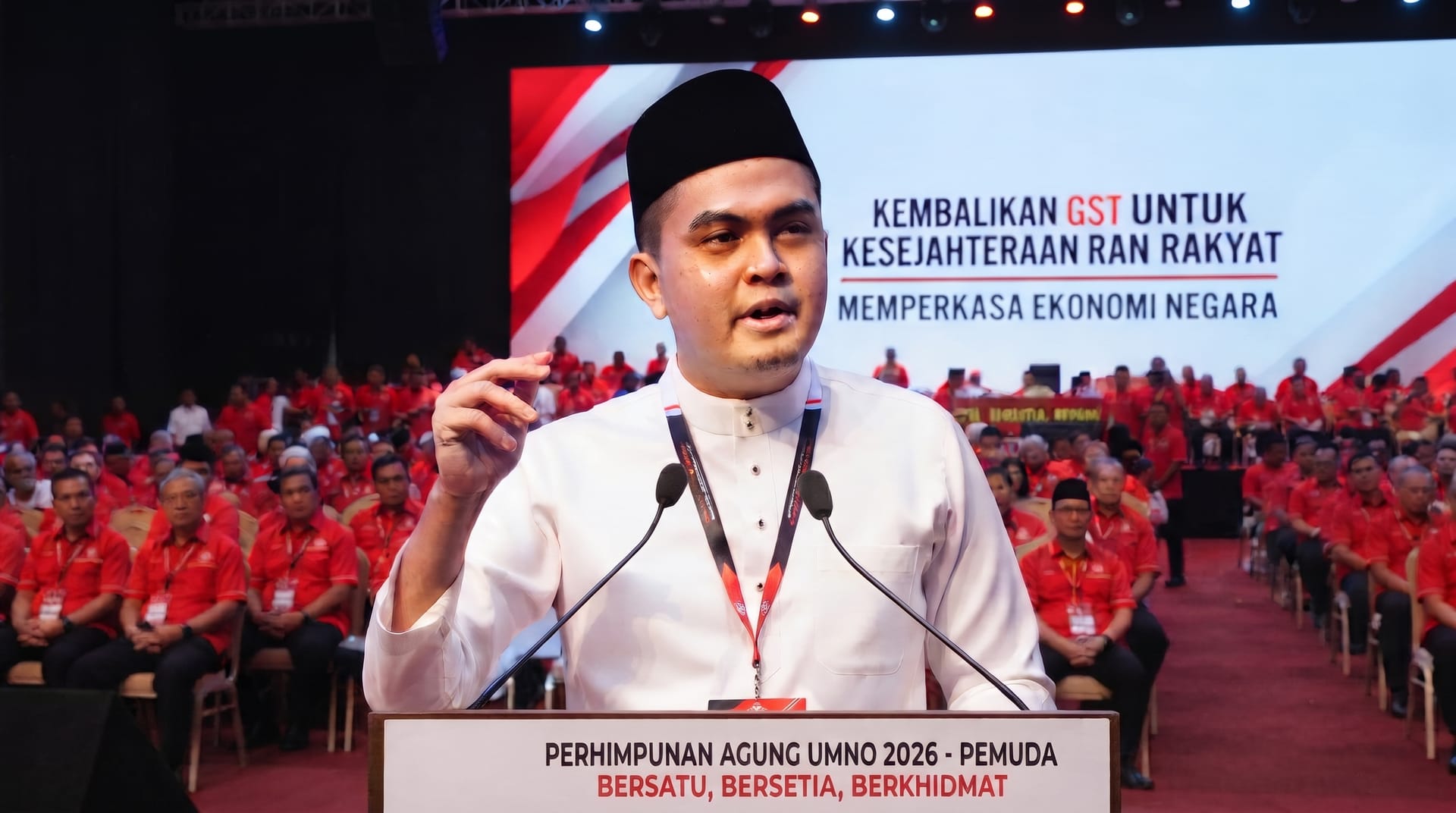
The latest manifestation of this political maneuvering is the aggressive, orchestrated push to resurrect the Goods and Services Tax (GST). Framed by party architects and enthusiastic youth wings as a visionary blueprint for national economic resilience, the proposal is pitched as a masterclass in fiscal modernization. Yet, when examined through the lens of contemporary Malaysian realities, this resurrection campaign feels less like serious economic statecraft and more like political amnesia wrapped in technocratic jargon. It exposes a profound disconnect between the sterile spreadsheets of macroeconomic theory and the raw, unhealed grievances of a public tired of bearing the cost of elite miscalculation.
The Mechanical Allure and the Historical Irony
To understand why the debate over the GST refuses to die, one must first confront the raw economic mechanics that make it eternally attractive to technocrats. From a purely structural standpoint, the arguments in favor of a broad-based consumption tax are textbook correct. Unlike the narrow-net Sales and Service Tax (SST), which lingers quietly at specific points of the supply chain and creates a compounding “tax-on-tax” distortion, a multi-stage GST captures value added at every single link.
Economically, it is a wider net. It sweeps up the sprawling shadow economy, minimizes corporate leakages, establishes a transparent paper trail on retail receipts, and provides the federal treasury with a predictable, stable stream of revenue that is insulated from the volatile whims of global crude oil prices. Proponents are quick to point out that these attributes saved the national ledger during past fiscal crunches.
Yet, there is an inescapable historical irony in watching the very same political faction that once weaponized public anger against the GST blaming it for every household financial woe a decade ago now champion its return as the ultimate salvation. Back in 2015, the introduction of the 6% consumption tax became a lightning rod for anti-establishment sentiment, eventually helping to catalyze the historic 2018 political tsunami. To see its architects attempt to dust off the exact same policy framework, rebranded with modern political taglines and rhetorical flourishes, reveals a cynical disregard for public memory. It treats taxation not as an enduring social contract, but as an adjustable dial to be twisted depending on who happens to be sitting in Putrajaya.
The Regressive Reality and the Cost of Living
Beyond the political irony lies a harsher socio-economic truth: a consumption tax is, by its very design, regressive. It does not discriminate between the billionaire acquiring luxury assets and the daily wage earner buying basic milk and rice. Both pay the exact same percentage at the checkout counter.
When applied in an economy where household disposable incomes have been severely compressed by inflation, currency fluctuations, and stagnant wage growth, a broad-based consumption tax takes a punishing relative bite out of working-class survival. For the B40 and vulnerable M40 segments who spend nearly every ringgit they earn just to keep the lights on and food on the table, a consumption levy is not an abstract fiscal tool it is a daily tax on existence.
To suggest, as proponents do, that the public should embrace the GST as a cure-all for national debt without first fundamentally transforming the wage structure is to put the cart before a very broken horse. When ordinary Malaysians look at their monthly commitments, their primary anxiety is not whether the government is utilizing a multi-stage tax or a single-stage tax; it is whether their earnings can outpace the relentless creep of the cost of living. Pumping a regressive tax mechanism into an economy where wealth distribution remains deeply skewed only deepens the chasms between the comfortable elite and the struggling rakyat.
The Crisis of Institutional Trust
Yet, even the most sophisticated economic debates about tax elasticity and supply-chain efficiency collapse in the face of Malaysia’s true structural crisis: the wholesale erosion of public trust.
An efficient tax regime cannot function in a moral vacuum. It relies entirely on an unshakeable social contract between the citizen and the state the implicit understanding that every ringgit extracted from private pockets will be managed with absolute integrity, accounted for with rigorous transparency, and reinvested into the public good. That social contract in Malaysia is currently fractured.
The public psyche remains deeply scarred by monumental financial scandals, institutional decay, and the long-term debt burdens left in the wake of past administrations. When citizens are asked to tighten their belts, pay broader consumption taxes, and accept fiscal austerity, they do so against a backdrop of deeply unsettling headlines. The persistent sting of high-profile legal outcomes such as controversial discharges not amounting to an acquittal (DNAAs) and decisions of no further action (NFAs) granted to politically connected figures sends a corrosive message to the ordinary taxpayer.
It creates an inescapable public perception that accountability scales inversely with political power. When the institutional architecture appears incapable of delivering justice or enforcing honest stewardship at the top, asking the rakyat to contribute more to the national treasury feels less like civic duty and more like funding an unaccountable machine. Pumping more fuel into a state engine with cracked lines and corrupted valves will only accelerate the leak, no matter how advanced the pump design happens to be.
The Real Leadership Deficit
The current debate over the GST is ultimately a symptom of a much deeper malaise in Malaysian governance. It reveals a political class that would rather tinker with tax nomenclature and debate fiscal acronyms than confront the foundational rot of corruption, patronage, and institutional decay.
A nation cannot tax its way to prosperity while the integrity of its governance continues to bleed out through systemic loopholes and selective impunity. True economic leadership requires courage of a different order entirely one that prioritizes structural institutional reform, dismantles political patronage, and ensures that public funds are fiercely protected before demanding a single additional sen from the pockets of the working people.
Until the moral ledger of the nation is cleaned, any conversation about expanding the tax net is nothing more than an exercise in elite escapism. The greatest deficit facing Malaysia today is not a shortage of revenue extraction methods; it is an absolute bankruptcy of public trust.
A nation cannot rebuild its treasury on technical efficiency alone while the architecture of public trust remains structurally unsound.
Annan Vaithegi (annanvaithegi@icloud.com) is a content creator under the Newswav Creator programme, where you get to express yourself, be a citizen journalist, and at the same time monetize your content & reach millions of users on Newswav. Log in to creator.newswav.com and become a Newswav Creator now!
The User Content (as defined on Newswav Terms of Use) above including the views expressed and media (pictures, videos, citations etc) were submitted & posted by the author. Newswav is solely an aggregation platform that hosts the User Content. If you have any questions about the content, copyright or other issues of the work, please contact creator@newswav.com.