.png)
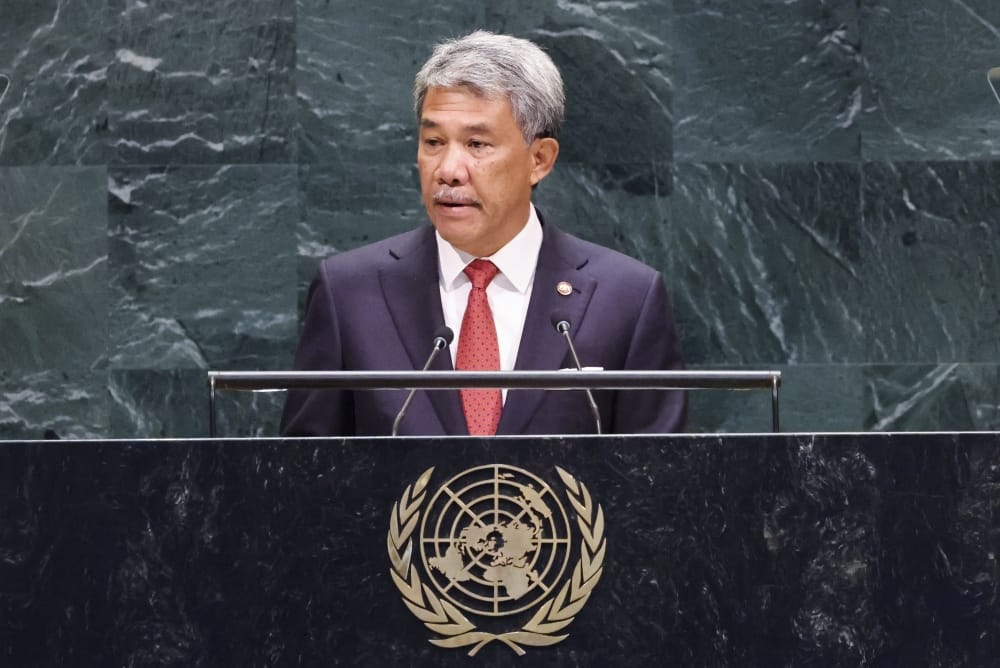
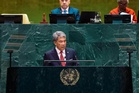
I was listening to Malaysia's Foreign Minister Mohamad Hasan speak at the United Nations in New York, and I found myself straining to understand what he was trying to convey.
No, I am not saying his English was bad. In fact, his Malaysian accent was perfectly familiar to us. Most Malaysians would have no trouble understanding him, and I suspect plenty of people elsewhere would have understood him too.
We've had ministers whose English was considerably harder to follow, sometimes I wondered whether they understood themselves. Mohamad's English was actually better than many of them.
My problem with his speech was not his English. It was that he wasn't really giving a speech. He was reading one. And there is a difference.
I come from theatre, so perhaps I am particularly sensitive to this.
One of the first things we teach actors is that standing in front of an audience and saying words is not the same as communicating those words.
You don't simply read a sentence. You tell the audience why that sentence matters.
You stress the important word. You change your pace. You pause when a thought needs to land. You allow emotion to enter your voice. You look up. You breathe. You make the audience feel that you are speaking to them, rather than merely making sure you get to the end of the paragraph.
Watching the Foreign Minister address the UN, I felt that almost all of that was missing.
And that is a pity, because the words themselves were not insignificant.
He was talking about the role of middle powers such as Malaysia and regional organisations such as Asean. He spoke about countries not simply having to live with decisions made by major powers, but having a role in shaping those decisions.
"We are the global majority," he said.
That is a sentence that should have landed.
He spoke about Malaysia's confidence to speak for its region rather than be spoken for.
Another sentence that should have landed.
But listening to him, I kept thinking, “Where is the feeling?”
Not theatrics. Not shouting. Not unnecessary hand gestures or some exaggerated performance of statesmanship.
Just communication.
Even when I train my ten year old nephew to read aloud, I make a distinction between reading for yourself and reading so that somebody else can hear and understand you.
If you are reading silently, you can skim. You can pause wherever you like. You can give every sentence the same internal voice because nobody else is listening.
But when you read aloud, your job changes.
You have to express yourself.
You have to help the person listening understand what is important.
You have to make the words mean something.
And sadly, watching our Foreign Minister at the UN, I found myself thinking that perhaps he needed the same lesson I give my young nephew.
This isn't about having a British accent. It isn't about sounding American. It isn't even about having particularly beautiful English.
It is about knowing how to use your voice.
And I am not singling out Mohamad Hasan. Far from it.
This is something I have noticed with many of our politicians and public figures. They may be perfectly capable of doing their jobs. They may know their subject matter. They may have spent years in politics and public service.
But when they have to stand before an audience and communicate something important, too often they sound as though they are reading a statement prepared by somebody else.
Perhaps that is exactly what they are doing, but the audience doesn't hear the piece of paper. The audience hears the person.
And when that person delivers every sentence with the same rhythm, the same volume, the same expression and the same emotional temperature, even a powerful message can become strangely lifeless. It becomes boring.
This matters even more when the audience isn't a classroom or a press conference.
This was the United Nations.
The words were representing Malaysia.
And whether we like it or not, the person standing at that podium is not merely reading his own speech. He is representing all of us.
I know being a Foreign Minister involves considerably more than giving good speeches. Diplomacy, negotiations, policy, international relations and political judgement are obviously far more complicated than knowing where to put a dramatic pause.
But communication is part of the job.
If you are going to stand before the world and tell it what Malaysia thinks, then surely it is worth learning how to make the world listen.
Because sometimes the problem isn't the message.
Sometimes the message is perfectly good.
It just needs someone to bring it to life.
Fa Abdul (fa.abdul.penang@gmail.com) is a content creator under the Newswav Creator programme, where you get to express yourself, be a citizen journalist, and at the same time monetize your content & reach millions of users on Newswav. Log in to creator.newswav.com and become a Newswav Creator now!
The User Content (as defined on Newswav Terms of Use) above including the views expressed and media (pictures, videos, citations etc) were submitted & posted by the author. Newswav is solely an aggregation platform that hosts the User Content. If you have any questions about the content, copyright or other issues of the work, please contact creator@newswav.com.