
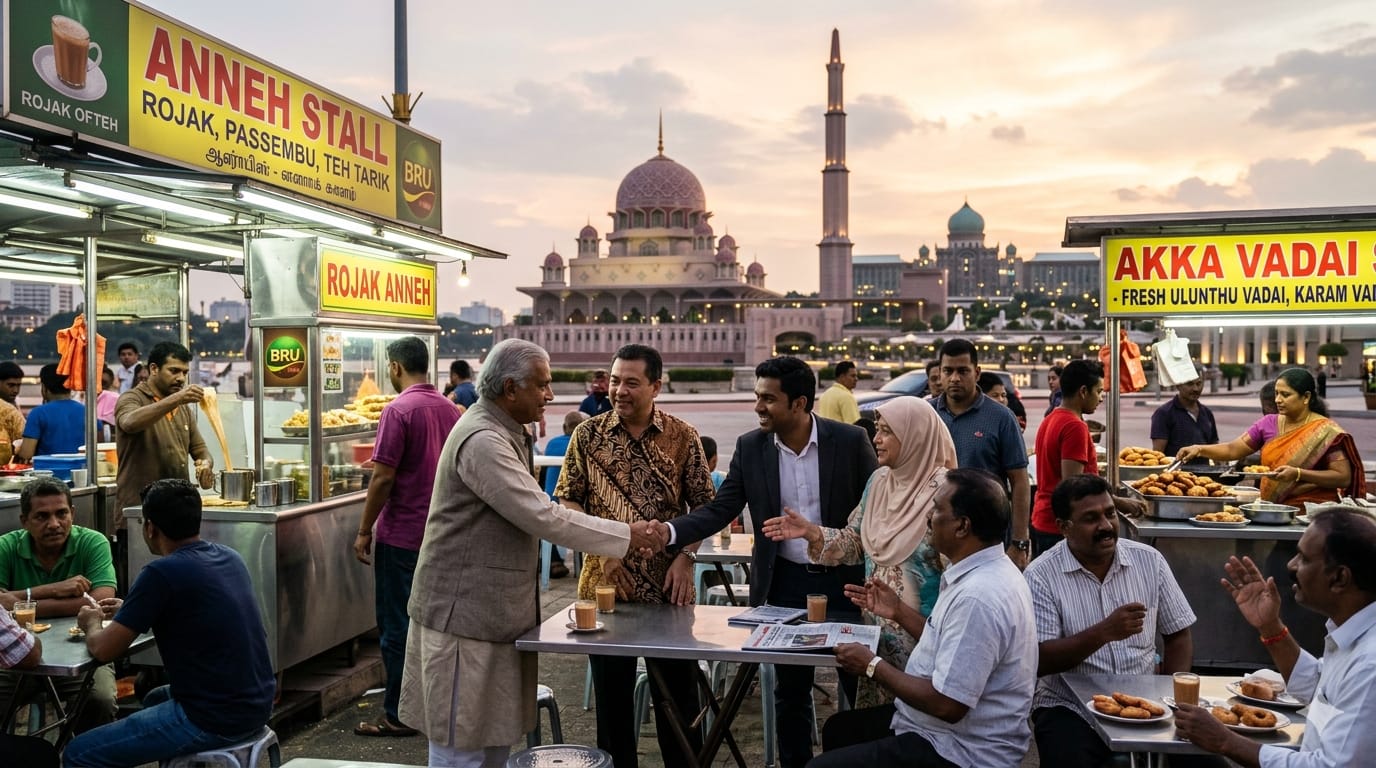
By 5:00 PM, the Anneh stall beside the old workshop in Klang was already alive.
Bru coffee smell hanging thick in the air. Hot ulunthu vadai frying in bubbling oil. One uncle pulling tea higher than election promises. Motorcycles squeezing past potholes big enough to qualify as constituency projects.
And, as always, politics sitting at every plastic table like an uninvited relative.
“Eh thambi, pass the vadai,” one uncle barked, folding his newspaper like a frustrated Finance Minister closing the budget.
The vadai came hot, golden, crispy outside.
Inside?
Kosong.
“Exactly like Indian politics,” another uncle laughed.
The whole table exploded.
That is the thing about Anneh stalls. Parliament talks policy. The stall talks truth.
And this week’s truth came wrapped in another political headline: a so-called 12,000-member NGO Perpaduan Pertubuhan Puratchi (Puratchi) now backing Hamzah Zainudin.
“Aiyo,” one uncle snorted into his Bru coffee. “Twelve thousand members ah? Last election also got people shouting revolution. End up not even 120 votes crawl out. Syok sendiri only.”
More laughter.
Another uncle, wearing a faded MIC-era shirt older than some political parties, shook his head slowly.
“Now everybody becoming kingmaker. Yesterday one NGO. Today one movement. Tomorrow another puratchi. Malaysian Indian politics now like banana leaf buffet. So many dishes. But when you eat properly, half the tray empty.”
Nobody disagreed.
That was the mood sitting heavily in the stall not excitement, not anger.
Indigestion.
Because somewhere between all the press conferences, slogans, protests, temple disputes, coalition hopping, and social media heroics, ordinary people are asking one brutal question:
Who is actually solving anything?
The tea Anneh stretched the teh tarik with dramatic flair.
“See ah,” he interrupted while pouring tea from one steel mug to another, “politicians also same. Pull here, pull there, pull there, pull here. End up same tea only.”
Again, the table roared.
That one sentence probably explained Malaysian Indian politics better than half the televised forums in the country.
Today, the community sits divided across more camps than a low-budget Kollywood war movie.
You got Ramasamy talking rights.
Waytha Moorthy talking activism.
Ramanan talking systems and MITRA.
Prabakaran talking youth engagement.
MIC talking legacy.
MIPP talking RESET.
Puratchi talking political awakening.
Everybody talking.
Nobody aligning.
One uncle leaned back dramatically.
“Macha, this not politics anymore. This full THUG LIFE movie already. One blind man and one crippled fellow trying to survive together.”
Even the tea boy nearly dropped the cups laughing.
But beneath the sarcasm sat something heavier.
Fatigue.
The community is tired.
Tired of leaders appearing during crises like seasonal mosquitoes.
Tired of hearing “this time different.”
Tired of watching politicians behave like mandores supervising estates they no longer understand.
And now comes the Hamzah factor.
One uncle suddenly leaned forward and lowered his voice like discussing football betting secrets.
“Macha… even Hamzah own position inside Bersatu also shaking already. Today everybody smiling together. Tomorrow who knows?”
Another uncle immediately interrupted.
“That’s the problem! Every few years our people jump into another political van thinking this one going to reach destination. End up halfway engine rosak, passengers stranded, leaders disappear.”
Somebody at the back laughed loudly.
“Bersatu, PN, BN, PH… nowadays political logo changing faster than restaurant menu.”
The tea Anneh shook his head while pouring another Bru coffee.
“Community cannot keep investing emotion into temporary political parking lots. Today handshake with Muhyiddin, tomorrow another realignment, next week another press conference. Meanwhile ordinary people still calculating grocery money.”
One uncle suddenly pointed at the television where another politician was confidently predicting Bersatu’s downfall.
“See ah… now even UMNO fellows saying Bersatu won’t last long. But our own small-small parties already queue up taking photo with Muhyiddin like wedding reception.”
Another uncle laughed into his Bru coffee.
“Today PPIP, tomorrow Puratchi, next week another movement. Everybody searching for political godfather faster than searching for policy.”
The tea Anneh rolled his eyes.
“That’s the danger. Big parties themselves fighting for survival, but our people still behaving like passengers jumping into buses without checking whether the tyres got air.”
Somebody from the back shouted:
“Macha… Malaysian Indian politics nowadays not strategy already. It’s speed dating.”
The whole stall erupted again.
But beneath the laughter sat an uncomfortable truth: communities desperate for relevance can sometimes become too eager to attach themselves to unstable political tides.
That one created the biggest argument at the stall.
One side called it betrayal.
“How can Indian NGO suddenly support leader close to PAS?” one uncle shouted. “Slap in the face only!”
Another uncle slammed his cup down.
“Then what all your old leaders delivered? Tell me. Besides empty subsidised oil packet and Deepavali banner?”
Silence.
Dangerous silence.
Because that is the uncomfortable truth nobody wants to admit publicly.
Political shifts do not happen because people suddenly fall in love with ideology.
Sometimes people drift because disappointment becomes heavier than loyalty.
That is the real danger facing Malaysian Indian politics today.
Not opposition.
Not government.
Drift.
The younger generation especially no longer thinks like their fathers.
Their fathers argued about party loyalty.
Today’s youth argue about rent.
Jobs.
Scholarships.
Mental health.
Whether they can survive another month in Klang Valley, Petaling Jaya and Puchong.
One engineering graduate now driving e-hailing.
Another degree holder selling perfume online through TikTok live.
Another working in Singapore because local salary cannot even pay room rental.
Yet politicians still behaving like they are casting heroes for an old MGR film.
One uncle waved his hand dramatically.
“Everybody wants to become Sivaji Ganesan. But nobody wants to carry gas cylinder into the shop.”
Perfect.
Because Malaysian Indian politics today resembles a giant buffet line.
Everybody fighting to become President.
Nobody wants to wash dishes after the dinner.
The fragmentation is becoming absurd.
At this point, opening an Indian political movement in Malaysia feels easier than opening a Anneh stall.
Every few months, another logo.
Another slogan.
Another “people’s movement.”
Another WhatsApp poster using words like transformation, reset, awakening, empowerment, renaissance.
But ask ordinary people what changed?
The answers become painfully small.
Rental still difficult.
Tamil schools still struggling.
Youth still drifting.
Temple disputes still happening.
B40 families still calculating groceries like accountants during recession.
One uncle pointed at the television showing politicians shaking hands.
“Look there. Everybody smiling. Meanwhile my son got degree but cannot even buy second-hand Proton even though proton new boss is chinese.”
That is the gap.
And the community feels it deeply.
To be fair, not everything is kosong.
MITRA’s education support did help thousands.
Dialysis assistance matters.
Scholarship pathways matter.
Temple allocations matter.
But here comes the Anneh stall question again:
Why does every solution still feel temporary?
Why does every programme feel like firefighting instead of rebuilding?
Why does the community always look politically active but structurally exhausted?
That is where the deeper frustration begins.
Because ordinary Malaysian Indians are not asking for miracles anymore.
They are asking for stability.
Predictability.
Respect.
A future.
Suddenly the akka frying vadai interrupted the entire political debate.
“Enough talking politics,” she snapped while wiping sweat from her forehead. “You know dhal price now how much or not?”
Instant silence.
Even the loudest uncle looked down.
There it was.
The real manifesto.
Not speeches.
Not coalitions.
Not viral Facebook live sessions.
The price of dhal.
The price of milk powder.
The price of room rental.
The price of survival.
That is the cruel comedy surrounding Malaysian Indian politics.
Leaders are debating kingmaker mathematics while ordinary people are calculating whether they can afford another cup of Bru coffee.
And still the political buffet keeps expanding.
More factions.
More presidents.
More logos.
More wayang.
At some point, even the voters start looking at the entire scene like a badly edited Tamil serial.
One uncle sighed deeply.
“Macha, nowadays we not voting for future. We voting for who disappoint less.”
Nobody laughed this time.
Because that sentence landed too close to reality.
The tragedy is that the Malaysian Indian community is not weak.
Far from it.
The community is resilient, entrepreneurial, adaptable, and globally connected.
From lawyers to lorry drivers, doctors to digital creators, many are building lives through sheer grind and discipline.
But politically?
The community increasingly looks like a side dish at somebody else’s banquet.
Useful during negotiations.
Decorative during festivals.
Replaceable after elections.
And that is the fear hidden beneath all this sarcasm.
Not whether one faction wins.
But whether the community itself is slowly becoming politically fragmented enough to be permanently manageable.
Divide the voices.
Scatter the loyalties.
Offer small allocations.
Keep everybody busy fighting for table scraps.
Then smile politely while the buffet continues.
By now the Bru coffee had gone cold.
The last vadai sat lonely on the steel tray.
Hollow in the middle.
Just like the promises everyone had heard too many times before.
One uncle stood up slowly, paid for the tea, and muttered the final line before leaving.
“Macha… nowadays I don’t know whether our community being served… or being served up.”
Nobody answered.
Only the sound of oil frying another batch of vadai filled the evening air.
“When politics becomes a buffet, ordinary people are usually the ones left washing the plates.”
Annan Vathegi
Annan Vaithegi (annanvaithegi@icloud.com) is a content creator under the Newswav Creator programme, where you get to express yourself, be a citizen journalist, and at the same time monetize your content & reach millions of users on Newswav. Log in to creator.newswav.com and become a Newswav Creator now!
The User Content (as defined on Newswav Terms of Use) above including the views expressed and media (pictures, videos, citations etc) were submitted & posted by the author. Newswav is solely an aggregation platform that hosts the User Content. If you have any questions about the content, copyright or other issues of the work, please contact creator@newswav.com.