.jpg)
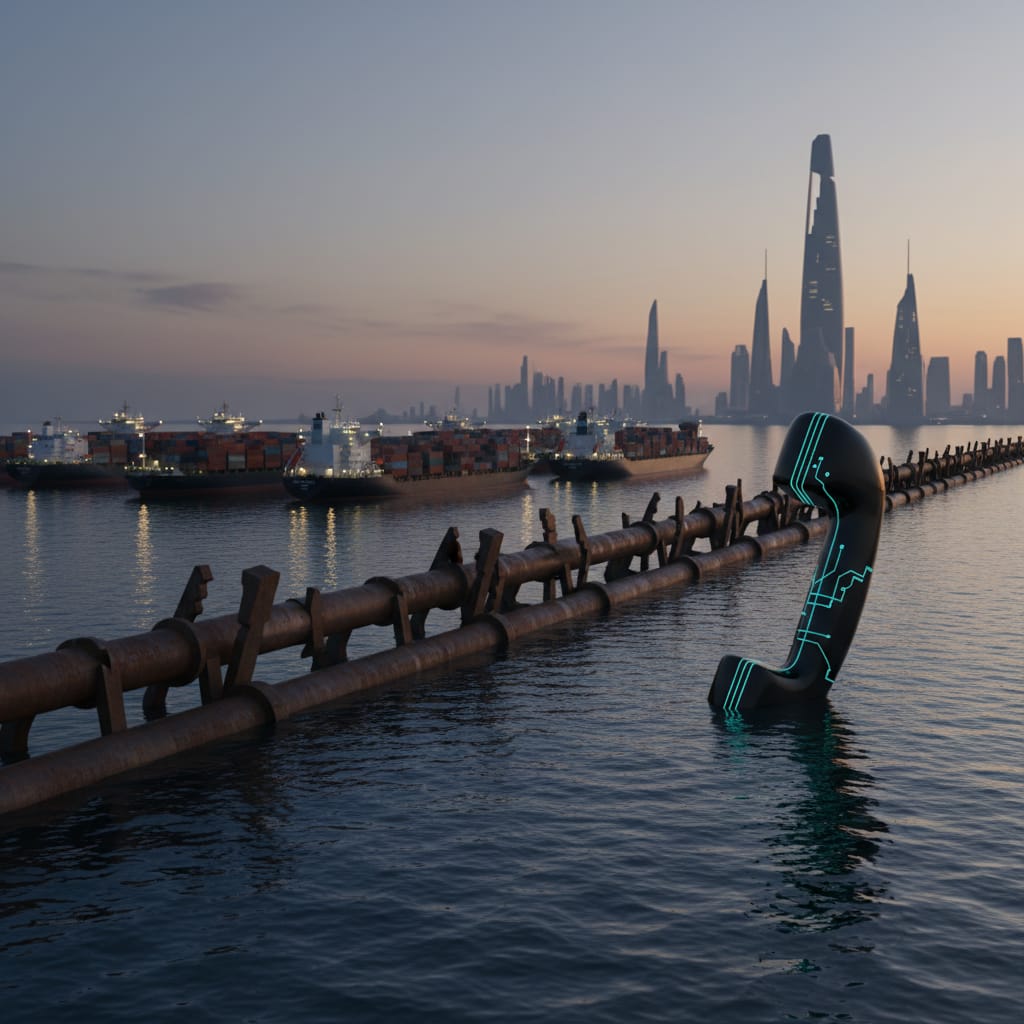
By Mihar Dias April 2026
Suddenly, geopolitics resembles a badly run toll plaza—too many barriers, too many enforcers, and not a single receipt you can claim from Accounts.
This latest drama in the Strait of Hormuz feels exactly like that. On one side, Donald Trump has decided that the United States Navy should play traffic police of the Persian Gulf—stopping ships, checking who paid whom, and, if necessary, “blowing things to hell,” which is not a phrase usually found in maritime insurance clauses. https://www.nst.com.my/world/world/2026/04/1416367/trump-orders-blockade-hormuz-strait-after-iran-talks-fail
On the other side, Iran, led politically by figures like Mohammad Bagher Ghalibaf, is hinting that passage through the world’s most important oil artery might soon come with a fee—cash, card, or geopolitical allegiance. https://www.nst.com.my/world/world/2026/04/1416367/trump-orders-blockade-hormuz-strait-after-iran-talks-fail. And somewhere in between floats Malaysia.
Not physically, of course. But economically, very much so.
The Illusion of the Friendly Phone Call
We like to think our supply lines are secured by diplomacy—the gentle art of picking up the phone, exchanging pleasantries, and perhaps invoking a shared sense of “Global South solidarity.” Our Prime Minister, Anwar Ibrahim—or PMX, as we have taken to calling him like a software update—has been particularly fond of this approach.
And to be fair, it works. Until it doesn’t.
Because oil tankers do not run on goodwill. They run on routes. And right now, those routes run through a chokepoint that is being turned into a geopolitical version of the Sungai Besi toll booth at 6pm—except this one comes with missiles.
So Who Stops Us First?
Let’s imagine a Malaysian-bound tanker—full of crude, minding its own business, having paid no “toll” to Iran because, well, we prefer our invoices not to come with sanctions attached.
Scenario 1: The Americans stop you.
The US Navy, under orders from Washington, intercepts vessels suspected of “cooperating” with Iran. You protest: “We didn’t pay anything!” They reply: “We’ll be the judge of that.” Suddenly your cargo is delayed, inspected, perhaps even seized under some creative interpretation of “international waters.”
Scenario 2: The Iranians stop you.
You refuse to pay their newly invented toll? Congratulations—you are now “unfriendly traffic.” Expect delays, inspections, or the maritime equivalent of being told to pull over and step out of the vehicle. Except the “vehicle” is a supertanker and the “step out” involves armed patrol boats.
Scenario 3: The Chinese wave you through… maybe.
China, the world’s largest energy importer, has a more pragmatic approach. If you are aligned, or at least not offensive, you might glide through under an unspoken umbrella of protection. But Malaysia is not China. We don’t have a blue-water navy escorting our shipments, nor the economic weight to demand preferential lanes.
So unless we suddenly become a subsidiary of China, that “friendlier route” is not exactly ours to claim.
The Price of Not Choosing Sides
Malaysia’s long-cherished foreign policy has been one of elegant ambiguity: friendly to all, offensive to none. It’s a bit like being the polite guest at a dinner party where two hosts are quietly sharpening knives under the table.
But the Strait of Hormuz does not reward neutrality. It punishes it.
Because in a world where:
• Iran may charge you for passing,
• The US may punish you for paying,
• And China may selectively shield its own,
…being “non-aligned” starts to look less like wisdom and more like standing in the middle of the highway hoping traffic will respect your principles.
The Real Cost: Not Oil, But Uncertainty
We often talk about oil prices rising. That’s the easy headline.
The harder truth is uncertainty.
Shipping insurers panic. Freight rates spike. Supply chains stutter. Refineries start hedging. And somewhere in Port Klang, someone is explaining why your petrol subsidy bill just became a national crisis.
Not because we ran out of oil—but because the journey from Point A to Point B now requires navigating three competing navies and at least two conflicting definitions of “legal passage.”
A Toll Booth With Missiles
In the end, this isn’t about whether Malaysia paid any “toll” to Iran. It’s about entering a system where everyone insists you owe them something.
The Americans demand compliance.
The Iranians demand recognition.
The Chinese demand alignment.
And Malaysia? We are still trying to pay in diplomacy.
Which is admirable. Noble, even.
But in the Strait of Hormuz, diplomacy does not clear a blockade. It does not escort a tanker. And it certainly does not stop a warship from asking inconvenient questions.
So the next time we take comfort in the idea that a well-placed phone call has secured our energy future, we might want to ask:
When the shooting starts—or worse, when the billing starts—who exactly is picking up the tab?
Mihar Dias (mihardias@gmail.com) is a content creator under the Newswav Creator programme, where you get to express yourself, be a citizen journalist, and at the same time monetize your content & reach millions of users on Newswav. Log in to creator.newswav.com and become a Newswav Creator now!
The User Content (as defined on Newswav Terms of Use) above including the views expressed and media (pictures, videos, citations etc) were submitted & posted by the author. Newswav is solely an aggregation platform that hosts the User Content. If you have any questions about the content, copyright or other issues of the work, please contact creator@newswav.com.