
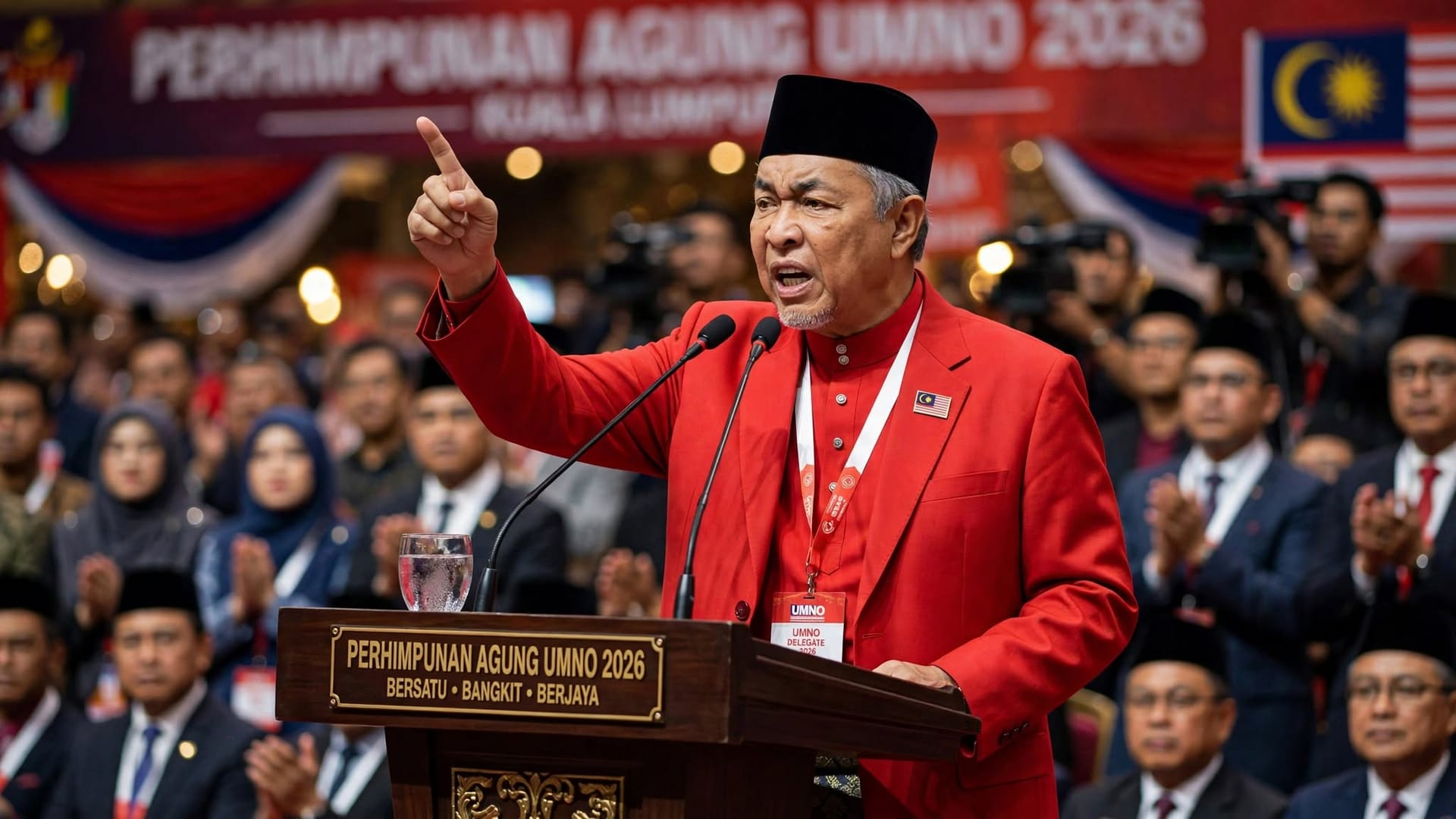
The art of Malaysian political survival has always relied on a very particular brand of theater, where the dagger is concealed behind a polite honorific and a practiced smile. When Datuk Seri Ahmad Zahid Hamidi took to the podium at the recent party assembly, he did not simply deliver a speech; he executed a textbook exercise in political judo. Standing before the faithful, he famously tossed out the moniker of guru for Prime Minister Datuk Seri Anwar Ibrahim, only to immediately pivot and savage the administration’s policy direction. From erratic economic shifts and targeted subsidy U-turns to the broader anxieties plaguing the nation's financial corridors, the critique was blistering.
Yet, calling a leader your teacher while simultaneously questioning his report card is a transparent rhetorical device. You do not publicly school your mentor unless your primary objective is to signal to the entire classroom that you no longer fear detention. It was a calculated display of dominance wrapped in feigned deference, designed to project strength to an audience that has spent years nursing the bitter taste of electoral decline and internal fractures.
To understand the sheer audacity of this maneuvering, one must look at the contradictory tightrope walk being performed in plain sight. On one hand, the leadership projects unshakeable confidence, demanding early electoral mandates and teasing fluid state-by-state alliances that look suspiciously like hedging every possible political bet. On the other hand, the underlying anxieties remain anchored to unresolved legal battles and the emotional bedrock of past grievances. Expressing public sorrow over the postponement of a high-profile pardon hearing is not merely an act of personal solidarity; it is a vital ritual of appeasement for a grassroots base that still measures loyalty by how fiercely it defends the old guard.
Yet, behind the sentimental rhetoric lies a ruthless operational logic. Keeping the ghost of the past alive rallies the troops, but it also serves as a perpetual insurance policy. The leadership knows precisely how to balance the projection of unwavering support for fallen chieftains with the quiet, calculated preservation of its own institutional stronghold. It is protection disguised as principle keeping old loyalties close enough to satisfy the faithful, but safely removed from actual operational influence so that no returning figure can threaten the current hierarchy.
Then came the grand climax of this political theater: the open dare. Telling Pakatan Harapan to kick UMNO out of Putrajaya and dissolve Parliament if they possess the courage is a breathtaking piece of brinkmanship. It is an aggressive stress test of the unity government’s fragile arithmetic. The calculation is simple, even if the execution is volatile. The party leadership operates under the assumption that Putrajaya's survival is heavily tethered to Barisan Nasional’s parliamentary bloc, and by daring coalition partners to pull the plug, they attempt to flip the script entirely. Instead of acting as a junior partner navigating a marriage of convenience, they posture as the indispensable kingmaker whose sudden departure would bring the roof crashing down upon everyone.
Down at the Anneh Stalls Coffee shop, where the morning mist mixes with the heavy scent of condensed milk and frying roti canai, the regulars watching this political soap opera could easily mistake it for a live episode of Pi Mai Pi Mai Tang Tu. It is the same old neighborhood cast playing out the same predictable sketch on a national stage. Just like Mad Som arguing over coffee or Tok Ayah holding court while nothing ever truly changes, the characters switch hats, shout across the coffee tables, hurl theatrical threats, and throw grand tantrums, yet by the time the credits roll, everyone is right back where they started stuck in the exact same spot. Over the clatter of saucers and the steady hum of ceiling fans, the verdict from the common folk is sharp and unsparing. When a deputy prime minister openly taunts his own prime minister, trashes economic policies formulated by the very cabinet he sits in, and treats the foundational principle of collective responsibility like an inconvenient suggestion, the unity government ceases to look like a cohesive coalition. Instead, it looks precisely like a run-down flat association meeting where everyone is threatening to walk out, but nobody actually leaves because the coffee tab hasn’t been paid yet.
The irony running through this entire saga is thick enough to cut with a dull butter knife. For years, the prevailing reformist narrative was built on the promise of escaping the dark shadow of systemic decay, moving past the culture of institutional impunity, and establishing a cleaner, more accountable model of governance. Yet here we find ourselves, trapped in a relentless time loop, watching the exact same old scripts being read from the exact same weathered hymn sheets. Power is relentlessly prioritized over policy, institutional integrity is treated as a flexible negotiation, and every threat of an early election is weaponized as a bargaining chip for self-preservation.
The strategy relies heavily on the belief that collective memory is short and that the electorate can be easily manipulated through manufactured crises and high-stakes posturing. By manufacturing a narrative of being a political target, the leadership attempts to play the eternal victim while simultaneously holding the dagger to the throat of the administration. It is a dual-track survival mechanism: whip up nationalist and religious fervor on the outside while quietly cutting deals and securing structural leverage on the inside.
Whether this aggressive chest-beating will actually translate into the premature collapse of Parliament or merely serve to extract deeper ministerial and institutional concessions remains to be seen. But one undeniable reality has crystallized out of this weekend of political posturing. The Madani administration is learning the hardest lesson in Malaysian political history: feeding a crocodile in the desperate hope that it will eat you last is a strategy defined by eventual, inevitable consumption.
Politics remains the art of weaponizing gratitude, and nothing tests the limits of a fragile coalition faster than a partner who is utterly convinced that the house would crumble into dust without them.
Annan Vaithegi
Annan Vaithegi (annanvaithegi@icloud.com) is a content creator under the Newswav Creator programme, where you get to express yourself, be a citizen journalist, and at the same time monetize your content & reach millions of users on Newswav. Log in to creator.newswav.com and become a Newswav Creator now!
The User Content (as defined on Newswav Terms of Use) above including the views expressed and media (pictures, videos, citations etc) were submitted & posted by the author. Newswav is solely an aggregation platform that hosts the User Content. If you have any questions about the content, copyright or other issues of the work, please contact creator@newswav.com.