
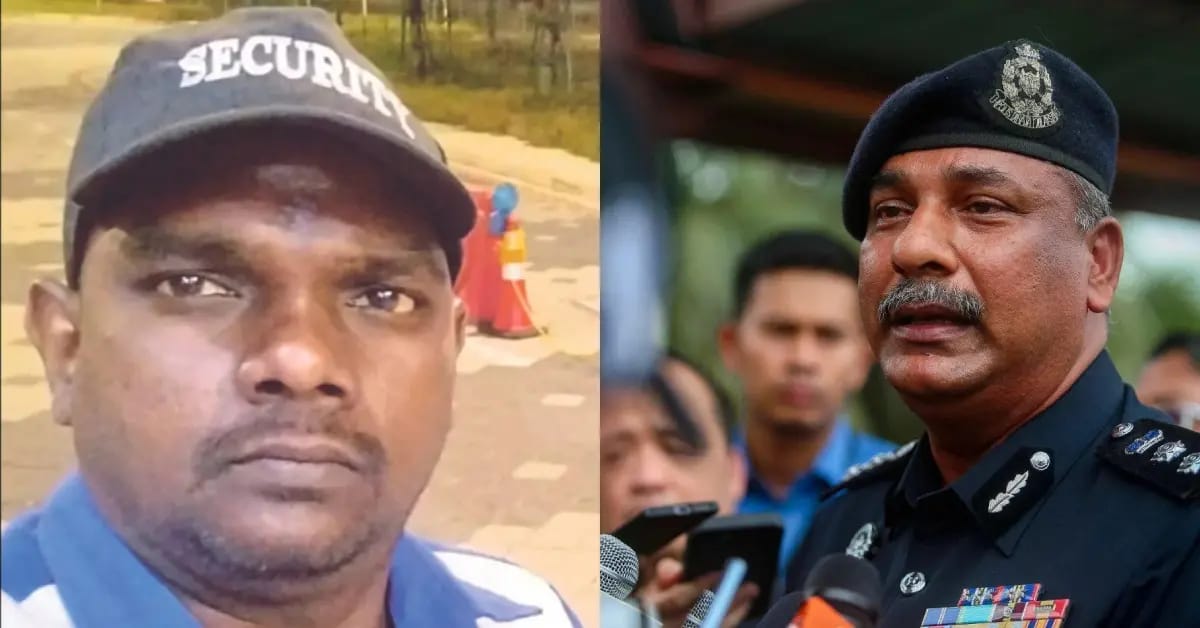
A security supervisor was killed in Klang in what can only be described as a senseless, almost absurd act of violence. But like many such tragedies, what appears senseless on the surface may, upon closer inspection, reveal something deeper and far more troubling.
G. Anand, a 43-year-old father of two, was doing what he had always done—working. By day, he earned a living at a production company. By night, he took on supervisory duties as a security guard in a residential area in Bandar Bukit Raja, trying to make ends meet for his family. Those who knew him described him as a devoted husband, a loving father, and a man who carried the quiet burden of responsibility without complaint.
In the early hours of Sunday morning, Anand noticed three men drinking within the compound of a rented house during his routine patrol. As part of his duty, he stopped and observed. One of the men, already intoxicated, took offense.
“What are you staring at?” the man reportedly shouted.
Anand did not escalate the situation. Another individual intervened, apologised, and told him to leave. He did. He returned to his guard post. The matter should have ended there.
But it didn’t.
The man came back—not once, but twice. The first time, his friends restrained him. The second time, he came alone. Armed with a steering lock, he attacked Anand. A blow to the rib area proved fatal. Anand was rushed to Shah Alam Hospital at around 1am, but he succumbed to his injuries.
Police later confirmed that the suspect, a 40-year-old man with a prior criminal record, did not know Anand. This was not gang-related. It was random. A moment of drunken rage that ended a life.
That is the official story. The easy explanation is also the most convenient one: alcohol. The “devil in the drink.” A man too drunk to control himself.
But that explanation, while comforting in its simplicity, is also deeply inadequate.
Because it does not answer the more important question—why did a mere glance provoke such disproportionate fury? Why did the man feel compelled to return, to hunt down, and to kill someone who had already disengaged?
The answer, I would argue, lies not in the drink—but in the mirror.
When the assailant looked at Anand, he may not have simply seen a security guard observing him. He may have seen himself reflected back—his own insecurities, his own perceived failures, his own sense of inadequacy. And he did not like what he saw.
Alcohol, in such cases, does not create the demon. It merely lowers the threshold that keeps it contained.
If you are sober and you dislike what you see in yourself, you can numb that discomfort. You can distract yourself. You can drink to forget.
But if you are already drunk, and that same discomfort resurfaces—triggered by something as simple as a stranger’s gaze—you do not look away.
You break the mirror.
The tragedy in Klang is that the “mirror” was not an object. It was a man. A father of two. A brother. A provider. A human being who had done nothing more than carry out his duty.
And this is where the issue becomes uncomfortable, especially for the Indian community.
There will be those who reduce this incident to a stereotype: that Indians are aggressive, prone to alcohol, quick to anger. It is a narrative we ourselves sometimes internalise and repeat. But that is merely the surface.
Beneath it lies a more corrosive reality.
There is, within segments of our community, a quiet but pervasive crisis of self-worth.
At almost every level of society—be it among the working class, in politics, in business, in sports, or within the civil service—many Indians are made to feel, subtly or otherwise, that they are worth less than others occupying the same space. This perception, whether rooted in systemic inequality, social conditioning, or lived experience, seeps deep into the psyche.
Over time, it breeds resentment. Frustration. A simmering anger.
Some are able to process it, to channel it productively, or to rise above it. But others cannot. And when they cannot, the consequences manifest in ways that are all too familiar: substance abuse, hypersensitivity, aggression, and ultimately, violence.
The man who killed Anand may not have been consciously thinking about any of this. But human behaviour does not operate solely at the level of conscious thought. It is shaped by accumulated experience, by internalised narratives, by how one sees oneself in relation to the world.
And when that self-image is fractured—when one does not like what one sees even in one’s own eyes—any external trigger can become explosive.
A look. A word. A perceived slight.
To address incidents like this, it is not enough to condemn alcohol or call for stricter enforcement alone, though both have their place. These are responses to symptoms.
The disease runs deeper.
It lies in a community grappling with issues of dignity, worth, and self-perception. It lies in the internal battles many fight silently—battles that, when left unresolved, sometimes spill outward in destructive ways.
If we are serious about preventing such tragedies, we must confront this uncomfortable truth.
Because until we fix how we see ourselves, we will continue to misread how others see us.
And in that gap—between perception and reality—more lives may be lost.
TheRealNehruism (nehru.sathiamoorthy@gmail.com) is a content creator under the Newswav Creator programme, where you get to express yourself, be a citizen journalist, and at the same time monetize your content & reach millions of users on Newswav. Log in to creator.newswav.com and become a Newswav Creator now!
The User Content (as defined on Newswav Terms of Use) above including the views expressed and media (pictures, videos, citations etc) were submitted & posted by the author. Newswav is solely an aggregation platform that hosts the User Content. If you have any questions about the content, copyright or other issues of the work, please contact creator@newswav.com.