
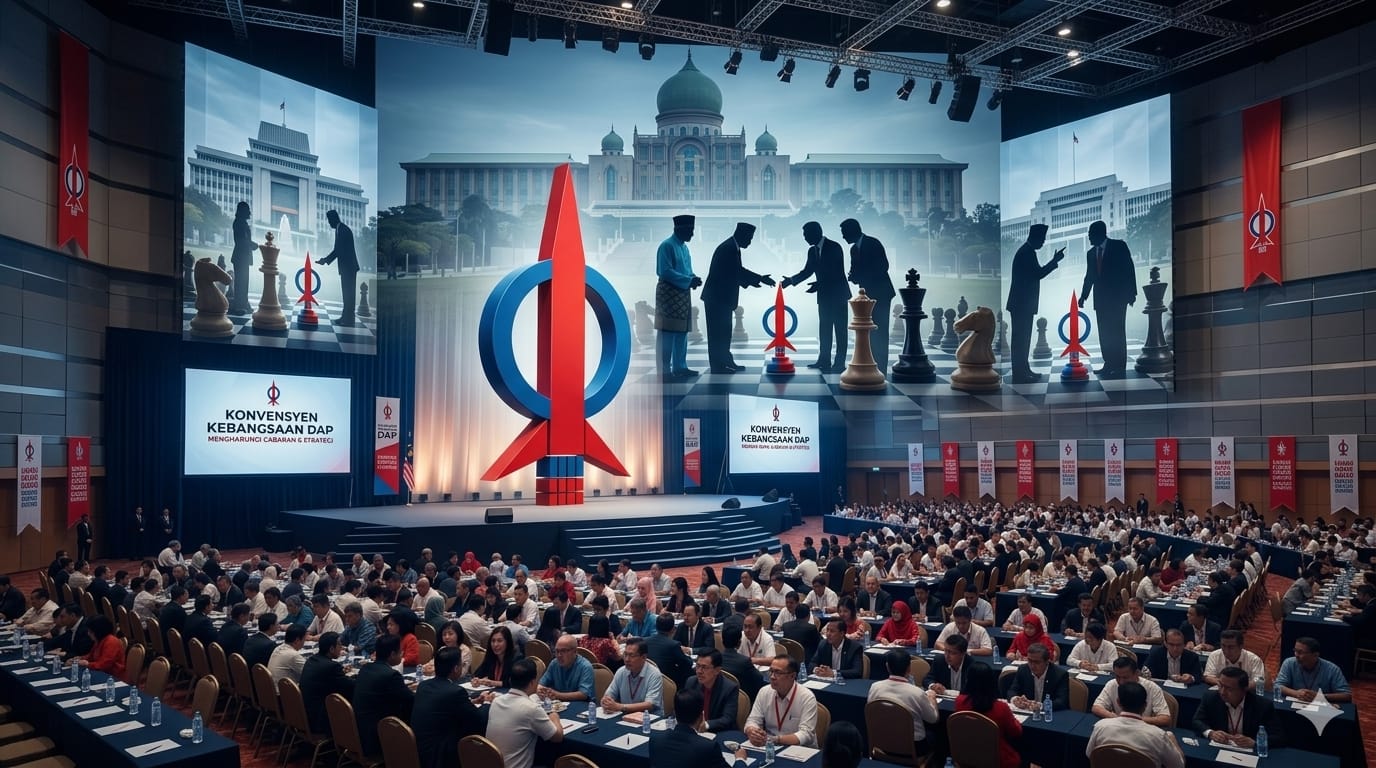
The political theater surrounding the 2026 DAP National Conference has exposed a profound, multidimensional crisis within Malaysia’s federal unity government. While the central leadership touts an 88.5% mandate to stay, the event has triggered a cascade of strategic counterweights, grassroots resistance, and severe economic anxiety. Understanding the current political reality requires analyzing it through three distinct lenses: the Prime Minister’s survival calculus, the blueprint for an internal party rebellion, and the immediate financial fallout shaking the capital markets.
1. The Anwar Equation: The Shield Against UMNO's Grip
To view DAP’s decision purely as a story of party capitulation is to miss the broader chess game being played inside Putrajaya. For Prime Minister Anwar Ibrahim, protecting DAP is not an act of ideological charity; it is a cold, calculated strategy to maintain his own leverage against an increasingly aggressive and resurgent UMNO.
Anwar knows that in the brutal math of the federal unity coalition, DAP's 40 parliamentary seats form the absolute bedrock of his premiership. Without them, his administration collapses instantly. As UMNO rides the high of consecutive state election victories in Johor and Negeri Sembilan, its warlords are becoming bolder, openly challenging the Prime Minister’s economic policies and testing his boundaries. To prevent himself from becoming a political hostage to UMNO’s demands, Anwar requires a powerful, loyal counterweight. DAP fulfills that role perfectly.
To keep this counterweight intact ahead of GE16, Anwar must engage in a delicate balancing act to protect DAP from total electoral annihilation. He cannot allow the non-Malay ground to completely freeze over from disillusionment. Therefore, expect the Prime Minister to quietly throw tactical bones to his loyal partner over the next 12 months:
- Fast-Tracking Institutional Reforms: Advancing the highly visible components of the shared reform agenda, such as the separation of the Attorney-General and Public Prosecutor roles, or introducing the National Ombudsman bill. This gives DAP ministers concrete legislative trophies to display to their cynical base.
- Economic Recalibrations: Intervening on the fiscal front to soothe grassroots anxiety over everyday living pressures. This includes raising mandatory e-invoicing thresholds for small businesses and adjusting the implementation timelines for diesel and RON95 subsidy rollouts, allowing Anthony Loke to claim a narrative of effective, quiet diplomacy.
Ultimately, Anwar’s goal is to keep DAP just strong enough to anchor his coalition, while ensuring they remain dependent on his leadership for their political survival.
2. The Insurgent Blueprint: Reclaiming the Soul of the Rocket
While the Prime Minister plays the macro-strategy, an internal crisis is brewing within the rocket itself. The abysmal 52% delegate turnout at the Putrajaya International Convention Centre proved that nearly half of DAP’s institutional core is suffering from profound moral exhaustion. For internal rebels like Sangeet Kaur Deo and the progressive factions who refuse to buy into the leadership's spin, the path forward cannot be business as usual.
To challenge a central leadership entrenched in the comforts of administrative office, the internal insurgency must transition from isolated rhetorical outbursts into a highly organized, tactical campaign. The rebel playbook requires three immediate structural steps:
- Weaponize the Silent 48%: The missing delegates who boycotted the conference are the rebellion's natural constituency. Dissident leaders must immediately initiate a nationwide, grassroots listening tour across fractured divisions in Sabah, Johor, and Selangor to formalize a powerful internal caucus.
- Demand a "Hard Trigger" for Reforms: Since the leadership has committed to "discussing a new timeline" with the Prime Minister, the rebels must force them to define the exact terms. The dissident faction should publicly demand a written, non-negotiable checklist of deliverables with clear quarterly benchmarks including the immediate resolution of the Teoh Beng Hock justice campaign.
- Mount a Direct Challenge at Party Elections: Speeches on the convention floor earn applause, but only structural power changes policy. The progressive bloc must systematically groom alternative, principle-driven candidates to contest key Central Executive Committee (CEC) seats in the upcoming elections, framing it as an existential battle for the party's very identity.
3. Capital Flight and Compromise: The Economic Fallout
As the political chess match and internal party rebellions intensify, the resulting coalition instability is sending shockwaves through Malaysia's financial landscape. For domestic and international investors, the sudden fragility of the Madani administration underlined by DAP's shifting ultimatums and UMNO’s aggressive maneuvers for an early general election has injected a heavy dose of policy uncertainty into a market that thrives on stability.
The economic fallout of this growing political anxiety manifests across three critical areas:
- The Fiscal Reform Freeze: International rating agencies are closely monitoring the government's commitment to fiscal consolidation. However, with a weakened DAP desperate to appease a disgruntled voter base and a Prime Minister forced to make popular concessions, the political will to execute difficult subsidy rationalizations is rapidly evaporating, risking wider fiscal deficits.
- Capital Market Volatility and Ringgit Pressure: The Kuala Lumpur Composite Index (KLCI) is highly sensitive to shifts in the political landscape. The looming threat of a premature dissolution of Parliament engineered by a resurgent UMNO is creating a risk-off sentiment among institutional investors, exerting downward pressure on the Ringgit.
Delays in Strategic Investment: Large-scale infrastructure projects, transport networks, and high-value data center investments require consistent administrative oversight. The threat of an early GE16 catches major government-linked companies (GLCs) and multinational corporations in a state of operational paralysis, slowing down crucial private sector growth.
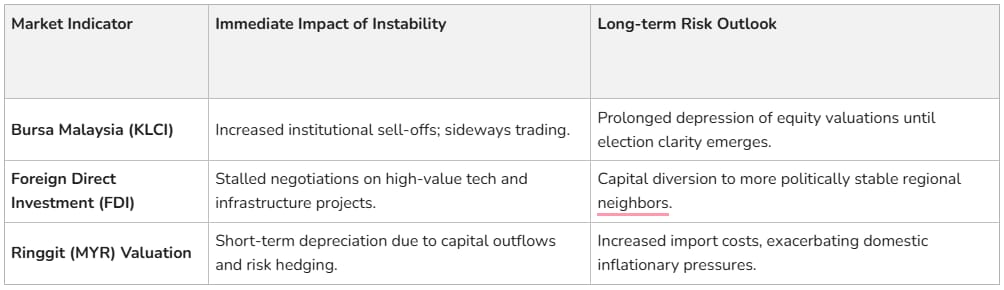
The Economic Price Tag of Malaysia's Ruling Tension
The Final Reckoning
Ultimately, these three dimensions Anwar's survival tactics, the grassroots rebellion, and the market volatility converge into a singular truth: when a political government prioritizes short-term survival over structural clarity, everyone pays the price.
Annan Vaithegi astutely reflected on this fragile state of affairs: "A leader caught between two ambitious rivals does not destroy the weaker one; he turns them into a shield. But capital is a coward; it does not wait to see who wins the war, it flees at the first sound of the drums. The moment a political movement accepts the safety of a cage for a regular supply of meat, it stops being a king and becomes just another exhibit. DAP has traded its roar for a seat at the table, oblivious to the fact that they aren't guests at the feast they are what's being served."
Annan Vaithegi (annanvaithegi@icloud.com) is a content creator under the Newswav Creator programme, where you get to express yourself, be a citizen journalist, and at the same time monetize your content & reach millions of users on Newswav. Log in to creator.newswav.com and become a Newswav Creator now!
The User Content (as defined on Newswav Terms of Use) above including the views expressed and media (pictures, videos, citations etc) were submitted & posted by the author. Newswav is solely an aggregation platform that hosts the User Content. If you have any questions about the content, copyright or other issues of the work, please contact creator@newswav.com.