
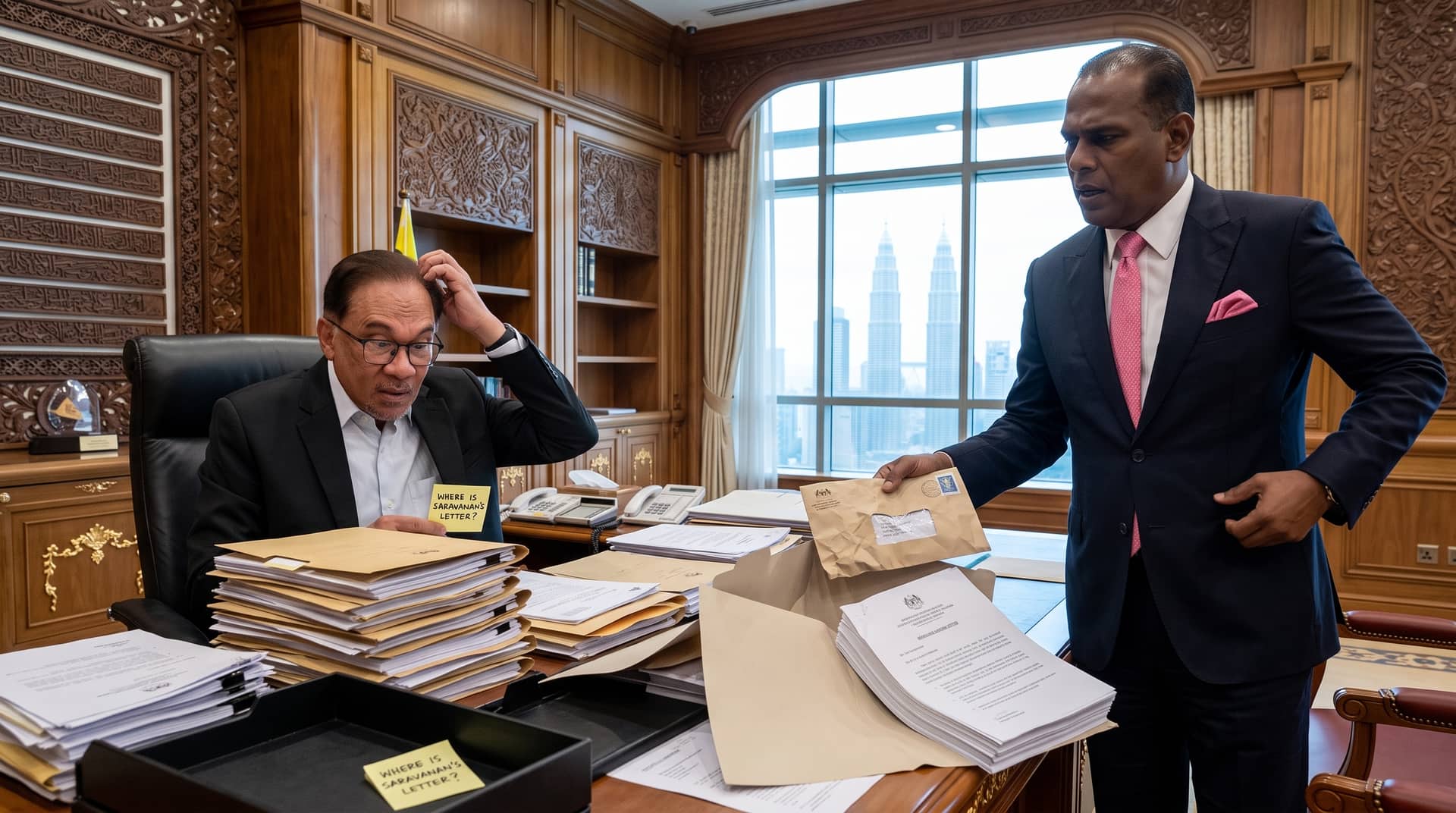
We are accustomed to bureaucracy taking its sweet time. Anyone who has stood in an endless line at the Road Transport Department, waited for a housing license approval, or tried tracking a Pos Laju parcel that seems permanently stranded in a sorting facility knows the quiet pain of institutional delay. Yet, few could have anticipated that the ultimate dead-letter office in the country would be located somewhere between the briefcase of a former Cabinet minister and the desk of the Prime Minister.
The public spectacle unfolded with almost cinematic timing at the Kuala Lumpur Sessions Court on August 28, 2026.Datuk Seri M. Saravanan, former Human Resources Minister and MIC Deputy President, stepped out looking dapper,ready to defend his reputation. Inside, he had pleaded not guilty to three counts of receiving RM1.097 million in bribes related to foreign worker quota approvals back in 2022.
Outside the courtroom, Saravanan revealed a startling detail: he had sent an official, 15-page representation directly to Prime Minister Datuk Seri Anwar Ibrahim his "boss" in the unity government clarifying his position, alleging that witnesses were coerced by the Malaysian Anti-Corruption Commission (MACC), and asking for a thorough investigation.He expressed genuine surprise when reporters informed him that the Prime Minister had not seen the document. Shortly after, Datuk Seri Anwar dryly remarked after Friday prayers that he had yet to receive any such letter. He promised that once it eventually lands on his desk, he will simply pass it along to the MACC and the Attorney General's Chambers for examination.
At face value, this is a procedural comedy a tale of a 15-page document vanishing into thin air while both men insist they have been on active speaking terms for months regarding this very issue. But beneath the administrative slapstick lies a sharp, uncomfortable look into how power, accountability, and political self-preservation operate in modern Malaysia.
Consider the sheer absurdity of the communication gap. We are talking about two senior political figures who attend the same coalition meetings, bump into each other in Parliament, and share direct access to every high-level messaging channel known to governance. Yet, a document of such gravity detailing allegations of witness coercion and protesting an imminent criminal charge is left floating in administrative limbo, as if delivered by a slow boat across the Straits of Malacca.
For ordinary Malaysians, this "I didn't get the letter" defense triggers an immediate sense of recognition. It is the political equivalent of telling your boss that the crucial project update landed in your spam folder, or telling the bank that the check is in the mail. When a politician wishes to maintain operational distance from a toxic issue, there is no tool more effective than strategic ignorance. By declaring that he has not read the letter, the Prime Minister neatly preserves his reformist posture: he does not interfere with the MACC, he lets the legal process run, and he avoids getting dragged into a messy public defense of a coalition partner.
Consider the sheer absurdity of the communication gap. We are talking about two senior political figures who attend the same coalition meetings, bump into each other in Parliament, and share direct access to every high-level messaging channel known to governance. Yet, a document of such gravity detailing allegations of witness coercion and protesting an imminent criminal charge is left floating in administrative limbo, as if delivered by a slow boat across the Straits of Malacca. Is it stuck in the PMO's in-tray? Was it eaten by a "little Napoleon"? Or did it simply require a RM1 million fee to move from the reception desk to the inner sanctum?
For ordinary Malaysians, this "I didn't get the letter" defense triggers an immediate sense of recognition. It is the political equivalent of telling your boss that the crucial project update landed in your spam folder, or telling the bank that the check is in the mail. We’ve all used it, or had it used on us. But when employed at the apex of power, it serves a much grander purpose.
When a politician wishes to maintain operational distance from a toxic issue, there is no tool more effective than strategic ignorance. By declaring that he has not read the letter, the Prime Minister neatly preserves his reformist posture. He can stand before the cameras and assert that he does not interfere with the MACC, that he lets the legal process run, and that the authorities must probe the document.
Furthermore, he avoids getting dragged into a messy public defense of a coalition partner. Let’s be honest, the "boss" has enough problems. People are already chasing him, blaming him for the sudden, convenient explosion of DNAAs (Discharges Not Amounting to an Acquittal) and NFAs (No Further Action) in high-profile cases. They are still questioning why the apology for the demolition of the kuil haram (illegal temple) was so late and reluctant. And they are noticing that when it comes to certain cases, like the ongoing issues involving former PM Ismail Sabri, Anwar conveniently has nothing to say. With so many political fires already burning, why would he willingly pick up another kerosene lamp labeled "MIC Foreign Worker Scandal"?
On the other side of the aisle sits Saravanan's own delicate balancing act. He went to great lengths to insist that his letter was not an appeal for executive intervention or political immunity. He framed Anwar as his administrative superior the “boss” merely asking for an objective look at what he claims is a flawed prosecution. He was not asking for protection,he said; he supports the Madani government.
But in Malaysian politics, the line between a humble representation and an appeal for political cover is vanishingly thin. Reminding the Prime Minister of one's loyalty, one's support for the unity government, and one's past parliamentary votes while under the shadow of a Sessions Court charge carries an unmistakable undertone. It is a subtle attempt to test the boundaries of executive sympathy, a plea of "Aney, help a brother out." The public skepticism is warranted; we have seen too many "big fish" rounded up only to see the charges dissolve like ais kacang in the sun. Saravanan may be a smaller ikan bilis compared to some, but he’s fighting for his political life, and in this environment, any letter to the boss is a gamble.
What makes this issue deeply resonant for taxpayers and working-class families is the subject matter itself: foreign worker quotas. The recruitment of foreign labor is not an abstract legal niche; it is an industry worth billions that touches every corner of the domestic economy from construction sites and plantations to neighborhood Anneh stalls and manufacturing plants. For years, Malaysian business owners have complained about bureaucratic red tape, sudden policy shifts, and the astronomical costs associated with securing labor quotas. When allegations emerge that over a million ringgit changed hands simply to facilitate a quota for 1,000 workers, it confirms the average Malaysian's worst suspicion:that the national economy is regularly taxed by a shadow economy of political rent-seeking.
The legal process must now run its course in court, where evidence not media statements or 15-page letters will decide guilt or innocence. Saravanan is entitled to the full presumption of innocence and his day before a judge. But the political optics have already delivered a verdict on how institutional power operates when the heat is turned up.
When convenient, politicians are quick to boast about seamless communication, direct access, and tight-knit solidarity within the government. They act like best friends sharing a teh tarik at the Akka coffee shop. Yet the moment a charge sheet is drawn up, those same direct lines magically go dead, letters go missing, and the administrative machinery suddenly acts like an impenetrable wall. The tragedy for ordinary citizens is not just that millions are allegedly siphoned off in quota approvals, but that accountability is so often treated as a game of hide-and-seek. In the end, whether Saravanan’s letter was lost in transit, sitting in a clerk's inbox, or intentionally left unread, the message received by the public is crystal clear: when trouble brews at the top, the safest place for a leader to be is safely out of reach.
Malaysian politics, the most important correspondence is rarely the letter that gets delivered, but the one everyone pretends never arrived. - Annan Vaithegi
Annan Vaithegi (annanvaithegi@icloud.com) is a content creator under the Newswav Creator programme, where you get to express yourself, be a citizen journalist, and at the same time monetize your content & reach millions of users on Newswav. Log in to creator.newswav.com and become a Newswav Creator now!
The User Content (as defined on Newswav Terms of Use) above including the views expressed and media (pictures, videos, citations etc) were submitted & posted by the author. Newswav is solely an aggregation platform that hosts the User Content. If you have any questions about the content, copyright or other issues of the work, please contact creator@newswav.com.