.jpg)
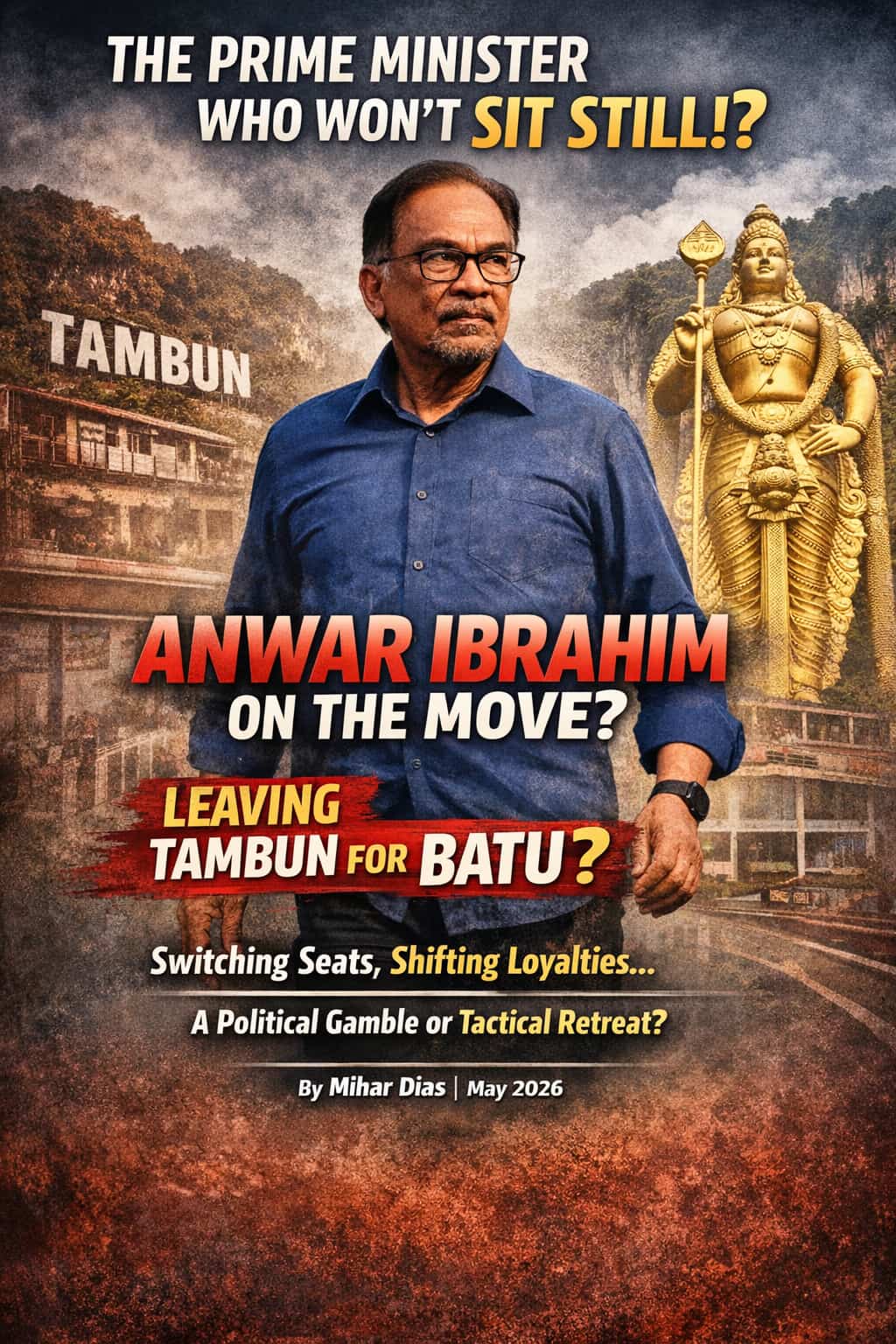
By Mihar Dias May 2026
There are politicians who build constituencies—and then there are those who seem to browse them.
Anwar Ibrahim, if current whispers prove true, may soon add Batu to a growing political itinerary that already includes Permatang Pauh, Port Dickson and Tambun. https://www.facebook.com/share/p/1UgTQaynaj/
At this rate, one half expects a loyalty card: contest three seats, get the fourth free.
The immediate excuse is familiar. Tambun, we are told, is no longer “safe.” The numbers are shifting. The ground is restless. The once-reliable fortress has developed cracks—small at first, now large enough for pollsters and party strategists to peer through nervously.
But politics is not only about numbers; it is about signals. And nothing signals uncertainty more clearly than a leader who appears ready to move before the battle even begins.
History offers useful, if uncomfortable, comparisons.
In the UK, when Winston Churchill lost his seat in Dundee in 1922, he did not pre-emptively relocate at the first sign of trouble. He lost—decisively—and only then returned to Parliament via the safer Epping seat. https://www.parliament.uk/about/living-heritage/transformingsociety/private-lives/yourcountry/collections/churchillexhibition/churchill-the-orator/gold-standard/) Churchill moved, yes—but only after the voters had rendered their verdict.
That distinction matters.
Contrast this with Mahathir Mohamad, Anwar’s predecessor, who in his political afterlife anchored himself to Langkawi. He won there in 2018, lost there in 2022, and—crucially—stayed. No tactical retreat, no late-stage search for friendlier terrain. The electorate ended the story, not a last-minute recalibration. https://thediplomat.com/2022/11/in-malaysia-a-political-stalwart-bows-out/).
Again another UK example, Margaret Thatcher, whose national popularity rose and fell like the British weather, never treated her Finchley seat as negotiable. Through controversy, riots, and declining approval ratings, Finchley remained constant—her political anchor throughout her parliamentary career. https://books.google.com/books/about/Margaret_Thatcher_From_Grantham_to_the_F.html?hl=ms&id=1LUtfg_1zlMC
These leaders were not immune to political calculation. But they understood an unwritten rule: movement carries meaning.
Move after defeat, and it is recovery.
Move to expand influence, and it is ambition.
Move before a fight, and it begins to look like doubt.
This is where Anwar’s present moment becomes more than a tactical adjustment—it becomes a test of identity.
For decades, his political brand was built on endurance. Prison, exile, political wilderness—he stayed the course when retreat would have been easier. That narrative carried him all the way to Putrajaya. It was, in many ways, his greatest political asset.
And yet now, faced with a constituency that may no longer be “comfortable,” the instinct appears to be repositioning rather than persuasion.
There is, of course, a modern defence for this. The age of “safe seats” is fading. Voters are less loyal, more volatile, and increasingly transactional. Today’s fortress is tomorrow’s marginal. In such a landscape, only a fool ignores the numbers.
But leadership is not merely about reading the map—it is about shaping it.
If every seat is uncertain, then the real test of leadership is not finding safer ground, but making uncertain ground winnable. That requires something more difficult than relocation. It requires conviction.
And this is where the optics begin to bite. A leader who moves too often risks appearing less like a national figure and more like a political nomad—drifting from constituency to constituency in search of electoral comfort.
The irony is hard to miss. The man who once stood firm against the full machinery of the state now risks looking unsettled by the far gentler pressure of a marginal seat.
PRU16, when it comes, will not simply be a contest of votes. It will be a contest of narratives.
If Anwar stays in Tambun and fights, he risks defeat—but reinforces the story that brought him to power.
If he moves to Batu and wins, he secures his seat—but invites a quieter, more enduring question.
Not whether he can win.
But whether he still stands.
Mihar Dias (mihardias@gmail.com) is a content creator under the Newswav Creator programme, where you get to express yourself, be a citizen journalist, and at the same time monetize your content & reach millions of users on Newswav. Log in to creator.newswav.com and become a Newswav Creator now!
The User Content (as defined on Newswav Terms of Use) above including the views expressed and media (pictures, videos, citations etc) were submitted & posted by the author. Newswav is solely an aggregation platform that hosts the User Content. If you have any questions about the content, copyright or other issues of the work, please contact creator@newswav.com.