
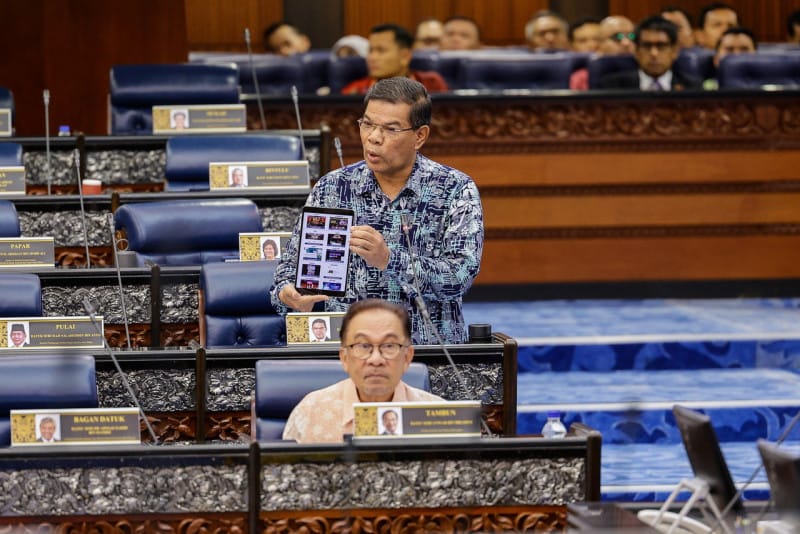
When the Home Minister stood in the Dewan Rakyat on November 12, 2026, to detail the conditions of PM6’s house arrest, he did not merely answer a routine parliamentary question.
By deliberately disclosing—and publicly rejecting—the written request from PM6 to serve his detention across a second residence, the Home Minister executed a calculated political communication strategy.
Navigating the fragile fault lines of Malaysia’s Unity Government, the Home Minister used the parliamentary floor to project institutional firmness, deflect accusations of preferential treatment, and speak simultaneously to three distinct audiences with competing political expectations.
His remarks were an exercise in political tightrope-walking.
By spotlighting the rejection of the request from PM6 for a second-residence alongside the threat of an immediate return to Kajang Prison, the Home Minister sought to neutralize the narrative that the government was granting VIP privileges to a convicted leader.
How naïve of him to think or has this belief that many of PH’s supporters are not only gullible but will also swallow whatever that he and his fellow politicians in PH are dishing out.
By highlighting that PM6 had requested an additional residence—and emphasizing that the government turned it down because the Federal Territories Pardons Board (FTPB) explicitly specified only the Jalan Langgak Duta property—the Home Minister sought to establish a clear boundary.
The Home Minister framed the arrangement as a strict, rule-bound continuation of a custodial sentence and that the house arrest does not equate to "two-tier justice," as PM6 is bound and have to adhere to 4 stringent categories of restrictions, amongst which are, he cant stay anywhere except at the designated address, his immediate family members (spouses, children, in-laws, and grandchildren) are allowed to stay with him, he is barred from using personal mobile phones, appearing on social media, issuing media statements, or participating in any political activities.
His communication is limited to devices registered with the Prisons Department for compliance checks.
Breaching any of the above would result in the immediate revocation of the house arrest and a return to Kajang Prison.
Aside, the Home Minister did not mention extending device registration with the Prisons Department to his spouse, children, in-laws, or grandchildren.
Does this mean PM6 is barred from using his personal mobile phones but not those that belongs and are registered to his spouse, children, in-laws, and grandchildren, and if he were to use those devices to communicate with any 3rd parties or people outside the restricted residence, there is no infringement by him of the restrictions placed on him?
Who Was the Intended Audience of his `revelation’?
In Malaysian politics, a ministerial statement on a polarizing figure is rarely aimed at a single demographic.
The Home Minister’s remarks were calibrated to address three overlapping groups:
A. Lawmakers in Parliament (Institutional Accountability)
In the Dewan Rakyat, the Home Minister was responding directly to backbenchers who pressed the government on oversight mechanisms, enforcement agencies, and whether the conditions would be gazetted.
By framing the conditions as a standardized framework under the Prisons Act meant for future cases as well, the Home Minister aimed to assure lawmakers that the executive branch was acting within clear legal parameters rather than ad-hoc political compromises.
B. Disillusioned Pakatan Harapan (PH) Supporters (Damage Control)
For the PH voter base—many of whom viewed the 1MDB and SRC International convictions as defining benchmarks of anti-corruption reform—the transition from prison to home detention for PM6 sparked immediate backlash and accusations of double standards.
The political fallout was severe enough to prompt high-profile friction within the coalition, including the resignation of the Transport Minister.
For this audience, the Home Minister’s disclosure of the rejected second-home request served a vital psychological purpose.
It allowed the government to signal to skeptical PH supporters that while it was constitutionally bound to execute the conditional pardon, it was actively pushing back against further concessions and keeping the former prime minister under tight surveillance.
FLK (leekhean.foo@gmail.com) is a content creator under the Newswav Creator programme, where you get to express yourself, be a citizen journalist, and at the same time monetize your content & reach millions of users on Newswav. Log in to creator.newswav.com and become a Newswav Creator now!
The User Content (as defined on Newswav Terms of Use) above including the views expressed and media (pictures, videos, citations etc) were submitted & posted by the author. Newswav is solely an aggregation platform that hosts the User Content. If you have any questions about the content, copyright or other issues of the work, please contact creator@newswav.com.


