.png)
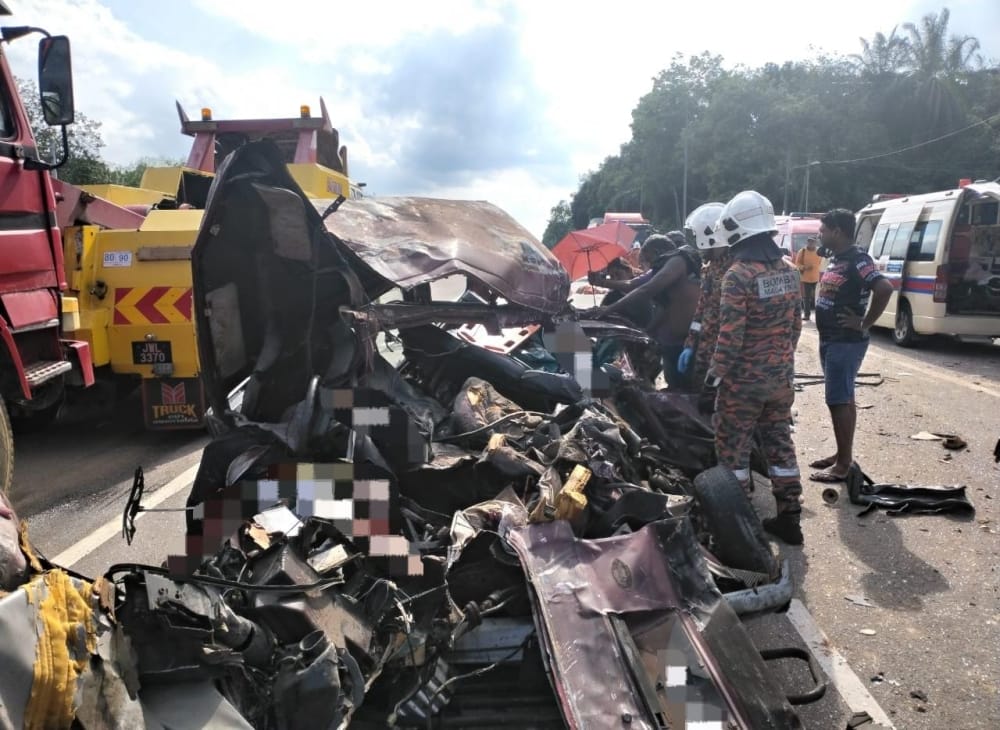
Public outrage tends to arrive in waves. Recently, it surged when a drunk driver who caused a fatality was charged with murder. Many welcomed the decision. It felt, to some, like a long-overdue recognition that getting behind the wheel intoxicated is not merely careless - it is knowingly dangerous.
The reasoning is straightforward: a person who drives under the influence understands the risks. The possibility of causing harm, even death, is neither remote nor abstract. It is well-established, widely publicised, and socially condemned. To drive anyway is to proceed in spite of that knowledge.
Not long after, another case confirmed that the logic could extend beyond alcohol. A trailer lorry driver in Segamat, Johor, who tested positive for drugs and caused a crash that killed three people, is now set to be charged with murder. The principle is consistent: knowingly putting others at extreme risk can carry the gravest legal consequences.
And yet, inconsistencies persist. A 71-year-old man was recently killed while crossing a zebra crossing in Bayan Lepas. The driver, a teenager, was not charged with murder but with causing death by reckless or dangerous driving. The case received attention, but not the same moral intensity. It was treated largely as a tragic accident.
This contrast invites an uncomfortable question: if knowledge of risk is what elevates an act to murder in some contexts, why does it not do so in others?
A zebra crossing is designed to be one of the safest points on the road for pedestrians. Drivers are expected to slow down, anticipate human movement, and yield. When a driver approaches such a crossing at speed, the risk is not speculative. The possibility of hitting someone is real and foreseeable.
In that sense, the driver is no different from the intoxicated or drug-impaired motorist. Both are aware - or ought reasonably to be aware - of the danger they pose. Both make a conscious decision to proceed regardless.
The same reasoning extends further. What of those who drive while using their mobile phones, diverting attention from the road? Bus drivers who take on excessive shifts despite fatigue? Truck drivers who fail to check the safety of their vehicles before setting off?
In all these cases, the risk is neither hidden nor unforeseeable. Fatigue, distraction, or mechanical failure can be catastrophic. Yet when such risks are taken - and lives are lost - we seldom ask whether the decision itself reflects awareness of the potential consequences.
If a fatality results from these choices, the distinction between negligence and knowledge becomes less obvious. To be sure, the law requires precision. Charges must be supported by evidence, and the burden of proving intent is high. Prosecutors may opt for charges more likely to succeed in court, rather than those that are more severe but harder to establish.
However, from a societal perspective, the inconsistency remains glaring. Two cases are elevated to murder; another, no less tragic, is framed as recklessness. This is not to suggest that every instance of dangerous driving causing death should automatically be classified as murder. Rather, it is to question where the line is drawn, and why it shifts depending on the circumstances.
If the defining factor is knowledge of risk, then it is worth asking how broadly that principle should apply. After all, the dangers of speeding, distracted driving, fatigue, poor vehicle maintenance, and driving under the influence - whether alcohol or drugs - are neither obscure nor disputed.
At what point, then, does a “tragic accident” become something more? And perhaps more importantly, are we consistent in how we answer that question?
Fa Abdul (fa.abdul.penang@gmail.com) is a content creator under the Newswav Creator programme, where you get to express yourself, be a citizen journalist, and at the same time monetize your content & reach millions of users on Newswav. Log in to creator.newswav.com and become a Newswav Creator now!
The User Content (as defined on Newswav Terms of Use) above including the views expressed and media (pictures, videos, citations etc) were submitted & posted by the author. Newswav is solely an aggregation platform that hosts the User Content. If you have any questions about the content, copyright or other issues of the work, please contact creator@newswav.com.