.png)
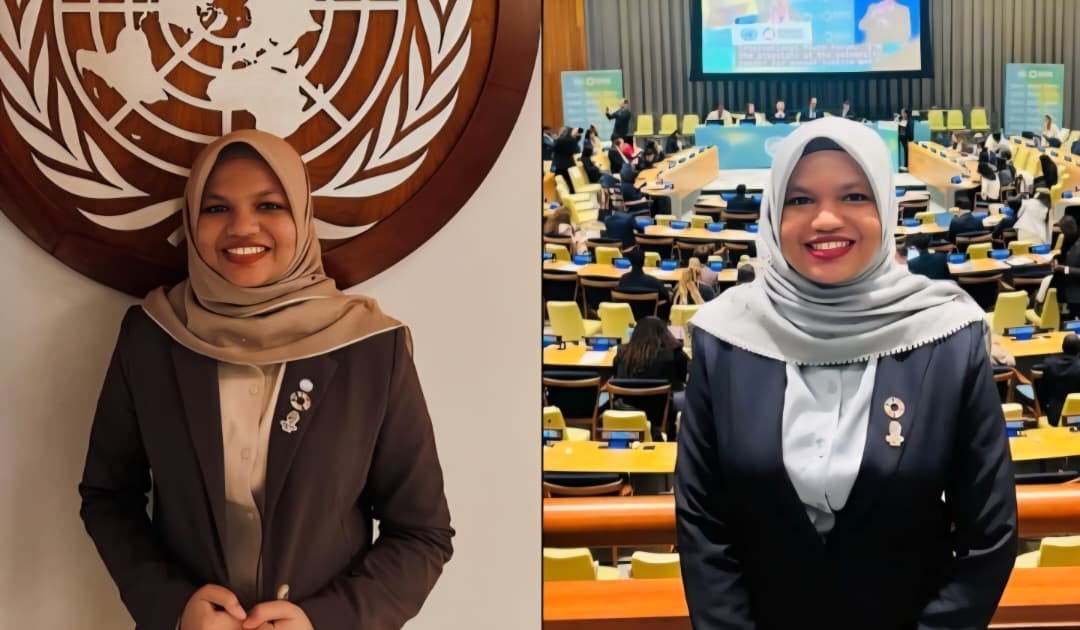
A 27-year-old Malaysian woman stands on a global stage, representing youth voices at the United Nations. She is educated, articulate, and chosen on merit. It should have been a proud moment.
Instead, it became a debate.
Shameera Nasreen Ahamed Noordeen, a Master’s student in Marine Science at Universiti Sains Malaysia, recently spoke at the UN ECOSOC Youth Forum as a representative of the Malaysian Indian Youth Council (MIYC). Rather than celebrating her achievement, some questioned her legitimacy—not because of her credentials, but because of how she looks.
More specifically, because she wears a tudung.
Online reactions quickly spiralled into a familiar line of argument. How can a Muslim represent the Indian community? Are the concerns of Indian Muslims the same as non-Muslim Indians?
Even prominent voices weighed in, raising concerns about whether she could “represent the whole” of the community.
To MIYC’s credit, they responded firmly. They made it clear that representation, in their view, is not defined by religion or outward appearance, but by capability, contribution, and impact. They also reminded the public of something that should not need reminding: the Indian community in Malaysia is not monolithic. It is diverse in language, culture, and yes, religion.
Shameera herself said it plainly: “I am an Indian Muslim.”
And yet, for many, that statement seems difficult to reconcile.
Not a genuine concern about representation
Here’s the uncomfortable question we need to ask. If we cannot even accept that an Indian Muslim can represent the Indian community because “their needs are different,” then how do we justify the idea of a Prime Minister from a different race or religion?
Because the argument is exactly the same.
If representation must be tied to shared religion or cultural experience, then by that logic, a non-Malay, non-Muslim Prime Minister would never be able to represent the majority Malay Muslim population. Their needs would be “different.” Their worldview would be “incompatible.” Their leadership would be “inauthentic.”
And yet, many who reject Shameera’s representation would likely reject that conclusion. This is where the contradiction becomes clear.
What we are witnessing is not a genuine concern about representation. It is a deeply ingrained way of seeing people—one that reduces identity to race and religion, and assumes that difference automatically means division.
It is a mindset that says: You are what you look like. You represent only your category. You cannot cross those boundaries.
But Malaysia has never been that simple.
We are a country where identities overlap, blur, and evolve. Where heritage, faith, language, and lived experience do not always align neatly into official boxes. Where someone can be Indian and Muslim, Chinese and Christian, Malay and culturally hybrid in ways that defy stereotypes.
And yet, despite living in this complexity, we often retreat into simplicity.
We insist on neat categories because they are easier to understand. We assign expectations to those categories because it makes the world feel more predictable.
But in doing so, we limit each other.
Are we ready for Bangsa Malaysia?
The backlash against Shameera reveals something uncomfortable but necessary to confront. We are not yet ready to see each other simply as Malaysians.
Our unity is often surface-level. We celebrate diversity in slogans and festivals, but when it comes to representation, trust, and leadership, we fall back on race and religion as the primary qualifiers.
We say we believe in merit, until someone challenges our mental image of what a representative should look like.
We say we value diversity, until that diversity exists within a single person.
The real issue is not whether an Indian Muslim can represent Indian youth.
The real issue is whether we believe anyone can represent anyone beyond their own identity group.
Because if the answer is no, then we are not just limiting Shameera.
We are limiting the very idea of Malaysia.
Perhaps it is time to ask a different question.
Not “Can she represent the Indian community?”
But “Why do we still think she can’t?”
And what does that say about us?
Fa Abdul (fa.abdul.penang@gmail.com) is a content creator under the Newswav Creator programme, where you get to express yourself, be a citizen journalist, and at the same time monetize your content & reach millions of users on Newswav. Log in to creator.newswav.com and become a Newswav Creator now!
The User Content (as defined on Newswav Terms of Use) above including the views expressed and media (pictures, videos, citations etc) were submitted & posted by the author. Newswav is solely an aggregation platform that hosts the User Content. If you have any questions about the content, copyright or other issues of the work, please contact creator@newswav.com.