
On a humid afternoon off the coast of southern Johor, the horizon is quietly crowded. In the waters known to international shipping charts as the Eastern Outer Port Limits (EOPL), dozens of massive, salt-stained supertankers sit low in the water. To the casual observer, they are merely part of the background noise of global commerce. But look closer, and a deeply unsettling reality emerges: this is the front line of a volatile, undeclared global conflict. These aging vessels comprise a key node of a secretive "shadow fleet", executing high-stakes ship-to-ship transfers of sanctioned Iranian crude oil destined for major Asian markets.
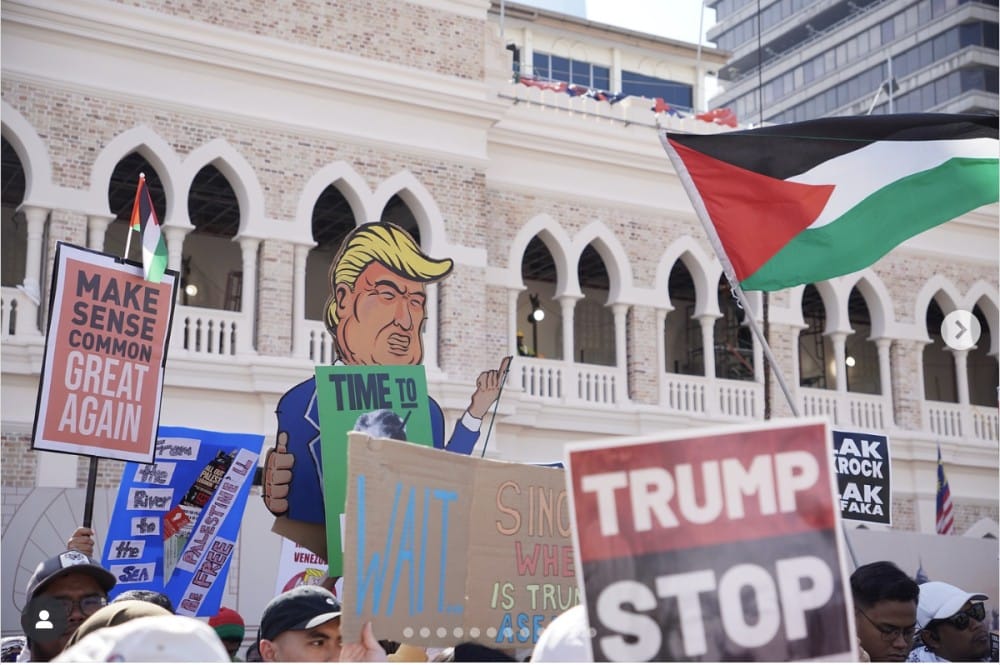
For the average Malaysian, geopolitical skirmishes in the Middle East have long felt like distant, abstract evening news segments. But under the heavy-handed, aggressive foreign policy of US President Donald Trump, that distance has completely evaporated. The geopolitical friction points are no longer contained to the desert sand or the Persian Gulf; they are washing up directly on Southeast Asian shores.
When Trump unilaterally reactivated his intense "maximum pressure" campaign and dramatically escalated hostilities, the shockwaves directly penetrated the highly sensitive maritime choke points of the Malacca Strait and the South China Sea. The global community is now forced to grapple with a stark and dangerous reality: a reckless pursuit of regime change in Tehran is pushing the global economy toward a highly precarious tipping point, and mid-level trading nations are being left to absorb the collateral damage.
The Anatomy of a Manufactured Crisis
To comprehend the full scale of the danger, one must look at how rapidly decades of delicate diplomatic maneuvering have been dismantled. The baseline for regional stability was shattered when the Trump administration abandoned years of structured international consensus and pivoted toward an overt, hardline strategy of regime change. This radical shift culminated in devastating joint US-Israeli military strikes against Iranian targets, throwing the international order into sudden disarray.
This aggressive approach represents a total abandonment of conventional, multilateral diplomacy. It is a high-stakes gamble driven by an institutional assumption that raw economic shock and overwhelming military superiority can force an adversarial state into unconditional submission. From an analytical perspective, however, this heavy-handed strategy ignores the deep, resilient complexities of Iranian internal politics. Rather than empowering moderate reformists or domestic pragmatists who might favor constructive international dialogue, this overt aggression has deeply vindicated Tehran’s staunchest hardliners. It effectively proves their long-held narrative that Western diplomatic promises are fundamentally untrustworthy, creating a highly volatile cycle where pressure is met with dangerous, unpredictable counter-pressure.
Economic Bullying and the Sovereign Squeeze
The fallout of this confrontational policy is engineered to ripple outward, deliberately targeting any nation that refuses to fall in line with Washington's unilateral dictates. By signing an aggressive Executive Order establishing sweeping tariffs on foreign countries that acquire goods or services from Iran, the White House has effectively weaponized the global financial system. The message to middle powers and independent sovereign nations is clear and uncompromising: abandon your independent trading relationships, or face severe, unilateral punitive trade measures.
For Malaysia, this represents a highly delicate diplomatic and economic tightrope walk. Total bilateral trade between Malaysia and Iran grew to a substantial RM2.6 billion, driven primarily by key Malaysian agricultural exports like palm oil and essential energy product imports. While prominent local financial analysts point out that this direct exposure is relatively modest within Malaysia’s massive global trade portfolio, the broader threat lies in Trump's threat of blanket 25 percent secondary tariffs. If enforced broadly across all exports entering the vital US market, it could severely disrupt competitive local manufacturing and agricultural sectors, caught entirely in the crossfire of a conflict not of their own making.
The Shadow Fleet and Our Maritime Backyard
The institutional strain on Southeast Asian nations is most visible across our immediate maritime borders. Because Washington has attempted to forcefully reduce Iranian oil exports to zero, a complex subterranean network has rapidly scaled up to bypass the blockade. International shipping watchdogs have identified the waters off southern Johor as an active global hub for ship-to-ship transfers of black-market oil, where aging tankers frequently operate with disabled transponders and obscured registrations.
This creates a profound structural crisis for local enforcement agencies. The Malaysian Maritime Enforcement Agency (MMEA) has consistently clarified that many of these clandestine operations occur in remote, international waters just outside territorial boundaries, exploiting complex jurisdictional gaps. Yet, the presence of these poorly maintained, un-insured vessels poses a severe, immediate environmental threat to our local marine ecosystems. A single major collision or structural failure in these crowded waters could trigger an ecological and economic disaster, devastating local fishing communities and coastal tourism sectors. This is the direct domestic cost of an aggressive foreign policy: an un-asked-for environmental hazard anchored right on Malaysia's doorstep.
A Fractured International Order
What makes this current trajectory so alarming is the deep institutional fracture it has caused across the global landscape. Rather than building a broad, durable international coalition, the current US approach has alienating traditional, key Western allies while driving global superpowers into deeply entrenched, adversarial camps.
- The European Dissensus: Major European powers have expressed profound discomfort with this unilateral strategy. Leaders like British Prime Minister Keir Starmer have publicly broken ranks, openly asserting that his government does not believe in regime change from the skies, highlighting a deep transatlantic rift over the legality and efficacy of these strikes.
- The Counter-Coalition: Predictably, this hyper-aggressive stance has hardened the resolve of major global rivals. Moscow has strongly condemned the strikes, with Russian Foreign Minister Sergey Lavrov warning that interventionist narratives are driven by narrow geopolitical and energy interests, threatening to escalate regional instability into a much wider, multi-theater proxy conflict.
- The Beijing Conduit: Most critically, the economic warfare is heading toward a direct, dangerous collision with Beijing. Because China remains the primary financial lifeline for Tehran purchasing roughly 90 percent of Iran’s total oil exports any aggressive US attempt to completely sever these financial networks via extreme measures could inadvertently spark a catastrophic trade war between the world's two largest economic superpowers.
Standing Firm for Sovereign Independence
In the face of this immense global pressure, Malaysia’s long-standing foreign policy of positive neutrality and non-alignment is undergoing its most severe test in modern history. The nation has consistently maintained a principled stance, firmly informing visiting Western diplomatic delegations that it will not abide by unilateral sanctions that lack the legitimate mandate of a United Nations framework.
This is not a matter of taking sides in a distant Middle Eastern rivalry; it is a fundamental, non-negotiable defense of national sovereignty and international law. Mid-sized developing nations cannot allow the dangerous precedent to stand where a single global superpower can unilaterally redraw trade boundaries and dictate the terms of global commerce through sheer economic coercion. Malaysia’s continued insistence on multilateralism, diplomatic dialogue, and respect for established international frameworks represents a vital, rational alternative to the destructive unilateralism currently radiating from Washington.
The Urgent Need for Global Restraint
The current trajectory is unsustainable, highly dangerous, and entirely unnecessary. The international community must collectively step forward to find an immediate diplomatic off-ramp before the localized conflict escalates into an irreversible global conflagration. True global leadership is not measured by the ability to launch devastating military strikes or to cripple foreign economies through aggressive, unilateral decrees. It is demonstrated through the patient, disciplined construction of stable, predictable international frameworks that preserve peace and facilitate equitable global trade.
The dangerous maximum pressure campaign must be halted. The world cannot afford to stand by as a passive spectator while reckless, short-sighted political gambits jeopardize the fragile stability of the global economy and threaten the security of distant nations. It is time for a concerted, multilateral push for diplomatic restraint, putting an end to a volatile cycle of aggression before the collateral damage reaches our own shores.
What do you think? I’d love to hear your opinion in the comments section.
Geopolitics can often feel like a distant, abstract board game played by powerful figures in far-off capital cities, completely detached from the daily realities of regular citizens. But as we watch the shadow fleet gather along our southern coastline, we are reminded that in our deeply interconnected modern world, no nation is an island. The choices made in the halls of Washington have a direct, undeniable impact on the security of our waters, the stability of our local economy, and the future economic well-being of every Malaysian household. We find ourselves living in an era where international law is increasingly disregarded in favor of raw power projection, forcing us to consider what kind of global order we want to leave behind for the generations to follow. Will it be an order defined by rules, dialogue, and mutual respect, or one ruled entirely by coercion and instability?
AM World (tameer.work88@gmail.com) is a content creator under the Newswav Creator programme, where you get to express yourself, be a citizen journalist, and at the same time monetize your content & reach millions of users on Newswav. Log in to creator.newswav.com and become a Newswav Creator now!
The User Content (as defined on Newswav Terms of Use) above including the views expressed and media (pictures, videos, citations etc) were submitted & posted by the author. Newswav is solely an aggregation platform that hosts the User Content. If you have any questions about the content, copyright or other issues of the work, please contact creator@newswav.com.