.jpg)
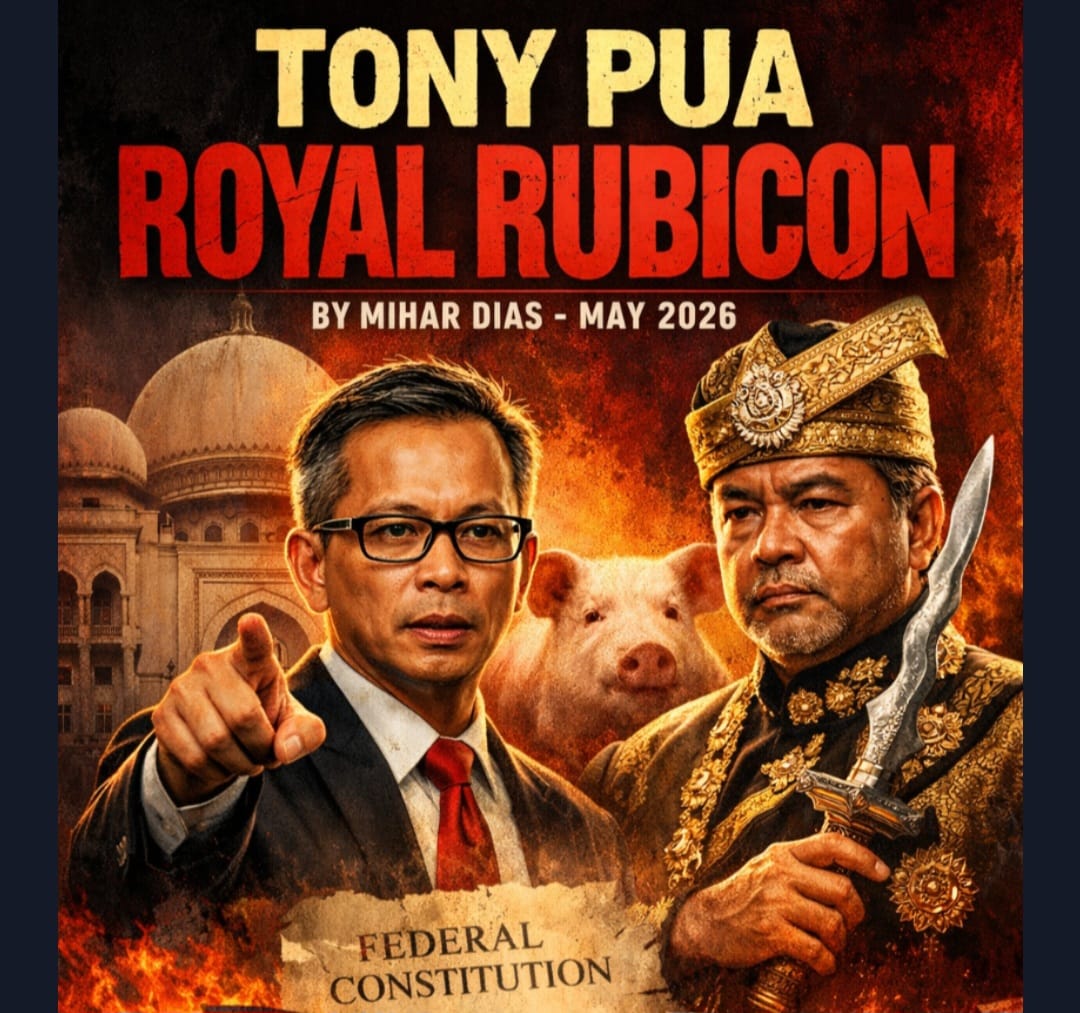
By Mihar Dias May 2026
In Malaysian politics, there are many dangerous hobbies. Questioning subsidy cuts is survivable. Mocking coalition mathematics is practically a national pastime. But wandering into the intersection between constitutional law and royal sentiment armed only with a Facebook post? That is like bringing a satay stick to a keris duel.
Tony Pua now finds himself standing in the middle of precisely that storm — a storm made more combustible because it involves three Malaysian ingredients that rarely mix peacefully: race, royalty, and pigs. https://www.malaysianow.com/news/2026/05/19/daps-policy-man-sparks-backlash-over-remarks-on-royal-decrees-amid-sultans-rukun-negara-reminder
What began as a debate over pig farming in Selangor has mutated into something far larger: a national argument over the meaning of constitutional monarchy itself. And in Malaysia, once the word “constitutional” appears in political debate, everyone suddenly becomes an armchair lawyer while simultaneously insisting emotions should not be involved. https://m.malaysiakini.com/letters/775616
The irony is delicious.
Pua’s argument, stripped of all outrage and Facebook warfare, is not exactly revolutionary in academic circles. https://www.malaysianow.com/news/2026/05/19/daps-policy-man-sparks-backlash-over-remarks-on-royal-decrees-amid-sultans-rukun-negara-reminder
Malaysia is a constitutional monarchy. The powers of Malay rulers are indeed defined and limited by the Federal Constitution. Parliament and state assemblies legislate. Courts interpret. Governments administer. That is the architecture. https://m.malaysiakini.com/letters/775616
But politics is not an undergraduate constitutional law tutorial.
The problem is not necessarily whether Pua is technically correct. The problem is timing, tone, and terrain.
Hours after the Sultan of Selangor publicly reminded politicians about loyalty to the monarchy and the Rukun Negara, Pua chose to emphasise that royal decrees are not supreme law. https://www.malaysianow.com/news/2026/05/19/daps-policy-man-sparks-backlash-over-remarks-on-royal-decrees-amid-sultans-rukun-negara-reminder
Legally nuanced? Perhaps. Politically suicidal? Quite possibly.
Malaysia’s monarchy does not operate merely through black-letter law. It operates through symbolism, cultural legitimacy, historical continuity, and moral authority. The rulers are not just constitutional fixtures; they are emotional institutions. And emotional institutions do not respond kindly to semantic precision delivered with lawyerly bluntness.
Especially not in a climate already charged by debates over race, religion, and agriculture involving pigs — an animal that somehow manages to become politically radioactive every few years.
The bigger issue here is the increasingly awkward relationship between elected politicians and royal institutions in modern Malaysia.
Politicians want democratic legitimacy.
Royal houses increasingly exercise moral legitimacy.
And sometimes both speak as though they possess final authority.
That tension has always existed quietly beneath the surface. But recent years have amplified it. During the Sheraton Move, the post-GE15 coalition crisis, and multiple hung parliament episodes, Malaysians saw rulers playing active stabilising roles. Many citizens welcomed it because politicians themselves looked incapable of governing without creating Netflix-level plot twists every six months.
Ironically, politicians who now insist on strict constitutional boundaries were quite happy when palace interventions produced outcomes favourable to political stability — or favourable to their side.
As several critics online sarcastically noted, constitutional flexibility suddenly becomes very elastic depending on who benefits.
This is where the public mood becomes dangerous for Pua and, by extension, Democratic Action Party.
DAP has spent decades trying to soften perceptions among Malay voters that it is anti-monarchy or dismissive of Malay institutions. Leaders like Anthony Loke have carefully cultivated a more moderate, institutional image. Then suddenly comes a controversy that revives old suspicions faster than a recycled UMNO ceramah clip on TikTok.
And Malaysian politics has a remarkable ability to turn constitutional debates into emotional loyalty tests.
The opposition, particularly Perikatan Nasional, could not have asked for a better issue. https://www.malaysianow.com/news/2026/05/19/daps-policy-man-sparks-backlash-over-remarks-on-royal-decrees-amid-sultans-rukun-negara-reminder
It combines monarchy, Malay sentiment, and DAP in one combustible package — essentially the political equivalent of discovering free campaign material falling from the sky.
Yet there is also an uncomfortable truth many are avoiding.
If royal decrees carry enormous moral authority but are not legally binding legislation, where exactly is the line? How should elected representatives respond when royal wishes conflict with economic interests, legal rights, or policy alternatives? Can disagreement exist without being framed as disloyalty?
Those are legitimate constitutional questions. Mature democracies debate such tensions openly.
Malaysia, however, often debates them emotionally first and constitutionally later.
So is Tony Pua in deep trouble?
Politically, yes. Because in Malaysia, perception often outruns precision. A constitutional argument can quickly become interpreted as a cultural insult. And once that happens, social media transforms into a digital kopitiam where everyone suddenly speaks on behalf of “the rakyat.”
Legally, probably not.
But politically, this episode may become another reminder that in Malaysia’s constitutional monarchy, the written constitution is only half the story.
The other half is understanding when not to sound like you are giving a constitutional lecture while the palace drums are beating outside.
Mihar Dias (mihardias@gmail.com) is a content creator under the Newswav Creator programme, where you get to express yourself, be a citizen journalist, and at the same time monetize your content & reach millions of users on Newswav. Log in to creator.newswav.com and become a Newswav Creator now!
The User Content (as defined on Newswav Terms of Use) above including the views expressed and media (pictures, videos, citations etc) were submitted & posted by the author. Newswav is solely an aggregation platform that hosts the User Content. If you have any questions about the content, copyright or other issues of the work, please contact creator@newswav.com.