
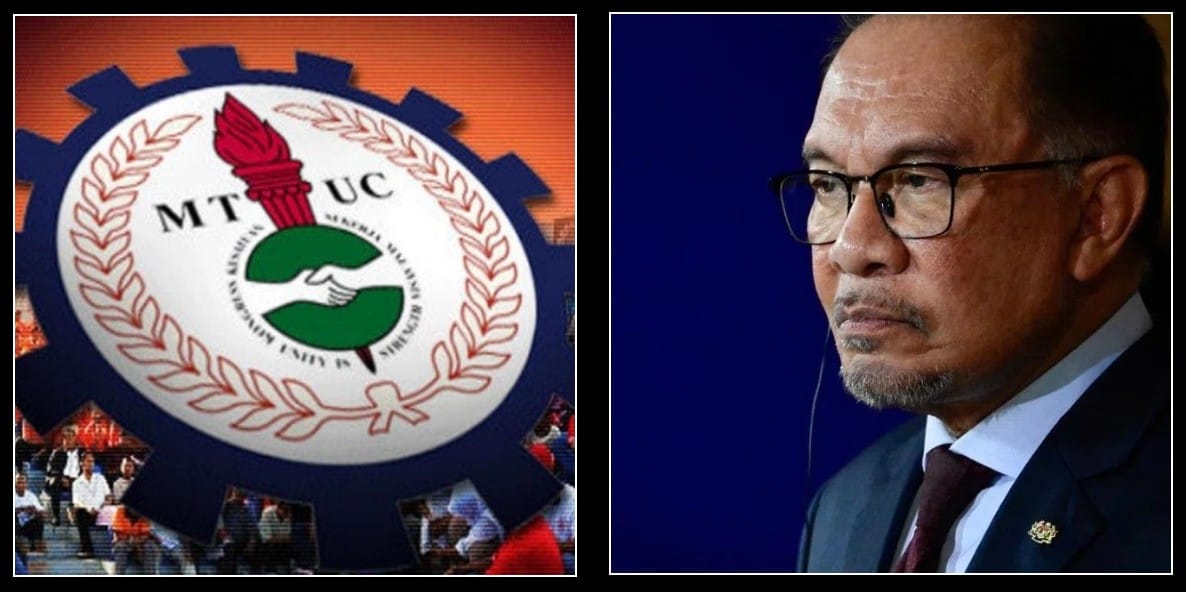
The last time Anwar truly looked like a winner was last November.
Just a month earlier, on 30 September, he had finally lowered the price of RON95 to RM1.99, just as he had promised.
By late October, he had also hosted a highly successful ASEAN Summit, where the eyes of the world were on Malaysia for all the right reasons.
Even Trump came to visit Malaysia, and for a few days, Anwar even looked almost like Trump’s equal.
Anwar also managed to help seal a peace deal between Cambodia and Thailand then, and for a while, there was even buzz about him potentially receiving a Nobel Prize for the achievement.
Since then, however, it has all been downhill for him.
Things have gotten so bad that when I think of Anwar today, I cannot help but think of a loser.
And as Anwar himself probably knows, politics is a game of winners. Losers in politics have a status worse than lepers.
As a rule, people follow winners, root for fighters, but avoid losers like the plague.
According to Bloomberg, the next election is likely to be called this October.
October is only five months away.
If Anwar calls an election in October, and if he continues to look like a loser, I have no doubt that will certainly lose.
So what can Anwar do to turn things around and shine like a winner in the eyes of the rakyat, the way he did last November?
Back then, he looked like a winner because he was winning for Malaysia internationally. But given the condition of the world today, it is difficult to see how Anwar can continue winning for Malaysia on the international stage.
From FIFA fining our football association for cheating, to our flotilla being intercepted by the Israelis, to our ships being detained in the Strait of Hormuz, Malaysia under Anwar's watch in recent days looks more like a loser than a winner internationally.
It is also difficult to see how Anwar can win domestically when political competition in Malaysia continues to be framed along racial lines.
When the contest is between Malays and non-Malays, if Anwar tries to win for the Malays, he risks losing the non-Malays. If he tries to win for the non-Malays, he risks losing the Malays.
Under such conditions, the best he can do is try not to lose either side. But not losing the Malays or the non-Malays is not the same thing as winning them.
If Anwar’s strategy is merely to avoid losing support, while another politician or party actively tries to champion one side, then people will naturally gravitate toward those who are fighting for them. And that, in turn, will eventually cause Anwar to lose as well.
To win domestically, perhaps what Anwar needs to do is change the frame of the contest — from race to class.
As long as Malaysian politics remains framed primarily around race, Anwar can never win.
But if he manages to shift the political contest toward one between the working class and the leisure class, then perhaps he may once again find a pathway to become a winner.
As we all know, trade unions — the institutions that represent the working class — have long been castrated and rendered impotent in Malaysia.
It is because our trade unions are so weak that millions of foreign workers have flooded into the country over the decades.
It is also likely because our trade unions are so weak that Khazanah Research recently drew significant attention by pointing out that only 30% of corporate profits in Malaysia go to workers.
The remaining 70% stays in the hands of business owners.
In comparison, workers in the United Kingdom receive around 49.8%, while workers in Germany receive around 54.7%.
If you further divide workers into the managerial and supervisory class on one hand, and the bona fide working class on the other — and if you consider that many Malaysian businesses are labour-intensive, meaning the ratio of the working-class to the managers is likely larger than in the UK or Germany — then the actual share received by ordinary workers may be even smaller than the figures suggest.
None of this would have happened if Malaysia’s trade unions were stronger and more vigorous.
And the fact that even the Malaysian Trades Union Congress (MTUC) — the country’s oldest and largest national trade union centre, representing hundreds of affiliated unions and roughly 500,000 members — was temporarily dissolved on May 7, 2026, is yet another indication of the dire state of our working-class institutions.
I think it goes without saying that our trade unions — the institutions of the working class — are in desperate need of a champion today.
At the same time, Anwar himself is today in desperate need to look like a champion as well.
I am not entirely sure how Anwar and the trade unions could cooperate in a mutually beneficial way, but I do believe such a synergy exists.
If realised, I think that a cooperation between Anwar and the working-class institutions could become a win-win arrangement for both sides.
Whatever the case, I believe reframing Malaysia’s political contest from one centered on race to one centered on class may be the only realistic pathway for Anwar to reinvent himself as a winner.
And considering that an election may be called soon, the sooner Anwar attempts such a reframing, the better it may be for him.
TheRealNehruism (nehru.sathiamoorthy@gmail.com) is a content creator under the Newswav Creator programme, where you get to express yourself, be a citizen journalist, and at the same time monetize your content & reach millions of users on Newswav. Log in to creator.newswav.com and become a Newswav Creator now!
The User Content (as defined on Newswav Terms of Use) above including the views expressed and media (pictures, videos, citations etc) were submitted & posted by the author. Newswav is solely an aggregation platform that hosts the User Content. If you have any questions about the content, copyright or other issues of the work, please contact creator@newswav.com.