
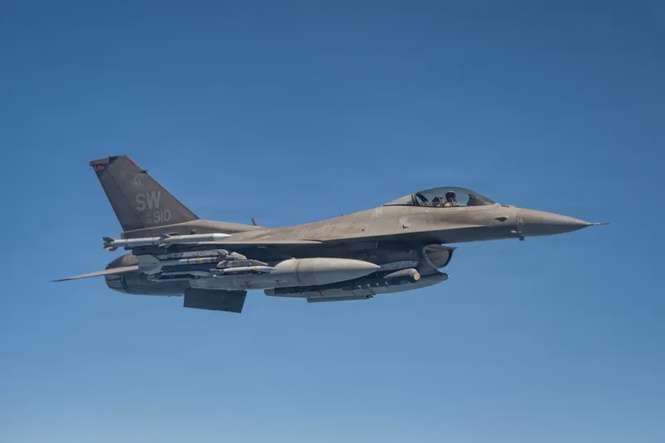
Two F-16V Block 70 fighters bound for Taiwan taxied toward the runway at Joint Base Pearl Harbor-Hickam in Hawaii on September 7, then turned back to the ramp without taking off. The jets, tail numbers 6727 and 6728, have been on the ground in Hawaii since August 21.
They left the continental United States on August 17 to begin the trans-Pacific ferry flight home, and reached Hawaii four days later with support from a U.S. Air Force KC-135 tanker. Under the pattern Taiwan has followed on previous F-16 deliveries, the next stop should have been Guam, and then Taiwan. Asked when the aircraft would move, Taiwan's air force offered a single sentence: "We are also waiting."
That answer deserves more attention than it got. The question worth asking is not which day 6727 and 6728 will finally land in Taiwan. It is what an advanced fighter, bought with a substantial share of Taiwan's defense budget, is still waiting for after it has already crossed half the Pacific.
Nothing in the public record supports a claim that Washington is deliberately holding the aircraft, and no evidence ties the delay to any particular political decision. The variables identified in reporting and by military analysts are mundane: weather at altitude, the sequencing of the ferry mission, the availability of U.S. tankers, and the routing from Hawaii through Guam to Taiwan. There is no need to reach for a conspiracy. There is every reason to treat the two jets as a lesson in what modern defense actually consists of.
A Ferry Flight Is A Full Mission Package
The F-16 has powerful engines and carries its own fuel, so the obvious question is why it needs to wait anywhere at all. The answer is that crossing the Pacific has never been a question of whether an aircraft can fly.
When Taiwan took delivery of its first F-16A/B fighters in 1997, the ferry route was broken into legs running from the continental United States to Hawaii, then Guam, then Taiwan. Records from that delivery show the Hawaii to Guam leg alone took about eight hours and 20 minutes, with roughly four hours and 40 minutes from Guam to Taiwan. Flights of that length depend entirely on aerial refueling and on staging bases able to receive and service the aircraft.
The Block 70 jets now arriving carry conformal fuel tanks, which changes the range arithmetic. It does not change the underlying fact that a trans-Pacific ferry is a complete mission package rather than a long flight.
Getting one F-16 home requires tankers matched precisely to the route, landing and servicing rights at each staging base, weather windows that meet flight safety standards, route planning with search and rescue contingencies, and the ground crews and Foreign Military Sales procedures that govern formal handover. If any one of those elements moves, the aircraft waits.
What 6727 and 6728 have made visible is a truth that rarely surfaces in peacetime. Buying a weapon is not the end of the process. Keeping it able to generate combat power is where the work begins.
AIDC Now Repairs More Than 300 F-16 Components
That dependence raises an obvious worry. If a Taiwanese F-16 needs deep maintenance or a difficult component, must it fly back to the United States?
Largely, no. Taiwan did not stop at taking delivery. Aerospace Industrial Development Corporation, the state-linked aerospace manufacturer known as AIDC, has published details of what it can now do domestically: airframe repair, inspection and overhaul of system components, and large-scale structural modification and performance upgrades, including the F-16V retrofit program. With the establishment of a dedicated F-16 maintenance center, AIDC has drawn domestic suppliers into the work and built local repair capability for more than 300 components, while continuing to press the original manufacturer for further technology transfer and certification.
The limits are just as clear. Routine maintenance and most system faults are now handled in Taiwan. Items involving high-end core software, highly classified electronic test equipment, and the original supply chain still depend on the manufacturer's technical support. That gap is where defense autonomy is genuinely difficult, and pretending otherwise helps no one.
The point most often missed is that sustainment is not an accessory to procurement. It is the substance of combat power. A fighter's capability is not fixed at the factory gate. It is established every time the aircraft is correctly maintained before flight, every time a fault is diagnosed accurately, every time a software build is updated, every time a part arrives when it is needed. Break that chain and the most advanced F-16V is metal parked on a ramp.
Autonomy Means Solving Problems, Not Building Everything
Debate about defense autonomy in Taiwan often collapses into a single misleading test: whether a weapon was manufactured here. In a globalized defense industry that test fails immediately. Taiwan does not need to rebuild the wheel. The United States holds the advanced technology, Lockheed Martin holds the systems integration capability, and the U.S. military operates a refueling and logistics network that spans the globe.
The useful questions are narrower and harder. When a fighter's hardware or software fails, can Taiwanese engineers diagnose it immediately? When a critical component supply is interrupted, can Taiwan's industrial base substitute or repair it quickly? When an airframe needs life extension, is there enough structural engineering capacity at home? And in the extreme case, if overseas support slows under wartime conditions, can Taiwan keep its own aircraft flying?
Measured that way, autonomy is not about the label on the aircraft. It is about whether Taiwan can solve its own problems when the system breaks.
Building that capacity does not mean pushing allies away. The opposite is true. A Taiwan that can maintain and upgrade its own fleet becomes a more capable partner, not a more distant one, and a node in the Indo-Pacific logistics network that is reliable, interoperable, and sustainable rather than a customer that only places orders. That argument carries further than any slogan about self-reliance.
Waiting Is Not A Capability
Some will say that if the weather or the schedule is not right, then waiting is simply correct. That is true. Aircraft and aircrew are not things to gamble with. If meteorological conditions fall short of safety standards, or if a tanker is not in position, waiting is the professional and responsible military decision. Bravado is the last thing a ferry mission needs.
But waiting is not itself a capability. The capability is knowing exactly what you are waiting for, and then making the wait shorter next time. That is the real examination 6727 and 6728 have set.
Today the wait is for a fighter. Tomorrow it may be a new class of drone, a ground-based missile system, a radar, or an AI-enabled joint command system. As weapons grow more complex, what decides outcomes shifts away from how many platforms were purchased and toward software maintenance, data integration, engineering talent, and the resilience of the local supply chain. That is what systems-level defense means.
Four Changes Taiwan Should Write Into Policy
First, treat sustainment funding as an investment in combat power rather than the tail end of a purchase. A defense budget should be read not only for how many platforms it buys but for life-cycle cost, maintenance capacity, spares inventory, and test equipment.
Second, build wartime logistics resilience: dispersed maintenance, mobile maintenance shelters, pre-positioned critical spares, domestic manufacture of non-critical parts, software version control, and data link continuity. None of it is glamorous. All of it decides whether aircraft can be regenerated under fire.
Third, keep the people. Aerospace engineers, software engineers, quality assurance and airworthiness certification staff, and engine and electronic warfare test specialists are the actual backbone of defense autonomy. Without them, a maintenance center is a building.
Fourth, integrate AIDC, the National Chung-Shan Institute of Science and Technology, and the private supply chain, and use industrial cooperation, technology transfer, and international certification to move Taiwan from receiving maintenance to performing it jointly, and eventually to operating as a regional maintenance hub.
What 66 Fighters Will Demand From Taiwan
Taiwan cannot control the weather over the Pacific. It cannot require allies to work to its calendar. And it cannot assume it already holds every capability it needs.
What Taiwan can do is build a sturdier ship: keep maintenance expertise at home, develop the component supply chain, retain skilled aerospace and software engineers, and forge a peacetime sustainment system into a wartime resilience system. Then, when the wind comes, there is something ready to catch it.
6727 and 6728 are still in Hawaii, and everyone here is waiting for the day they land safely. But the more useful question arrives with the rest of the fleet. When all 66 F-16V Block 70 fighters are in Taiwan, will the island's logistics and industry be ready for them?
Those 66 aircraft are a serious addition to the defense of the Taiwan Strait. They are also the next examination paper for Taiwan's aerospace industry and for its defense autonomy.
Real autonomy does not mean no longer needing friends. It means learning to solve problems with your own hands while your friends are still there to help.
So 6727 and 6728 should take their time. Safety first. What must be waited for can be waited for. But Taiwan itself cannot only wait, because a ship at sea meets the wind only after it has raised its own sail.
*The author works at Aerospace Industrial Development Corporation (AIDC).
Social Media Links & Editor Tag - Penny