
For decades, the issue of recognising the Unified Examination Certificate (UEC) has remained one of Malaysia’s most politically sensitive education debates.
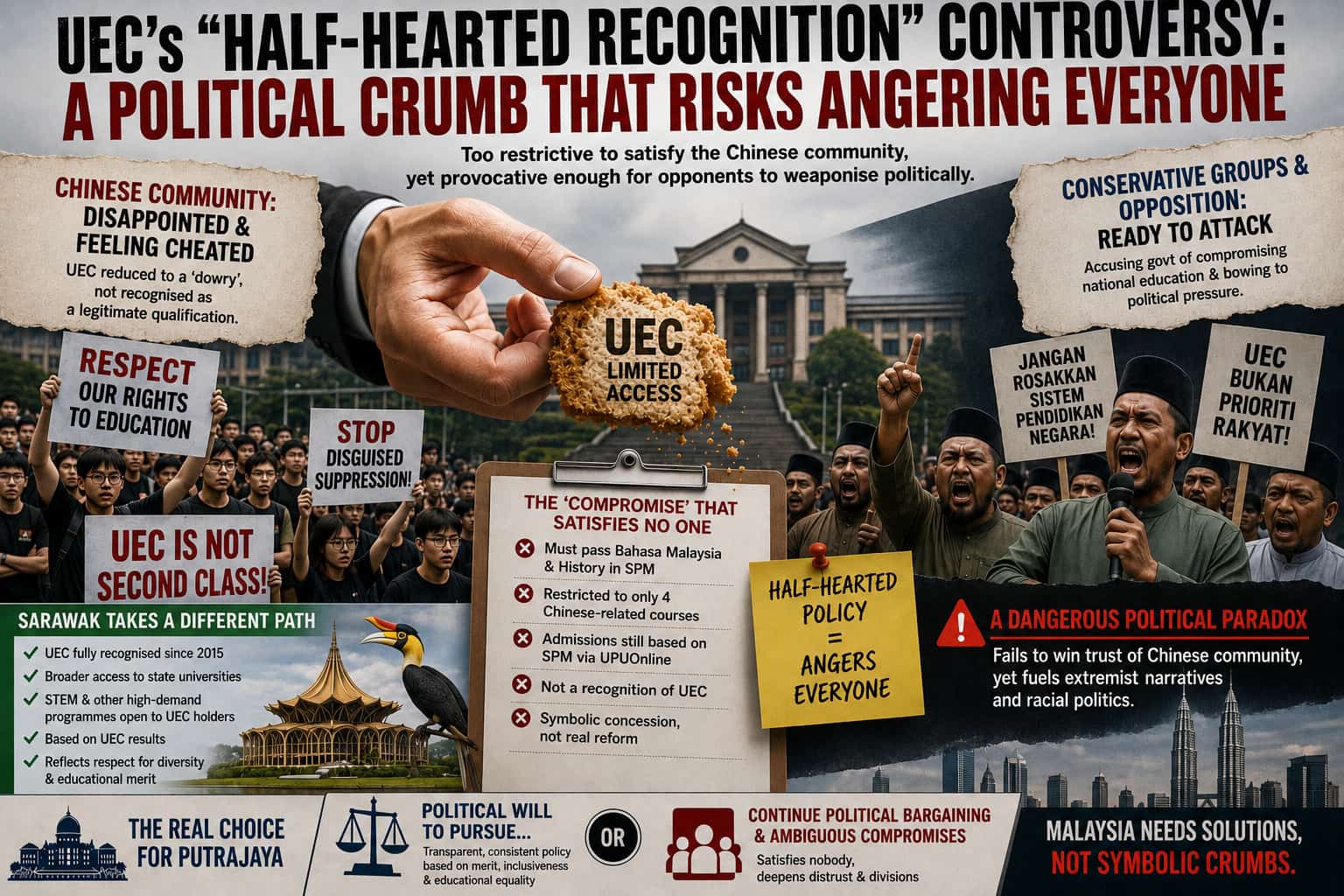
Now, the federal government’s latest “compromise” on allowing limited entry for UEC holders into public universities risks becoming the worst of both worlds - too restrictive to satisfy the Chinese community, yet provocative enough for conservative Malay groups and opposition forces to weaponise politically.
The recent announcement by Higher Education director-general Datuk Prof Dr Azlinda Azman that UEC holders may apply to public universities under strict conditions was initially presented as a progressive step forward. However, the reaction from the Sarawak Chinese school board revealed deep dissatisfaction beneath the surface.
Rather than being viewed as genuine recognition, the policy has been criticised as a symbolic concession designed more for political optics than meaningful reform. UEC holders are still required to pass Bahasa Malaysia and History in SPM, and applications are confined to only four Chinese-related courses. More importantly, admissions remain heavily dependent on SPM performance through the UPUOnline system.
This effectively reduces the UEC into a secondary or decorative qualification instead of treating it as a legitimate academic pathway in its own right.
The Sarawak Chinese school board did not hold back in its criticism, perceiving the policy as a form of “disguised suppression” and “deliberate belittling” of the UEC. Their frustration reflects a broader sentiment among many Chinese education groups who believe the issue has been repeatedly recycled by successive governments whenever political pressure arises, only to end with half-measures lacking institutional courage.
The irony is that the federal government’s cautious approach may ultimately create political backlash from all sides.
Among Chinese voters and education advocates, the policy risks being seen as humiliating and insincere. After decades of promises and negotiations, many expected a more comprehensive framework acknowledging the UEC’s international recognition and the proven academic performance of Chinese independent school graduates across fields such as engineering, science, business and medicine.
Instead, restricting UEC holders mainly to Chinese-related programmes sends a message that the government still narrowly perceives Chinese independent schools as language institutions rather than comprehensive education systems producing highly capable graduates.
At the same time, conservative Malay groups and opposition politicians are unlikely to remain silent. Even limited concessions on UEC issues have historically triggered accusations that the government is compromising the national education system or bowing to political pressure from Chinese-based parties.
This creates a dangerous political paradox.
A half-hearted policy as consolation crumb not only fails to win the confidence of the Chinese community, but simultaneously provides ammunition for extremist narratives and racial politics. In trying to avoid upsetting one side completely, the government may instead end up angering everyone.
The comparison with Sarawak further intensifies the debate. Since fully recognising the UEC in 2015, the Sarawak government has allowed UEC holders broader access into state-owned institutions and STEM-related programmes based on UEC qualifications. To many observers, this raises uncomfortable questions about why Putrajaya still appears hesitant despite years of discussion.
The deeper issue extends beyond education alone. The UEC controversy reflects Malaysia’s long-standing struggle in balancing national identity, multiculturalism and meritocracy within policymaking. Politicians across administrations often appear trapped between electoral calculations and genuine reform.
As long as the UEC remains treated as a political bargaining chip rather than a clear policy matter, the controversy will continue resurfacing before elections, coalition negotiations or moments of political weakness.
Ultimately, the federal government now faces a difficult choice: either pursue a transparent and consistent policy grounded in educational merit and national inclusiveness, or continue relying on ambiguous compromises that satisfy nobody while deepening racial and political distrust.
Because in Malaysia’s increasingly polarised political climate, symbolic crumbs are no longer enough.
By: Kpost
Kpost (ckhorsk@gmail.com) is a content creator under the Newswav Creator programme, where you get to express yourself, be a citizen journalist, and at the same time monetize your content & reach millions of users on Newswav. Log in to creator.newswav.com and become a Newswav Creator now!
The User Content (as defined on Newswav Terms of Use) above including the views expressed and media (pictures, videos, citations etc) were submitted & posted by the author. Newswav is solely an aggregation platform that hosts the User Content. If you have any questions about the content, copyright or other issues of the work, please contact creator@newswav.com.