In a nation as diverse as Malaysia, unity is not a luxury - it is a necessity. But can a ministry alone carry the weight of such a complex mission, or has the Ministry of National Unity become more symbolic than effective?
The establishment of Malaysia’s Ministry of National Unity was, on paper, a timely and necessary move. Designed to foster harmony among the country’s multi-ethnic and multi-religious population, it signaled a political commitment to healing long-standing societal divides. Yet, years into its existence, a pressing question lingers: is the ministry truly making a difference, or merely serving as a ceremonial gesture?
Source: YouTube/TheGoodCastShow
Critics argue the latter. Lawyer Andrew Coup has openly questioned the ministry’s capacity to address sensitive issues involving race and religion. His concerns are not just about performance, but about priorities. The stark disparity in funding between the unity ministry and the Department of Islamic Development Malaysia raises eyebrows.
A closer look at recent federal budgets further fuels the criticism that the Ministry of National Unity may be structurally underpowered:
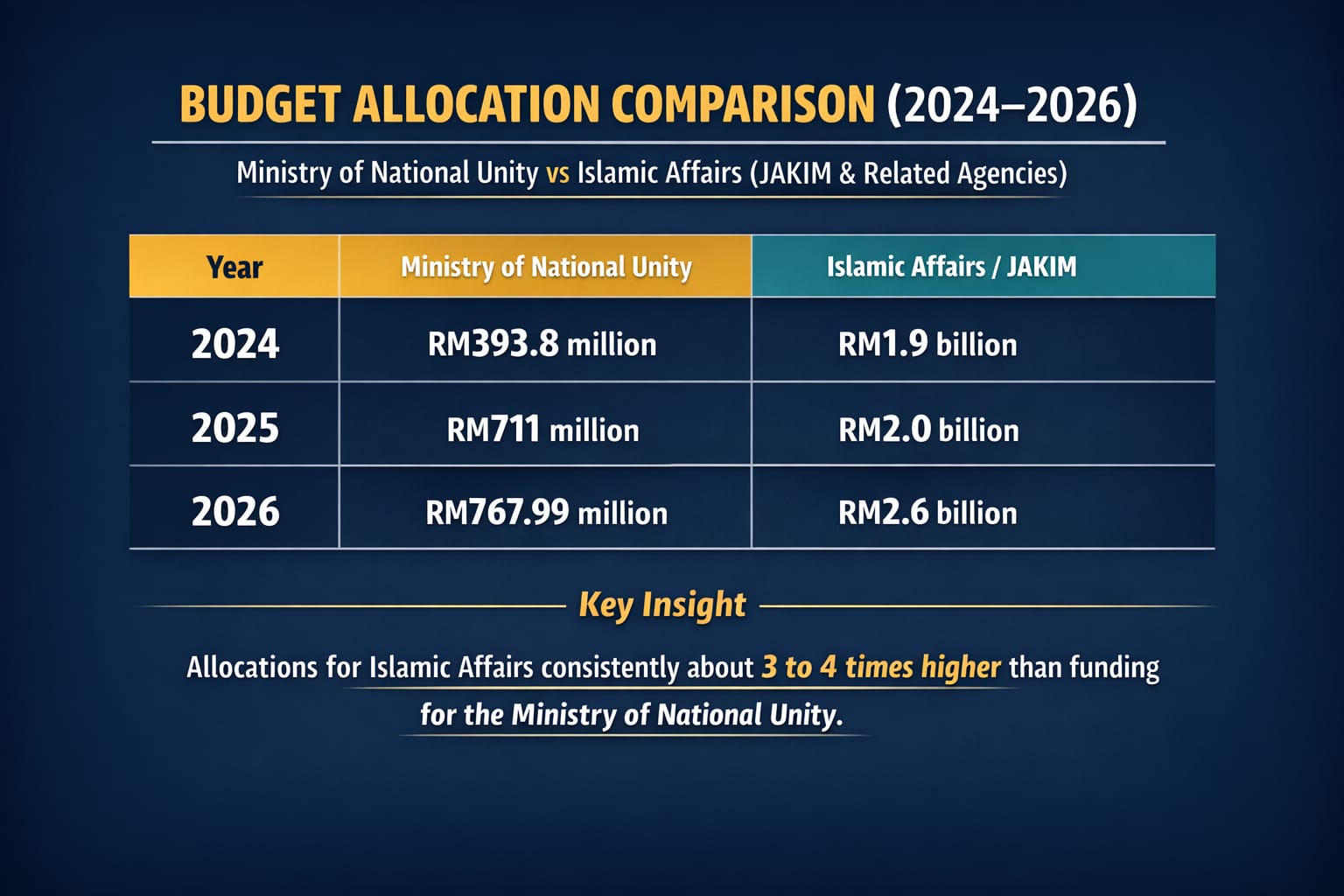
In Budget 2026, the Ministry of National Unity received approximately RM767.99 million according to the Ministry of Finance Malaysia, while funding for Ministry of Islamic affairs - including JAKIM and related agencies - rose sharply to about RM2.6 billion.
This disparity is not new.
In Budget 2025, the unity ministry was allocated around RM711 million, compared to roughly RM2 billion for Islamic affairs.
Similarly, in Budget 2024, Islamic affairs received about RM1.9 billion, while the Ministry of National Unity was allocated approximately RM393.8 million.
This consistent disparity - where unity-focused initiatives receive less than one-third of religious administration funding - raises a fundamental question about national priorities: can Malaysia genuinely address sensitive race and religion issues if the very institution tasked with unity operates with comparatively limited resources?
When an agency like JAKIM receives significantly higher allocations, it inevitably sparks debate about whether the government is placing greater emphasis on religious administration over broader national cohesion.
Activist Siti Kasim has been even more blunt. She labels the Ministry of National Unity as “toothless” and largely ineffective - an institution that exists more for optics than action. According to her, the ministry lacks the authority to intervene meaningfully in racial or religious disputes. Instead, it is often confined to organizing dialogues, officiating events, and promoting campaigns that may raise awareness but fall short of resolving deep-rooted tensions.
Her criticism cuts deeper when she questions the very necessity of the ministry. Would Malaysia be better off reallocating its resources? Siti argues that funds could yield greater long-term unity if invested in education and healthcare - sectors that shape societal values and reduce inequality, which is often a root cause of division.
However, the government offers a different perspective. Former Religious Affairs Minister Mohd Na'im Mokhtar has clarified that the roles of JAKIM and the Ministry of National Unity are fundamentally distinct. JAKIM focuses on Islamic affairs and the well-being of the Muslim community, while the unity ministry’s role is to build bridges across communities. From this standpoint, the disparity in funding is not a matter of imbalance, but of differing mandates.
Still, this explanation does not fully address the core concern: can a ministry tasked with unity succeed without sufficient authority and resources? Unity cannot be legislated through ceremonies alone - it requires structural reforms, equitable policies, and the political will to confront uncomfortable truths.
Ultimately, the debate over the Ministry of National Unity reflects a broader dilemma in Malaysia’s governance. Is unity best achieved through a dedicated institution, or through a holistic approach embedded across all ministries and policies?
The answer may lie somewhere in between. A ministry can serve as a focal point, but without power, funding, and cross-government support, it risks becoming exactly what critics fear: a symbol without substance. In a country where unity is both fragile and vital, Malaysia cannot afford symbolism alone.
By: Kpost
Information Source:
YouTube/TheGoodCastShow , Malaymail , Mof , Nst , SinarDaily , Mof , Scoop
Kpost (ckhorsk@gmail.com) is a content creator under the Newswav Creator programme, where you get to express yourself, be a citizen journalist, and at the same time monetize your content & reach millions of users on Newswav. Log in to creator.newswav.com and become a Newswav Creator now!
The User Content (as defined on Newswav Terms of Use) above including the views expressed and media (pictures, videos, citations etc) were submitted & posted by the author. Newswav is solely an aggregation platform that hosts the User Content. If you have any questions about the content, copyright or other issues of the work, please contact creator@newswav.com.