
Malaysian politics has always mastered one art better than governance: survival.
This week alone, three separate political developments exposed the increasingly fragile balancing act inside the Madani government.
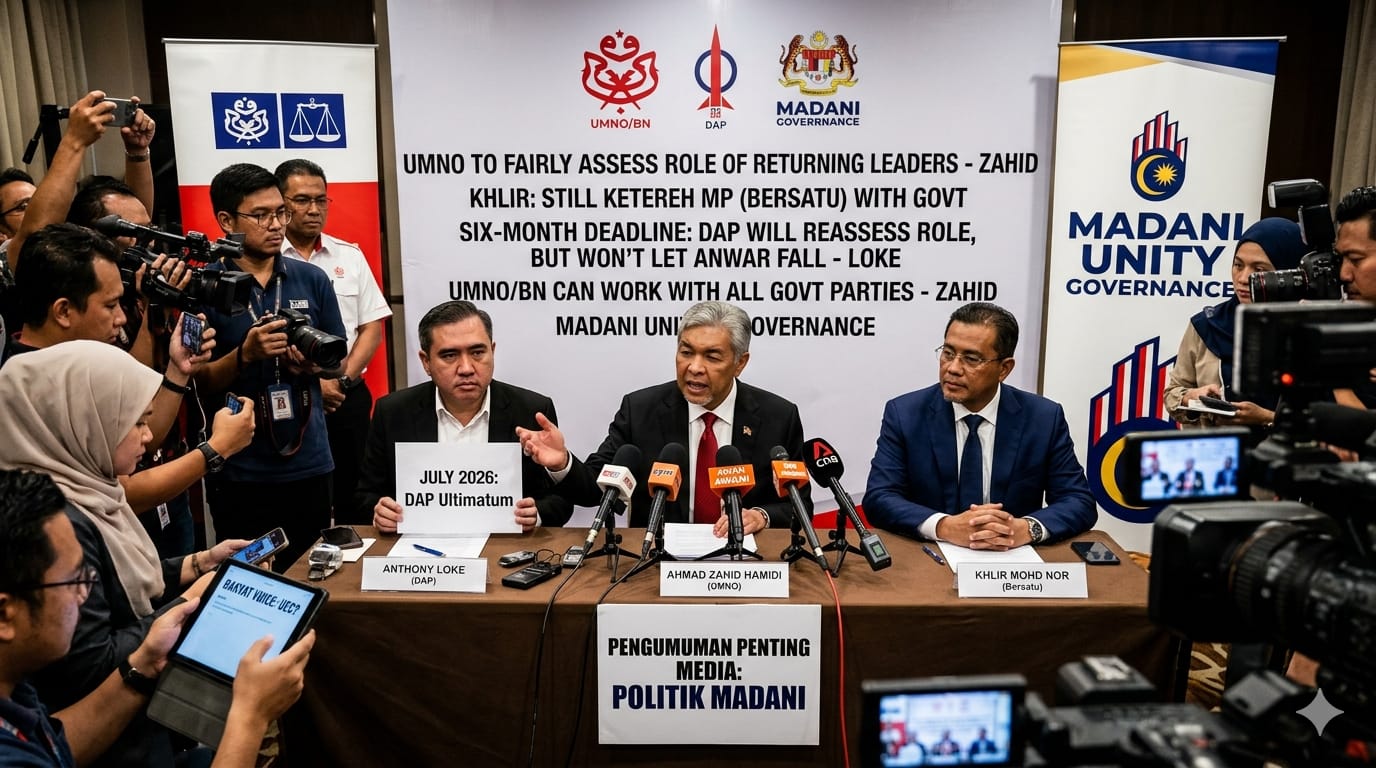
First, UMNO president Ahmad Zahid Hamidi announced that returning leaders would be assessed fairly based on “winnability” and suitability for the party’s future direction. At almost the same time, Zahid also reiterated that UMNO and Barisan Nasional remain open to working with all government parties.
Then came the other side of the coalition equation.
DAP secretary-general Anthony Loke declared that the party would reassess its role in the government if promised reforms were not delivered within six months while simultaneously insisting DAP would not allow Prime Minister Anwar Ibrahim’s government to collapse.
And just like that, the rakyat heard two very different messages wrapped inside the same political sentence:
“We are unhappy.”
“But don’t worry, we are not leaving.”
That contradiction is exactly why public cynicism is growing.
Because to many Malaysians, especially frustrated grassroots voters, this six-month “deadline” sounds less like political pressure and more like performance management.
Or as many ordinary Malaysians now mockingly put it:
“It’s like asking your boss for a raise while promising you won’t quit no matter what.”
The metaphor stings because it captures the public mood perfectly.
For months, the Madani government has sold itself as a coalition built on reform, moderation, and institutional stability. Yet increasingly, voters from all sides see something else emerging beneath the branding: a coalition driven less by reform urgency and more by political dependency.
This is where Zahid’s latest political manoeuvres become important.
UMNO is already preparing for GE16.
The “open door” policy toward returning leaders is not sentimental politics. It is strategic consolidation. After the fragmentation of Malay politics since 2018, UMNO understands that rebuilding grassroots machinery and reabsorbing influential defectors could determine future electoral survival.
The message is simple:
Come back.
The old political house is rebuilding.
But this restructuring inside UMNO creates direct pressure on DAP.
Because while UMNO consolidates Malay support, DAP must now convince its own base that staying inside the Madani coalition still produces meaningful reform outcomes.
And this is where the problem becomes dangerous.
The Chinese electorate, particularly urban middle-ground voters, did not support Pakatan Harapan merely for administrative efficiency or political stability. They supported it because they believed institutional reform, meritocracy, education rights, and governance reforms would finally move forward.
Instead, many now feel trapped inside an endless exercise in “the art of compromise.”
Compromise itself is not the issue.
Every coalition government requires compromise.
But compromise without visible progress slowly starts looking like surrender.
That is why the unresolved issue of UEC recognition has quietly become one of the coalition’s most symbolic political tests.
For many Chinese voters, UEC is no longer merely an education issue.
It has become a litmus test of sincerity.
Can DAP deliver meaningful reform while inside government, or is it merely defending coalition stability at all costs?
The frustration is no longer hidden.
Among grassroots discussions, Anneh coffee shop debates, and social media reactions, the tone has grown harsher. Some accuse DAP of becoming too comfortable inside government. Others openly mock the six-month “deadline” as political theatre because DAP has already publicly promised not to withdraw support.
A threat without consequences is no threat at all.
This is why the coalition now faces a deeper credibility issue.
The public no longer judges political parties merely by speeches or slogans.
They judge outcomes.
And increasingly, many voters feel the government has become stronger in administrative optics than institutional reform.
Take transport minister Anthony Loke himself.
His ministry’s efficiency in summons collection, public transport management, and operational matters has often received praise. These are tangible administrative wins.
But while the government becomes more efficient in collecting summonses, the larger reform agenda appears trapped in slow motion.
Where is the progress on institutional reform?
Where is the movement on SOSMA?
Where is the confidence-building effort on UEC?
Where is the structural courage once promised under the reform narrative?
This growing disconnect explains why the recent Sabah election shockwaves matter so much.
The fear inside both UMNO and DAP is no longer theoretical.
A Sabah-style voter backlash in Peninsular Malaysia is now a genuine concern.
For UMNO, that fear drives consolidation.
For DAP, that fear drives urgency.
And suddenly, after months of quiet accommodation, DAP has rediscovered its political voice.
The timing is not accidental.
Coalitions often remain stable until election fears begin overtaking internal discipline.
Right now, every major party inside the Madani government is quietly recalculating its survival strategy.
UMNO wants to rebuild Malay confidence.
DAP wants to calm grassroots frustration.
PKR wants to preserve coalition continuity.
And Anwar Ibrahim remains trapped between reform rhetoric and coalition arithmetic.
This is the real quicksand beneath the Madani government.
Not open rebellion.
Not dramatic collapse.
But slow erosion of belief.
The rakyat are beginning to suspect that every party inside the coalition now speaks two political languages at once.
One language for public reform.
Another for internal survival.
That contradiction becomes impossible to hide when reform deadlines are announced alongside promises of unconditional loyalty.
And nowhere is this contradiction more obvious than in the current debate surrounding DAP’s six-month ultimatum.
If the coalition truly faces a hard reform deadline, what happens after six months?
Will DAP actually walk away?
Or will another explanation emerge about “stability,” “responsibility,” and “preventing political chaos”?
Because many voters already believe they know the answer.
This is why cynicism has become the defining political emotion of the moment.
Not anger.
Not outrage.
Exhaustion.
The rakyat are tired of snake-oil promises packaged as transformation.
They are tired of slogans replacing outcomes.
They are tired of being told that compromise today will somehow become reform tomorrow.
Even minority communities increasingly ask uncomfortable questions.
Why does every new policy discussion feel disconnected from vernacular education concerns?
Why does Tamil language visibility remain inconsistent in national initiatives?
Why do coalition partners suddenly rediscover principles only when electoral fear appears?
These frustrations may sound small individually.
Together, they create political sediment.
And political sentiment eventually hardens into voter resentment.
The Madani government still has time to change the narrative.
But time alone is not reform.
At some point, coalition partners must decide whether they are serving voters or merely practicing feudal loyalty to preserve power.
Because Malaysian voters are becoming more politically sophisticated.
They no longer ask only whether a government survives.
They ask what the survival is actually for.
And if the answer continues sounding more like political maintenance than national transformation, then the greatest threat to the Madani coalition may not come from the opposition.
It may come from exhausted supporters who quietly stop believing.
Annan Vaithegi writing on power, governance and society
Annan Vaithegi (annanvaithegi@icloud.com) is a content creator under the Newswav Creator programme, where you get to express yourself, be a citizen journalist, and at the same time monetize your content & reach millions of users on Newswav. Log in to creator.newswav.com and become a Newswav Creator now!
The User Content (as defined on Newswav Terms of Use) above including the views expressed and media (pictures, videos, citations etc) were submitted & posted by the author. Newswav is solely an aggregation platform that hosts the User Content. If you have any questions about the content, copyright or other issues of the work, please contact creator@newswav.com.
