-T5N-List-(Twitter)-(1).jpg)

By P Gunasegaram
The temptation to hail the landslide victory for the Mahkota by-elections on Saturday as a solid, unwavering endorsement of the Madani government and Pakatan Harapan’s alliance with Umno Baru will be there and it will be milked to the most.
But the figures show a different picture - the maintenance of a status quo with neither the Madani coalition or the Perikatan Nasional coalition of Bersatu and Pas making any significant headway or losses in the overall equation.
That means, despite his past, which included a stint as menteri besar of Johor, Muhyiddin Yassin’s Bersatu does not even hold much sway in his home state of Johor let alone the rest of the country. And Pas’ grip of the northern states has not shown a similar tightening at all in the south.
With a reduced turnout of Chinese voters, indications are that if they voted in greater numbers, and voted for the Madani coalition which they surely would, the majority would have been larger. That would not change things much though.
Despite the unhappiness with Umno and the duelling between Umno Youth and DAP, it’s hard to believe that pragmatic Chinese voters will abandon the relative safety of the Madani coalition in favour of an extremely uncertain PN coalition which will give greater power to Islamists.
The table below shows voting pattern changes over the last three elections for Mahkota.
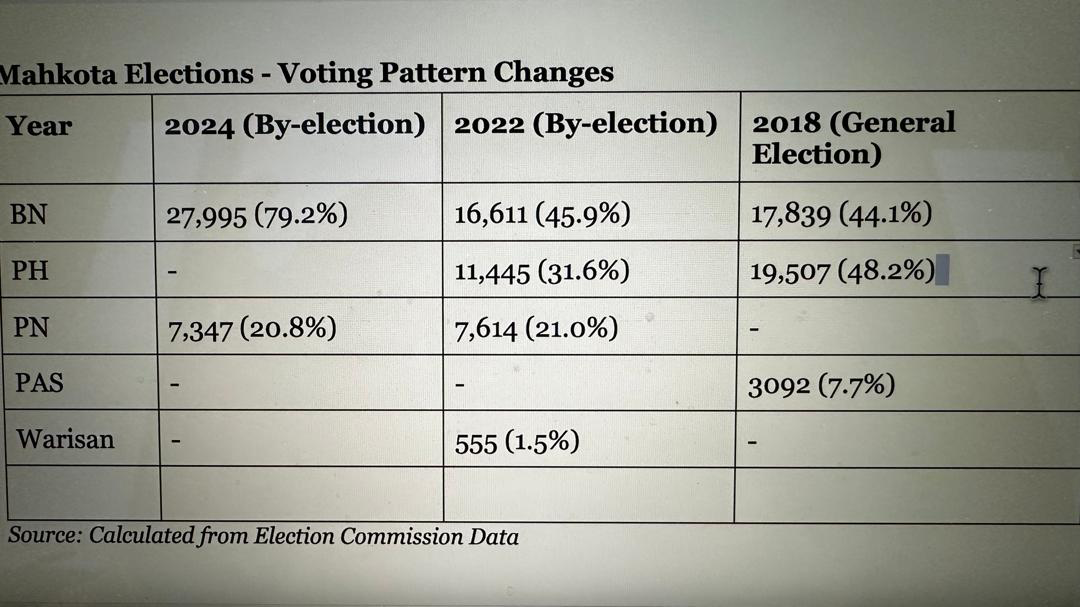
If one expects the voting pattern will follow that of the parties in the coalition, the figures suggest that the Madani coalition would win by a massive majority - and indeed they did.
In 2022, when PH contested against BN, the latter won by a much lower margin, not even obtaining an outright majority. Add up the BN and PH figures of 45.9% and 31.6% of votes respectively, and we obtain 77.5%.
If we add back the distorting 1.5% that went to Sabah’s Warisan to PH’s total, that works out to 79%, hardly unchanged from the recently concluded by-election figure of 79.2% for the Madani coalition.
That’s a remarkable adherence to the status-quo - things have not changed much, with support for PN still hovering around 21% for both elections.
It is obvious however that Bersatu’s fortunes will likely decline in future when it made no headway in the home state of its leader which means the alternative government will move towards Pas.
If we just go one step back to the 2018 election, things get interesting. We can reminisce about how things were when PH on its own toppled the once mighty Umno, not just at Mahkota, but nationwide.
PH obtained 48.2% of the votes to edge out Umno with 44.1% in Mahkota. And the impregnable Umno fortress at Johor fell to the unfancied PH, changing the political landscape immutably forever. It was an example of what could be done when everyone, irrespective of race, put their shoulders to the same wheel.
PH’s decline post 2018, caused by interim Trojan-horse PM Mahathir Mohamad’s refusal to hand over power as promised to Anwar Ibrahim.
Mahathir undermined the PKR- DAP bond courting DAP via a finance minister’s post to Lim Guan Eng while he cut PKR’s strength through the seduction of Azmin Ali with the economy ministry and future political gains.
PKR never quite recovered from that and DAP’s handling of its new-found power then only increased suspicion among Malays rather than trust, leaving Malays with little choice in the 2022 general elections and a hung parliament as the Malay vote was dispersed among PKR, PAS, Umno and Bersatu.
That led to another unlikely partnership after the one where Mahathir joined hands with PH ahead of the 2018 elections - between Umno and PH this time, including DAP, which became the Madani coalition. It was facilitated by the past close ties that bind between Anwar and Umno chieftain Ahmad Zahid Hamidi.
With this alliance and the support of Sarawak’s mainstream parties amongst others, Anwar’s Madani government enjoys a two thirds majority. But it is a tenuous knot nonetheless, which can untangle quite quickly.
Anwar is not about to let that happen. He is determined to stay in power no matter what and in his mind, it is clear - he is prepared to do pretty much close to anything to keep Umno in the fold.
For some components in PH, particularly the DAP and weighty elements within PKR, including Malay ones, that’s a bit too much and may come to bite back PH and particularly PKR in a big way.
Anwar cannot afford to ignore the DAP’s contribution to PH - 40 out of 81 MPs, even more than Umno’s 26 MPs or 30 from BN and PKR’s 31. Contemporaneously he has to take care of Sarawak’s 23 MPs in the coalition through Gabungan Parti Sarawak which is making increasingly strident demands for Sarawak.
It is pertinent to note that the Mahkota by-election has not changed any of these in any way and leaves serious questions as to how things will be divided up for the next general elections and who will contest where and who will be PM after that.
Despite continuing hype, Mahkota has no meaningful impact on Anwar’s continuing predicament of having to satisfy competing and sometimes even contradicting demands and run the country well and fairly.
(P Gunasegaram says satisfying everyone’s demands is impossible - something has to give.)
P Gunasegaram is a content creator under the Newswav Creator programme, where you get to express yourself, be a citizen journalist, and at the same time monetize your content & reach millions of users on Newswav. Log in to creator.newswav.com and become a Newswav Creator now!
The User Content (as defined on Newswav Terms of Use) above including the views expressed and media (pictures, videos, citations etc) were submitted & posted by the author. Newswav is solely an aggregation platform that hosts the User Content. If you have any questions about the content, copyright or other issues of the work, please contact Newswav.
