.jpg)
By Mihar Dias July 2026
When I left school in the '60s, a university degree was a passport to the middle class. My parents, like many during that era. proudly framed graduation photographs and displayed them in the living room like trophies.
Employers queued in campus fairs to recruit fresh graduates. A degree was not just a qualification; it was a promise.
Today, it is often just another piece of paper.
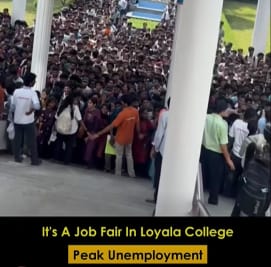
A viral video from India tells a sobering story. Thousands upon thousands of young graduates packed into a single job fair, stretching as far as the eye could see. At first glance, one might mistake it for pilgrims climbing Tirumala Hill in search of divine blessings. It was a job fair at Loyala Colleg in India. https://www.facebook.com/share/r/1DETGPtcUP/
In a way, they were.
Only these pilgrims were praying to the god of employment.
Each carried a résumé instead of a prayer book. Each hoped that somewhere among the dozens of booths was a recruiter willing to exchange four years of university education for a monthly salary.
It was both inspiring and heartbreaking.
India is producing graduates at an astonishing pace. Unfortunately, the economy is not producing quality jobs at the same speed. The result is an army of educated young people competing for a handful of vacancies.
Sound familiar?
Malaysia is not yet witnessing job fairs that resemble rock concerts or religious festivals, but the warning signs are impossible to ignore.
Every year our universities produce tens of thousands of graduates. Every year ministers proudly announce higher enrolment, more scholarships and additional university places.
Far less attention is given to the equally important question: where are the jobs?
We have become experts at manufacturing degrees.
We are less successful at creating careers.
Employers complain graduates lack practical skills. Graduates complain employers offer salaries barely enough to survive in Kuala Lumpur.
Some degree holders now discover that the barista preparing their latte has a business degree. The Grab driver may have studied engineering. The insurance agent might possess a master's qualification.
Education has become inflationary.
When everyone has a degree, the degree itself loses much of its signalling power.
Yesterday's bachelor's degree is today's SPM.
Tomorrow's master's degree may become today's bachelor's.
The cycle never ends.
Parents continue believing another certificate will solve the problem. Universities happily offer another postgraduate programme. Banks willingly finance another education loan.
Everyone profits—except the graduate.
Artificial intelligence threatens to complicate matters further. Routine office jobs, entry-level analysis and administrative work are increasingly automated. Ironically, graduates entering the workforce today face competition not only from one another but also from algorithms.
The world has changed faster than our education system.
We still educate students for jobs that may disappear before they graduate.
Perhaps it is time to stop measuring national success by the number of university graduates produced each year.
A country does not become advanced simply because more people wear mortarboards.
It becomes advanced when educated people can find meaningful, productive work.
Germany built its economy on skilled technicians as much as academics. Switzerland values apprenticeships. Singapore continuously retrains its workforce rather than assuming one degree lasts a lifetime.
Meanwhile, Malaysians continue chasing certificates as though every graduation ceremony automatically ends with an appointment letter.
It doesn't.
The uncomfortable truth is that universities cannot become factories whose products nobody needs.
Nor should vocational education be treated as a consolation prize for those who supposedly failed academically.
Our obsession with degrees has created an imbalance. We have shortages of skilled electricians, welders, technicians and healthcare workers, while producing graduates for sectors already overflowing with applicants.
That is not a labour shortage.
It is a planning failure.
The Indian job fair should not be viewed with sympathy alone. It should be viewed as a glimpse into a possible future if economic planning, industrial policy and education continue moving in different directions.
The real challenge for Malaysia is not producing more graduates.
It is producing an economy worthy of them.
Otherwise, the next great Malaysian gathering may not be at a concert, a football final or a political rally.
It may simply be outside a job fair, where thousands of hopeful graduates queue patiently, clutching immaculate résumés and wondering how so much education could lead to so little opportunity.
Mihar Dias (mihardias@gmail.com) is a content creator under the Newswav Creator programme, where you get to express yourself, be a citizen journalist, and at the same time monetize your content & reach millions of users on Newswav. Log in to creator.newswav.com and become a Newswav Creator now!
The User Content (as defined on Newswav Terms of Use) above including the views expressed and media (pictures, videos, citations etc) were submitted & posted by the author. Newswav is solely an aggregation platform that hosts the User Content. If you have any questions about the content, copyright or other issues of the work, please contact creator@newswav.com.