
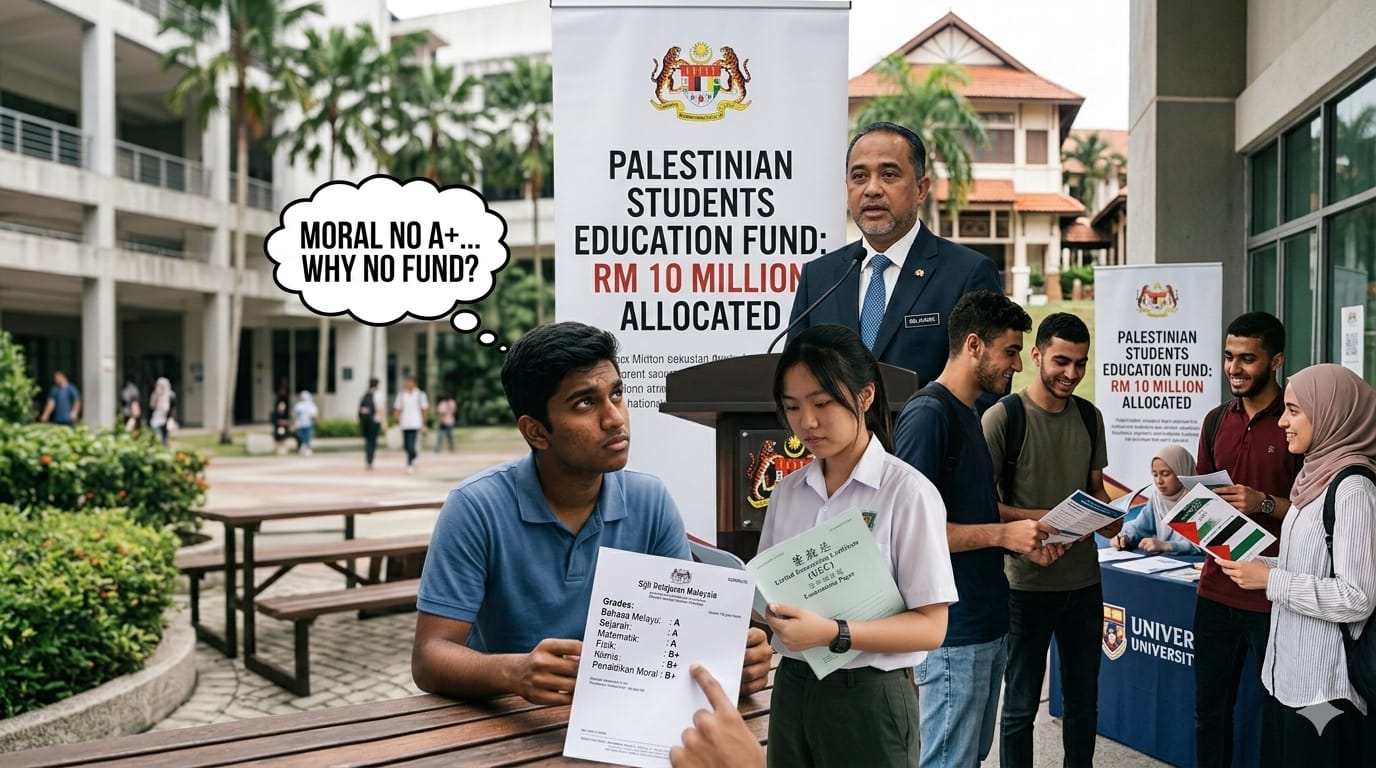
Malaysia’s decision to mobilise RM10 million in aid and scholarships for Palestinian students was, fundamentally, a moral act.
At a time when Gaza’s education system has been shattered by war, extending assistance to displaced students reflects a humanitarian instinct that many Malaysians are proud of. In moments of global suffering, compassion should never be questioned.
But compassion also reveals something else: capability.
Because when genuine political will exists, Malaysia can move remarkably fast.
Funds can be mobilised. Bureaucratic layers suddenly become flexible. Inter-ministerial coordination appears almost overnight. Policies are announced with urgency.
In other words, when the state truly wants something done, the machinery of government works.
And that is precisely why many Malaysians are beginning to ask a more uncomfortable question.
If the federal government can move swiftly to support an international humanitarian education crisis, why do long-standing domestic educational inequalities continue to remain trapped in endless committees, delayed studies, political hesitation, and selective urgency?
Because for many communities inside Malaysia’s own education ecosystem, waiting has become policy.
That contradiction resurfaced sharply following Higher Education Minister Datuk Seri Dr Zambry Abd Kadir’s recent defence of special entry pathways for UEC and tahfiz students into public universities.
His argument was politically careful.
Zambry insisted that the policy does not amount to formal recognition of the Unified Examination Certificate (UEC) or a restructuring of national education policy. Instead, he described it as a tightly controlled admission pathway operating under strict federal conditions.
UEC students, he explained, would still need to sit for components of the national Sijil Pelajaran Malaysia (SPM) framework and pass compulsory subjects such as Bahasa Melayu and History before gaining access to public universities.
Even then, the pathway remains heavily restricted.
Tahfiz graduates are largely limited to Islamic and religious studies-related programmes. UEC holders are generally confined to Chinese language or specific related academic tracks.
On paper, this appears to be compromise.
In reality, it raises a deeper question: is Malaysia solving educational division, or merely managing political discomfort?
Because the policy does not fundamentally resolve the issue of educational recognition. It merely narrows access carefully enough to avoid triggering political backlash from either side.
The government can now tell critics that UEC has not been fully recognised. At the same time, it can reassure supporters that some level of access exists.
This is not structural reform.
It is political balancing.
And political balancing, while useful in the short term, rarely resolves long-term national anxieties.
The consequences become clearer when viewed against the broader educational inequalities already shaping other communities.
For decades, the Malaysian Indian community has raised concerns over the condition of many Sekolah Jenis Kebangsaan Tamil (SJKT), especially the so-called “micro-sized” estate schools scattered across the country.
Many were built during the plantation era for communities that have since shifted economically and geographically. Some now operate with extremely low enrolment, ageing infrastructure, limited digital facilities, and chronic teacher shortages.
Yet relocation, consolidation, and long-term redevelopment often move painfully slowly because education policy in Malaysia frequently becomes trapped between administrative logic and political sensitivity.
Meanwhile, poverty continues to quietly shape educational outcomes within parts of the Indian community.
While Malaysia proudly celebrates successful Indian professionals and corporate figures, another reality receives far less national attention: students leaving school early to support struggling households, families overwhelmed by socioeconomic pressure, and young people treating education not as opportunity, but as survival.
Each year, high-achieving Indian students scoring 8As and 9As discover that academic excellence alone does not guarantee access to preferred pathways into public higher education.
The Bumiputera quota structure surrounding Matriculation admissions continues to create a perception fair or otherwise that merit operates selectively.
Many students eventually turn toward STPM, private colleges, overseas institutions, or alternative pathways not because they initially desired them, but because the route into IPTA becomes narrower despite strong results.
The damage here is not merely educational.
It is psychological.
When a generation repeatedly feels that structural ceilings exist regardless of effort, belonging itself begins to erode.
And belonging is the invisible foundation that keeps talented citizens emotionally invested in their own country.
The Chinese vernacular education system faces a different, but equally revealing, crisis.
Public debate around SJKCs often revolves around symbolism, language, and politics. Far less attention is paid to the demographic pressures quietly reshaping many Chinese schools themselves.
Across several states, urban migration has produced a growing number of under-enrolled Chinese vernacular schools struggling to remain sustainable.
Entire communities have shifted into urban centres, while some rural and semi-rural schools continue operating with shrinking student populations. Calls for relocation into higher-density areas have existed for years.
Yet approvals remain painfully slow.
Even practical educational adjustments become entangled in political narratives.
Then there is the long-standing frustration surrounding SPM Chinese Language grading.
For years, students and parents have questioned why top-performing candidates often struggle to secure clean A+ results in Chinese Language despite excellent overall academic performance.
The subject has developed a reputation for disproportionately severe marking standards, creating a paradox where students pursuing multilingual excellence feel punished rather than encouraged.
Malaysia repeatedly speaks about producing globally competitive, multilingual graduates. Yet students who pursue linguistic mastery often experience the system as discouragement.
And all roads eventually lead back to the unresolved issue that has haunted Malaysian education for decades.
Here lies the ultimate irony.
Malaysia accommodates foreign qualifications with remarkable administrative flexibility. British A-Levels. International Baccalaureate. Australian Matriculation. Various international pre-university certifications.
These pathways are integrated into university admission frameworks with relatively little existential debate.
But local students educated within Malaysia’s own ecosystem continue facing rigid conditional frameworks just to gain access to public universities in their own country.
The federal government continues defending conditional entry arrangements rather than confronting the larger question directly.
Meanwhile, East Malaysian states have increasingly moved ahead pragmatically.
Sarawak has recognised the UEC for entry into state-linked institutions, scholarships, and its broader free tertiary education framework beginning in 2026. Sabah has also adopted more practical accommodation measures.
In many ways, East Malaysia appears less ideologically anxious about educational diversity than the federal centre itself.
And while Malaysia debates endlessly, neighbouring countries quietly absorb its talent.
Singapore continues attracting high-performing Malaysian students seeking merit-driven university systems and globally competitive institutions.
Taiwan, meanwhile, has become an increasingly attractive destination for Chinese Independent School graduates because of language compatibility, scholarship opportunities, and smoother qualification recognition.
This is the hidden tragedy beneath Malaysia’s education politics.
Brain drain rarely begins with salary.
It begins when talented young people stop believing they fully belong within the system they grew up in.
None of this means Malaysia should stop helping Palestinian students.
Humanitarian compassion should never become a competition.
But a nation must eventually ask itself whether the same urgency shown internationally can also exist domestically.
Because true patriotism is not measured only through speeches about justice abroad.
It is measured by whether citizens feel seen, valued, and included within the institutions shaping their future at home.
An Indian student trapped inside an underfunded estate SJKT. A Chinese student navigating uncertainty surrounding UEC recognition. A tahfiz student confined within narrow academic pathways. A multilingual student penalised by inconsistent grading structures. A high-achieving non-Bumiputera student struggling to access Matriculation despite outstanding SPM results.
These are not isolated grievances.
They are structural warning signs.
A nation cannot continuously demand loyalty, contribution, and excellence from its young people while simultaneously leaving them uncertain about where they stand educationally.
Politicians must stop playing with fire when it comes to education.
Malaysia already possesses universities, technical institutes, research centres, TVET pathways, and specialised programmes across multiple fields. The issue is no longer simply about infrastructure.
The deeper problem is accessibility, consistency, and whether every talented student genuinely feels those pathways are open to them.
Education cannot continue being shaped by political hesitation, ideological anxiety, or selective urgency.
The nation’s future rests on these young Malaysians students striving to become scientists, engineers, researchers, teachers, entrepreneurs, technologists, and nation-builders.
What they need is not endless political signalling, but a system confident enough to expand opportunity fairly, transparently, and sustainably.
Because a strong country is not built merely by having institutions.
It is built when its citizens believe those institutions were built for them too.
True national strength emerges when governments apply the same urgency, compassion, administrative courage, and financial will to their own backyard.
And true equity begins with a simple principle:
No Malaysian child whether studying in an SJKT, SJKC, tahfiz institution, Chinese Independent High School, or national school should ever grow up feeling like a second-class citizen within their own homeland’s education system.
Because the most dangerous form of brain drain is not when talent leaves the country.
It is when hope leaves first.
Annan Vaithegi, who believes national unity is strengthened not by forcing sameness, but by ensuring every Malaysian child sees dignity, fairness, and opportunity within the nation they call home.
Annan Vaithegi (annanvaithegi@icloud.com) is a content creator under the Newswav Creator programme, where you get to express yourself, be a citizen journalist, and at the same time monetize your content & reach millions of users on Newswav. Log in to creator.newswav.com and become a Newswav Creator now!
The User Content (as defined on Newswav Terms of Use) above including the views expressed and media (pictures, videos, citations etc) were submitted & posted by the author. Newswav is solely an aggregation platform that hosts the User Content. If you have any questions about the content, copyright or other issues of the work, please contact creator@newswav.com.