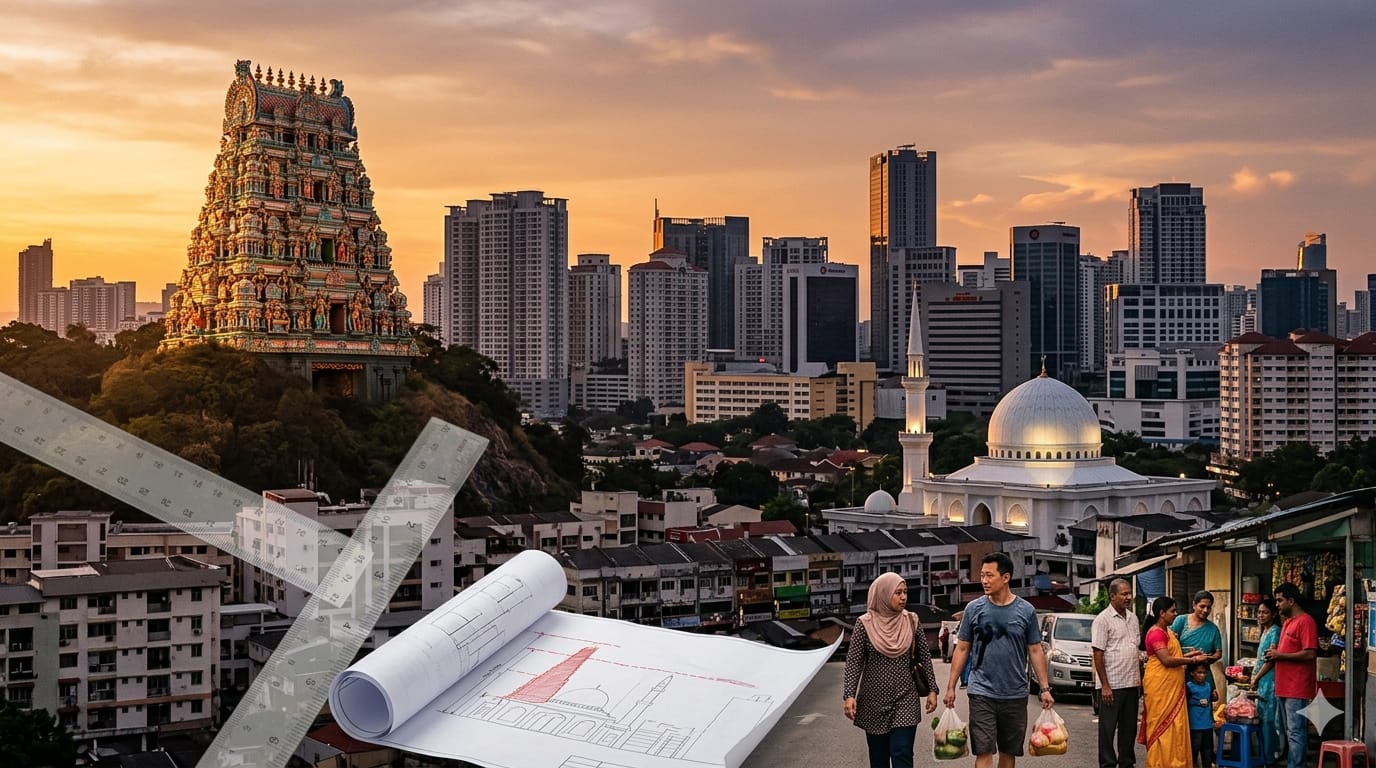
A curious question has emerged from Selangor's now-suspended guideline on non-Muslim houses of worship: if a temple on a hilltop stands higher than a mosque in the valley below, does that make the temple spiritually superior?
The question sounds ridiculous because it is.
If physical elevation determined the strength of faith, then the temples perched on the misty slopes of Genting Highlands would surely possess greater holiness than every house of worship on the plains. If altitude was a shortcut to God, mountain climbers would be saints and surveyors would be theologians.
Every religion understands this instinctively. Faith has never been measured in feet, metres, domes, towers, gopurams, or minarets. It is measured through compassion, humility, integrity, service, and the character of those who practise it.
That is why the controversy surrounding Selangor's proposed guideline limiting non-Muslim houses of worship to 72 feet and requiring them to remain lower than nearby mosques feels so deeply misplaced. It transforms spirituality into a construction contest and devotion into a question of architectural hierarchy. Worse still, it sends a message that some communities must visibly occupy a lower place than others.
And that should concern every Malaysian, regardless of religion.
While the World Builds the Future
At a time when nations across Asia are racing to dominate artificial intelligence, semiconductor manufacturing, biotechnology, renewable energy, and advanced education, Malaysia finds itself debating the height of religious buildings.
Singapore is investing aggressively in AI capabilities.
Vietnam is positioning itself as a semiconductor hub.
Indonesia is expanding downstream industries and digital infrastructure.
China and India are competing for technological leadership on a global scale.
Meanwhile, in one of Malaysia's most economically important states, administrative attention has been consumed by questions such as whether a temple, church, or shrine should be permitted to stand taller than a mosque.
One cannot help but wonder whether our priorities have become inverted.
We are arguing over who commands the clouds while ordinary Malaysians are struggling to afford what is on the ground.
Families worry about rising living costs.
Young graduates worry about stagnant wages.
Parents worry about the quality of education.
Businesses worry about competitiveness.
Investors worry about policy consistency.
Yet somehow, building height has become a matter of public debate.
The Wrong Signal to Talent and Investors
The most successful economies do not attract talent because one religion's buildings stand taller than another's.
Engineers do not relocate based on minaret height.
Scientists do not choose countries based on dome dimensions.
Foreign investors do not evaluate religious skylines before committing billions in investment.
They look for something far more valuable:
Institutional stability.
Meritocracy.
Predictable governance.
Social harmony.
A society confident enough to focus on progress instead of symbolism.
When governments spend time regulating perceived religious hierarchy instead of solving practical challenges, the signal sent to the world is troubling. It suggests a nation distracted by identity politics while others focus on innovation and growth.
In a fiercely competitive global economy, that is a luxury Malaysia can no longer afford.
The Dangerous Illusion of Hierarchy
Perhaps the most troubling aspect of the guideline is the underlying assumption it appears to create.
It suggests that harmony is achieved when one community remains visibly lower than another.
But genuine harmony does not work that way.
A society does not become stronger when one group is diminished.
A community does not become more secure by restricting another community.
A faith does not become more respected because another faith is instructed to build lower.
That is the psychology of a zero-sum society the belief that one group can only rise if another group is pushed down.
History repeatedly shows the opposite.
The strongest societies are those where every community feels secure enough to stand proudly without threatening the dignity of others.
Malaysia's greatest strength has never been uniformity.
It has always been diversity.
Character Cannot Be Measured with a Ruler
A taller prayer hall does not automatically create a better citizen.
A shorter temple does not produce greater humility.
A lower church does not generate stronger morality.
Character is built through values.
Integrity is demonstrated through actions.
Spirituality is reflected in service.
Religious teachings are validated through kindness, honesty, charity, and compassion.
Corruption is not reduced by lowering buildings.
Crime is not reduced by lowering buildings.
Poverty is not reduced by lowering buildings.
Educational achievement is not improved by lowering buildings.
No blueprint can manufacture virtue.
No measuring tape can quantify righteousness.
Selangor Must Lead, Not Follow
Selangor is not an ordinary state.
It is Malaysia's economic powerhouse.
It contributes the largest share of national economic output and often sets the standard for governance, investment, and urban development.
That position comes with responsibility.
Selangor's policies should reflect the confidence of a modern, inclusive, globally competitive metropolis.
They should showcase rational governance.
They should inspire unity.
They should demonstrate that economic excellence and social cohesion can coexist.
Most importantly, they should never create the perception that one Malaysian must stand lower than another Malaysian.
The suspension and review of the guideline is a welcome step. But leadership requires more than review. It requires clarity.
The guideline should be withdrawn permanently and replaced with planning standards that apply fairly, transparently, and consistently based on safety, engineering, traffic management, environmental impact, and urban planning not religious hierarchy.
Because a progressive society is not built by forcing some people to build lower.
It is built by creating conditions where everyone can rise higher together.
And in 2026, when the world is competing for ideas, innovation, talent, and investment, that is the only height that truly matters.
Annan Vaithegi, writes meaningful opinion columns that explore important social, cultural, and community issues.
Annan Vaithegi (annanvaithegi@icloud.com) is a content creator under the Newswav Creator programme, where you get to express yourself, be a citizen journalist, and at the same time monetize your content & reach millions of users on Newswav. Log in to creator.newswav.com and become a Newswav Creator now!
The User Content (as defined on Newswav Terms of Use) above including the views expressed and media (pictures, videos, citations etc) were submitted & posted by the author. Newswav is solely an aggregation platform that hosts the User Content. If you have any questions about the content, copyright or other issues of the work, please contact creator@newswav.com.