.jpg)
By Mihar Dias August 2026
There is something almost touching about Malaysia’s recurring discovery of Hong Kong.
Whenever somebody sees too many Chinese characters on a shop sign, hears too much Mandarin in a shopping district, or encounters a commercial area that does not look sufficiently “Malaysian”, Hong Kong is summoned as though it were a warning from the future.
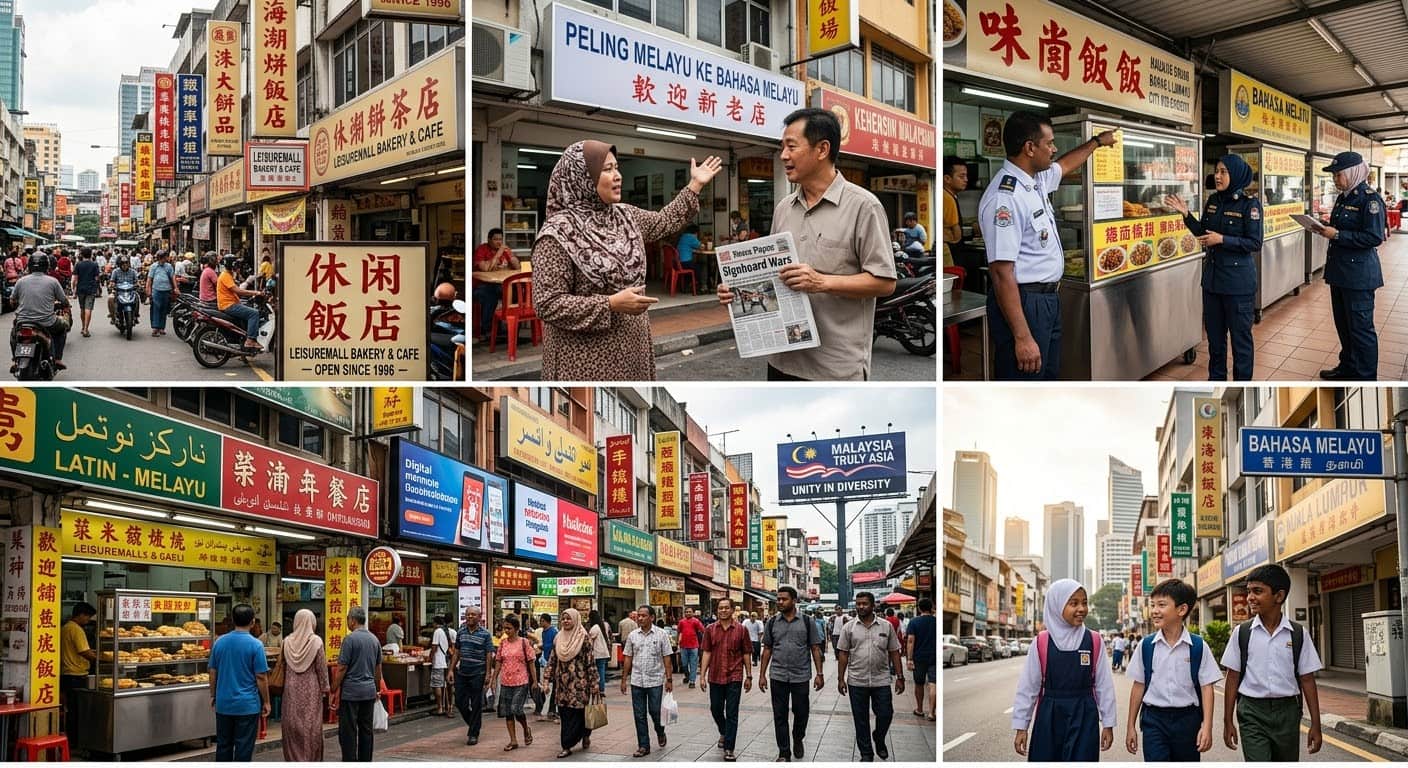
This time, Chinese-Muslim preacher Ridhuan Tee has looked at the shops around Cheras LeisureMall and apparently seen a little bit of Hong Kong.https://newswav.com/A2608_wbW0tx?s=A_bgATVt7&language=en
“This looks like Hong Kong. Where are the authorities?” https://newswav.com/A2608_wbW0tx?s=A_bgATVt7&language=en
He complained that Bahasa Melayu had allegedly fallen to “third place”, questioned the enforcement of signboard regulations and added that roadside stalls and pedestrian walkways were being occupied with apparent impunity.https://newswav.com/A2608_wbW0tx?s=A_bgATVt7&language=en
There is a legitimate issue buried somewhere in all this: rules governing commercial signs and public spaces should be enforced fairly and consistently.
But that is not quite the same thing as saying that Malaysia must panic whenever a neighbourhood looks, well, Malaysian.
Because if the benchmark for Malaysian identity becomes the visual disappearance of Chinese, Tamil or other languages from commercial life, we are heading into a very strange future indeed.
The Hong Kong obsession
Hong Kong is an odd bogeyman.
It is one of Asia’s great international cities, Chinese in cultural character, intensely commercial, multilingual, globally connected and remarkably comfortable with the fact that different languages occupy the same physical space.
Yet in Malaysia, “Hong Kong” is sometimes deployed as shorthand for something supposedly threatening: too many Chinese signs, too much Chinese culture, too little Malay.
The irony is palpable.
Malaysia has spent decades telling the world that it is multicultural. We proudly advertise our diversity to tourists, investors and diplomats. We celebrate Chinese New Year, Deepavali, Hari Raya and countless cultural festivals. Even our tourism slogan says it, "Malaysia Truly Asia".
But every now and then someone looks at a row of Chinese shop signs and apparently concludes that multiculturalism has gone too far.
Perhaps the real problem is not the signboard.
Perhaps it is our inability to decide what multiculturalism actually means.
Bahasa Melayu must be respected — but not weaponised
Of course Bahasa Melayu has an important constitutional and national role. There is nothing unreasonable about requiring commercial establishments to comply with legitimate language regulations.
If the law says Malay must appear on a signboard, enforce the law.
If a business violates local council regulations, issue the appropriate notice.
If a stall blocks a pedestrian walkway, remove it — whether the owner is Malay, Chinese, Indian, Iban, Kadazan or anybody else.
That last part is rather important.
Because the moment enforcement becomes a question of ethnicity — “they allow them to do it but tear ours down” — we have moved away from law and into the dangerous territory of grievance.
A decent local authority should not ask: Who owns the stall?
It should ask: Is the stall legal?
That is what equality before the law is supposed to mean.
And then comes the slippery slope
Today the complaint is about signboards.
Tomorrow it could be shop names.
Then restaurant menus.
Then advertisements.
Then the language used by customers inside shops.
Then the music played in shopping centres.
Then the language parents use with their children.
Eventually someone will announce that a neighbourhood “doesn't feel Malaysian anymore” because too many people are speaking a language other than Bahasa Melayu.
At that point, we will have achieved the extraordinary feat of turning national identity into a matter of typography.
Imagine the future council meeting.
“Chairman, we have a serious problem.”
“What is it?”
“There are 37 Chinese characters on Jalan Cheras.”
“Good heavens. How many Malay words?”
“Forty-two.”
“Then we are safe.”
This is where cynical nationalism eventually takes us: counting letters instead of building a nation.
The real danger is not Chinese signboards
Malaysia does have a serious problem with public-space enforcement.
Pavements are blocked. Illegal extensions appear. Hawkers occupy road shoulders. Buildings alter their facades. Signboards sometimes ignore regulations. Enforcement can be selective, inconsistent and frustrating.
But none of these problems is inherently Chinese, Malay, Indian or anything else.
They are problems of governance.
And if the authorities really are selective, the answer is not to create another ethnic grievance. The answer is to demand uniform enforcement.
A Chinese-owned stall blocking a pavement should be removed.
So should a Malay-owned stall.
An Indian restaurant violating signboard regulations should comply.
So should a Malay restaurant.
That would be rather revolutionary: enforcing the law without first checking the owner's surname.
What will Malaysia look like in 2050?
This is where today's seemingly small arguments matter.
Malaysia's cities are changing. Young Malaysians are increasingly multilingual. Shopping districts are becoming more international. Digital commerce ignores language boundaries altogether. Chinese, Tamil, English, Malay, Korean, Japanese and Arabic appear side by side in commercial life.
The Malaysia of our grandchildren will almost certainly be more linguistically mixed, not less.
So what are we going to do?
Will we spend the next 25 years policing signboards in the hope that every street looks sufficiently Malay?
Or will we create a country confident enough in its national language that it doesn't feel threatened by another language appearing beside it?
A strong national language does not need a weak Chinese language.
A confident Malay identity does not require Chinese characters to disappear.
And a Malaysian identity should certainly be large enough to accommodate both.
Perhaps we should stop looking for Hong Kong
There is one final irony in the whole argument.
If we keep worrying that Cheras looks like Hong Kong, perhaps one day we should actually visit Hong Kong.
We might discover something rather inconvenient.
Hong Kong is not Hong Kong because of its signboards.
It is Hong Kong because it built a globally competitive city in which commerce, law, infrastructure, education and enterprise mattered enormously.
The lesson Malaysia should take from Hong Kong is not that Chinese characters are dangerous.
It is that cities become successful when governments enforce rules, provide infrastructure, protect public spaces and allow businesses to prosper.
So yes, by all means enforce Bahasa Melayu requirements.
Clean up the pavements.
Remove illegal stalls.
Regulate signboards.
But do it with one standard for everybody.
Otherwise, we may spend so much time trying to make Malaysia look Malaysian that we forget the much harder job of making Malaysia work.
And that would be the real tragedy.
Because the Malaysia our children inherit should not be a country where every street has been linguistically sanitised to prove its patriotism.
It should be a country where a Malay sign stands proudly beside a Chinese sign, beside a Tamil sign, beside an English sign — and nobody needs to curse the authorities because the whole street happens to look like Malaysia.
Not Hong Kong.
Not China.
Not India.
Malaysia.
Mihar Dias (mihardias@gmail.com) is a content creator under the Newswav Creator programme, where you get to express yourself, be a citizen journalist, and at the same time monetize your content & reach millions of users on Newswav. Log in to creator.newswav.com and become a Newswav Creator now!
The User Content (as defined on Newswav Terms of Use) above including the views expressed and media (pictures, videos, citations etc) were submitted & posted by the author. Newswav is solely an aggregation platform that hosts the User Content. If you have any questions about the content, copyright or other issues of the work, please contact creator@newswav.com.