
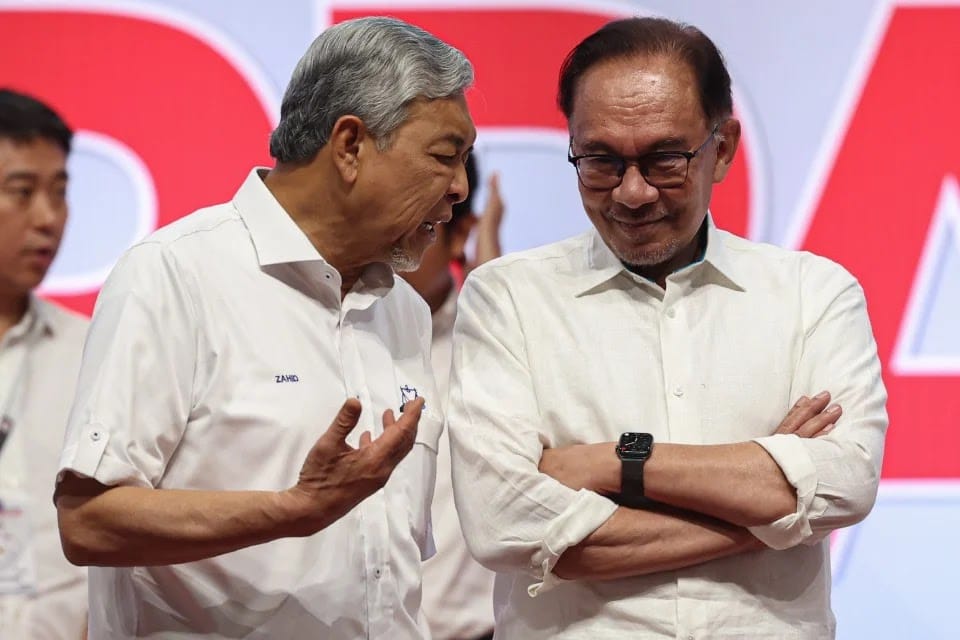
The air inside Persada Johor International Convention Centre was thick with the scent of cheap catering coffee and latent existential dread. It was May 17, 2026, and Prime Minister Datuk Seri Anwar Ibrahim was on stage at the Pakatan Harapan (PH) Convention. To the untrained eye, the Unity Government the historical anomaly born out of the 2022 hung parliament seemed to be chugging along smoothly. After all, the official narrative has always been one of ironclad stability. When critics ask how two lifelong rivals now manage the nation’s highest offices together, the defense is invariably uniform, structural, and dismissive.
“APA YANG SULIT?” (What is so difficult?) insiders will tell you with a shrug. “ZAHID TPM, jadi beliau memang jumpa Anwar hampir setiap hari!” (Zahid is the DPM, so he naturally meets Anwar almost every single day!).
But on that humid Sunday afternoon in Johor Bahru, the script completely shattered. Anwar took the podium and issued his sharpest, most visceral ultimatum yet to his coalition partner, Barisan Nasional (BN). Infuriated by state-level rebellions, Anwar openly warned that a total breakdown in their alliance could trigger a snap general election, raising massive doubts about whether this political marriage can survive its full term.
“We don't take kindly to threats,” Anwar declared to a roaring crowd of PH delegates. “Beaten? I have been beaten. Jailed? I have been jailed.”
This sudden, fiery escalation exposes the grand illusion of contemporary Malaysian politics: the naive belief that institutional proximity equals ideological harmony. For over three years, the federal administration has run on the mechanical routine of two men meeting over morning briefings, scanning Cabinet papers, and sharing superficial pleasantries. Yet, as the ground shifts beneath them, Malaysia is learning a brutal lesson in statecraft. You can share a breakfast table every single morning, but if your houses are burning down at the state level, the morning coffee leaves nothing but a bitter aftertaste.
The Anatomy of the Daily Meeting
To understand why the "they meet every day" argument is failing, one must look at the structural mechanics of the Deputy Prime Minister’s office. Datuk Seri Dr. Ahmad Zahid Hamidi does not just hold a ceremonial title; he sits at the absolute center of federal execution. He manages massive rural development portfolios, chairs high-stakes cabinet committees, and coordinates the daily operational machinery of the civil service right alongside the Prime Minister.
From an institutional standpoint, their interactions are a daily operational necessity. They review macroeconomic pressures, debate fiscal adjustments, and discuss federal policies. At the federal level, this structural closeness has successfully preserved a vital layer of administrative stability that the country desperately needed after years of revolving-door prime ministers.
But this daily routine operates under a false assumption that federal mandates can seamlessly dictate grassroots realities. In Malaysia’s highly decentralized, fractured political landscape, what happens in Putrajaya often stays in Putrajaya. The daily meetings between Anwar and Zahid are happening within a pristine, air-conditioned vacuum, completely detached from the hyper-local, tribal warfare raging across the dynamic states of the peninsula.
The State-Level Wildfires Melting Putrajaya
The profound flaw in relying on the Anwar-Zahid bromance as a proxy for national stability became painfully clear through two massive explosions in state-level politics. The first detonated in Negeri Sembilan, where an unprecedented constitutional and political crisis ground the state government to a complete halt.
All 14 Barisan Nasional state assemblymen (ADUNs) completely broke ranks, unanimously announcing a total withdrawal of support for Pakatan Harapan’s Menteri Besar, Datuk Seri Aminuddin Harun. The mutiny forced an unprecedented, indefinite postponement of the state legislative assembly sitting.
While Zahid was forced to scramble to the media, stating desperately that he urgently needed to meet Anwar to resolve the bleeding politically, the message from the grassroots was loud, clear, and incredibly hostile: We do not care who you eat breakfast with in Putrajaya; we will not bow to PH here.
Before the dust could even settle in Negeri Sembilan, an even larger political earthquake struck Johor. On May 16, Johor BN chief Datuk Onn Hafiz Ghazi dropped a political bombshell by declaring that Barisan Nasional will contest all 56 state seats solo in the upcoming state elections.
This was not a minor disagreement; it was an open, aggressive declaration of war against their federal PH allies. Anwar was left with no choice but to retaliate fiercely at the Johor convention, threatening to match BN's arrogance by throwing the gates wide open and contesting every single seat nationwide, daring the public to decide the fate of the entire country.
The Identity Crisis of a Century-Old Titan
To diagnose why Zahid cannot simply order his party to behave, one must conduct a deep sociological analysis of UMNO’s profound internal identity crisis. For over six decades, UMNO was the undisputed, supreme hegemon of Malay politics. Its entire institutional DNA is hardwired for absolute dominance, built on a robust patronage system and a foundational narrative that positions the party as the singular, ultimate defender of Malay-Muslim interests.
When the 2022 elections forced Zahid to pivot and align with PH and by extension, the historically demonized Democratic Action Party (DAP) it triggered a massive, systemic shockwave across the party's traditional grassroots. Today, Zahid is forced to spend a huge amount of political capital trying to actively defend UMNO-DAP ties within the ruling coalition, a bizarre ideological marriage that cynical observers have mocked with the derogatory label “UMDAP.”
This unnatural alliance has severely alienated traditional Malay voters. Rank-and-file members look at the federal compromise and see a catastrophic dilution of their core principles. Regional warlords and youth leaders recognize that if they remain passive sub-partners to Anwar’s reformist agenda, they risk being completely replaced by the rising green wave of Perikatan Nasional (PN) in the rural heartlands.
This deep-seated anxiety explains the aggressive, public rebellion led by figures like UMNO Youth Chief Dr. Akmal Saleh, who has repeatedly and loudly suggested that UMNO consider quitting the Unity Government entirely to protect its tattered reputation. Zahid might hold absolute structural control over the supreme council via strategic purges of his rivals, but he does not control the hearts, minds, or votes of the local division chiefs who actually run the ground campaigns.
The Burning Economics of Joint Governance
Compounding this explosive ideological friction is the harsh reality of shared economic responsibility. As critical partners in Anwar’s administration, UMNO can no longer sit comfortably on the sidelines throwing stones; it must now actively defend unpopular, painful federal policies.
The administration is currently grappling with severe global economic headwinds and intense domestic pressures, including public dissatisfaction with a highly challenging job market, stagnant wages, and the soaring costs of daily living.
When the Ministry of Finance proposes deeply controversial fiscal consolidation measures such as cutting nearly RM6 billion from crucial health and education budgets UMNO’s leadership cannot criticize the government to appease its working-class base. Instead, it is forced to actively champion these deeply unpopular decisions.
This shared economic baggage is electoral poison in mixed, working-class, or rural constituencies. Without the robust backing of non-Malay voters to stabilize their margins, UMNO's electoral ceiling in contested seats drops catastrophically. The party's legendary, formidable election machinery which historically relied on a massive, seemingly endless federal campaign chest is showing undeniable signs of widespread grassroots exhaustion, weaker mobilization capabilities, and a total failure to attract vibrant young talent.
What do you think? I’d love to hear your opinion in the comments section.
We often find comfort in the administrative myth of proximity. We desperately want to believe that if our top leaders are talking, if they are resolving differences over a quiet morning tea before a cabinet meeting, then the underlying system must be safe. But a country is not a corporate boardroom, and a fractured coalition cannot be held together by two politicians trying to protect their own careers.
The escalating wars in Johor and Negeri Sembilan have shown us that the daily meetings between Anwar and Zahid are no longer a sign of deep unity. Instead, they look like desperate, daily firefighting sessions. They are the frantic actions of two captains trying to patch up a leaking hull while their crews are actively shooting at each other below deck.
When we look past the official press releases and the superficial displays of federal unity, we see a political system that is deeply strained. The daily meetings are happening, yes. The coffee is being poured, and the papers are being signed. But as the state-level alliances continue to splinter and the grassroots grow increasingly hostile, we have to ask ourselves how much longer this delicate arrangement can survive. Putrajaya may look completely calm from the inside, but the foundations beneath it are beginning to crack.
AM World (tameer.work88@gmail.com) is a content creator under the Newswav Creator programme, where you get to express yourself, be a citizen journalist, and at the same time monetize your content & reach millions of users on Newswav. Log in to creator.newswav.com and become a Newswav Creator now!
The User Content (as defined on Newswav Terms of Use) above including the views expressed and media (pictures, videos, citations etc) were submitted & posted by the author. Newswav is solely an aggregation platform that hosts the User Content. If you have any questions about the content, copyright or other issues of the work, please contact creator@newswav.com.