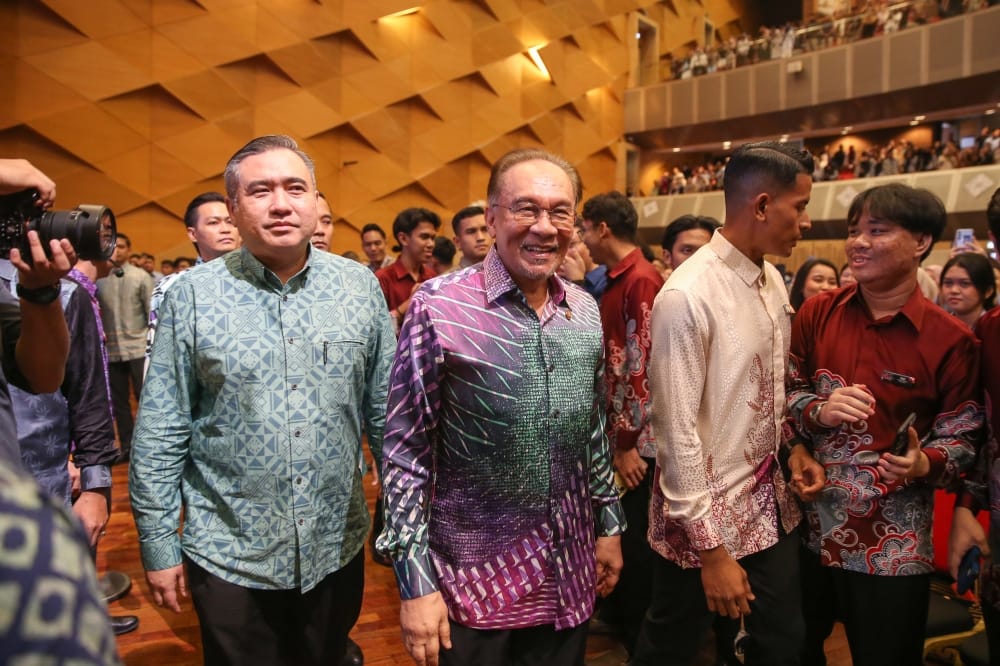
Few political moments in Malaysia move quite as briskly as a Cabinet exit until a prime minister decides the exit door should stay slightly ajar. Following the dramatic developments surrounding former prime minister Datuk Seri Najib Razak’s house arrest ruling in mid-November, Transport Minister Anthony Loke announced his resignation from the Cabinet with immediate effect, sending ripples through Putrajaya and coalition circles alike. Yet, Prime Minister Datuk Seri Anwar Ibrahim has charted a markedly different course, confirming that he has not accepted Loke’s resignation and has instead asked him to go on leave for now while Anwar temporarily steps in to help oversee the Ministry of Transport (MOT). That distinction between a finalized departure and a sanctioned pause carries weight far beyond administrative paperwork. Beneath the polite formalities of Putrajaya press briefings lies a deeper institutional and political question: how does a multi-party unity government manage principled disagreements and high-pressure flashpoints without fracturing the trust that holds the coalition together? Recent remarks by the Prime Minister highlight a delicate balancing act, showing that keeping a key ally on leave while reassuring the public that ministry operations remain steady is both a tactical buffer and a signal of institutional continuity. This unfolding episode challenges us to look past surface-level headlines of Cabinet shake-ups and confront the real mechanics of coalition management in Malaysia. To push the conversation forward, we must deconstruct the comforting illusion that ministerial resignations are purely individual, standalone acts detached from broader political survival. Instead, we need to examine why Anwar opted for a cooling-off pause over immediate acceptance, how MOT’s leadership structure absorbs the transition, and what this temporary arrangement signals for governance and political maturity in twenty-first-century Malaysia.
A Tactical Pause Between Principle and Coalition Pragmatism
To understand why Anwar asked Loke to take leave rather than formally accepting his resignation, one must look at the delicate equilibrium of Malaysia’s unity government. As reported by Berita Harian, Anwar confirmed he met with Loke, heard the reasons already known publicly, and told him to go on leave first rather than treating the matter as closed. In coalition politics, an abrupt, unabsorbed resignation over a polarizing legal and political issue can quickly snowball into wider friction across party lines. By placing Loke on leave while maintaining that Loke and DAP lawmakers continue to back his leadership, Anwar creates space for tempers to cool, conversations to continue behind closed doors, and political calculations to settle without forcing an immediate, irreversible rupture. As highlighted in coverage by Astro Awani, formalizing a resignation before exhausting dialogue carries real symbolic costs for coalition cohesion. In a system where stability relies on constant negotiation among partners with distinct constituencies, a temporary leave functions as political shock absorption buying time while keeping core alliances intact.
Holding the Reins: How the Ministry of Transport Operates in the Interim
Asking a minister to step back on leave immediately raises a practical governance question: who keeps the wheels of a major portfolio like transport turning? According to The Edge Malaysia, Anwar explained that under established rules, the ministry’s secretary-general, deputy minister, and senior management continue carrying out their duties while he helps oversee the ministry for a while. That division of labor points to an important institutional truth often missed in political commentary: ministries are not powered by a single figurehead alone. Day-to-day execution, regulatory oversight, and civil service administration rest heavily on career officials and deputy leadership, preventing policy paralysis even during leadership transitions. At the same time, Anwar’s decision to temporarily step in signals executive attentiveness to a high-profile portfolio that touches everyday commuters, logistics, and infrastructure. As noted by Malay Mail, framing his role as filling in for a short period reassures stakeholders that governance remains steady without permanently absorbing the portfolio. It is a pragmatic middle ground combining institutional routine with top-level political oversight.
Signaling Resolve Amid High-Stakes Political Pressures
Loke’s decision to tender his resignation following the High Court ruling allowing Najib to serve the remainder of his prison term under house arrest underscores just how sensitive judicial and executive flashpoints remain in Malaysian politics. For reform-minded voters and coalition partners alike, such moments test whether political principles can coexist with the realities of power-sharing. According to the New Straits Times, Anwar’s refusal to accept the resignation immediately coupled with his emphasis that administrative procedures are being followed projects a posture of measured steadiness rather than reactive panic. Yet, this approach also carries a subtle risk: leaving a minister’s status in limbo can prolong uncertainty among ministry staff, industry players, and the public who look for clear lines of authority. Institutional credibility depends not only on calming immediate political storms, but also on providing timely clarity once consultations conclude. How decisively Putrajaya resolves Loke’s status will shape perceptions of whether the administration favors swift clarity or prolonged political maneuvering.
What This Episode Reveals About Institutional Maturity in Putrajaya
Viewed through a wider lens, the leave-versus-resignation dynamic around the Transport portfolio offers a revealing look at how Malaysian statecraft handles internal strain. As documented by Malaysia Gazette, the Prime Minister’s insistence that Loke remain on leave while his resignation is not approved highlights a preference for managed containment over public confrontation. In a maturing democracy, disagreements over policy or political sensitivity should ideally be processed through transparent institutional mechanisms rather than ad-hoc pauses. Still, in a coalition still navigating its fourth year in office, leaders frequently weigh legal formality against relational trust. True institutional strength lies in using temporary breathing room constructively to strengthen policy alignment, respect civil service professionalism, and ensure that public service delivery never becomes collateral damage in wider political debates.
What Do You Think? I’d Love to Hear Your Opinion in The Comments Section
Ultimately, the decision to place Anthony Loke on leave while the Prime Minister temporarily oversees the Transport portfolio captures a defining tension in modern Malaysian politics: balancing firm convictions with the intricate demands of coalition stability. We stand at a point where how leaders handle moments of friction whether through hasty breaks or thoughtful pauses will shape public confidence in democratic governance for years to come. Real political maturity is measured not by pretending tensions do not exist, but by how responsibly leaders protect institutions, honor dialogue, and keep the machinery of government working for ordinary citizens. Navigating complex political realities requires candor, steady stewardship, and an unwavering commitment to public trust. As Malaysians watch how this chapter unfolds, let us remember that lasting stability is built when principle and responsibility are weighed with equal care.
AM World (tameer.work88@gmail.com) is a content creator under the Newswav Creator programme, where you get to express yourself, be a citizen journalist, and at the same time monetize your content & reach millions of users on Newswav. Log in to creator.newswav.com and become a Newswav Creator now!
The User Content (as defined on Newswav Terms of Use) above including the views expressed and media (pictures, videos, citations etc) were submitted & posted by the author. Newswav is solely an aggregation platform that hosts the User Content. If you have any questions about the content, copyright or other issues of the work, please contact creator@newswav.com.