
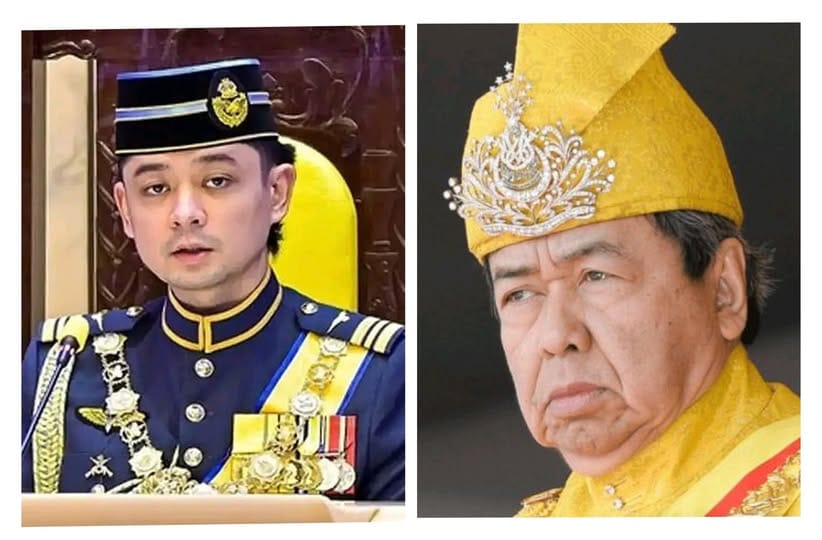
In the last few months, we have seen two titahs or royal decrees being issued by two royal houses in Malaysia, and the way that both of these titahs have been treated is probably making a lot of us ask the question: just what is a titah, and what powers does it have?
The first titah that was issued was by the Selangor palace, which decreed that pig farming should be banned in the whole of Selangor.
This titah was received by the Selangor government as an irrevocable command. Not only have they agreed to execute this titah without question, those that questioned it have been under a lot of pressure.
Wong Siew Ki, the Seri Kembangan assemblywoman who tried to circumvent the titah by suggesting that perhaps pig farming can continue in Selangor if it is done in a fully enclosed space, was roundly criticised by various parties.
The only person who stood up to defend Wong was former DAP strongman Ronnie Liu, but even Ronnie came under heavy fire for his stance.
Ronnie and Wong have since shown contrition for their actions — Wong has publicly declared that she will humbly uphold the royal decree, while Ronnie visited Dataran Selangor immediately after the Sultan of Selangor advised him to do so, to reflect on the Rukun Negara.
Tony Pua, the DAP adviser who publicly questioned the authority of the royal titah in support of Ronnie and Wong, would also find himself under police investigation.
In comparison to the titah by the Selangor palace, the titah issued by the Pahang palace last week does not seem to exhibit the same level of force that the Selangor decree has.
Last week, the Crown Prince of Pahang issued a decree expressing that royal assent must be acquired by the military before it conducts military exercises on islands and coastal areas within Pahang.
Unlike the titah from the Selangor palace, the titah from Pahang seems to be treated more as advice rather than a command. Also, unlike the Selangor titah, it also seems to be acceptable to disagree with the titah from the Pahang palace.
So far, the Pahang titah has been opposed and criticised by legal experts, constitutional lawyers, and subtly downplayed by fellow royalty.
Prominent lawyers, including Zaid Malek, publicly stated that the decree is constitutionally baseless.
The Crown Prince and Regent of Johor has also reportedly poured cold water on the move by remarking that such cross-jurisdictional demands could create operational confusion between state rulers and the federal armed forces.
Unlike the dissenters of the Selangor titah, no one who has disagreed with the Pahang titah has been roundly condemned, forced to apologise or backtrack, had hundreds of police reports lodged against them, or been investigated by the police.
Why, you might ask? What is the basis of this difference?
Why is one titah treated one way and the other titah treated another way?
Now, there are obviously some differences in the way the titahs were issued and who issued them.
For one, the Selangor titah was issued by a long-reigning Sultan while the Pahang titah was issued by a young Crown Prince.
The Selangor titah was also addressed to the Selangor state government itself, while the Pahang titah was addressed to the military — a national institution.
But more than that, I truly believe that the reason why many of us are confused as to why these two titahs are treated differently goes back to the foundation of our country itself.
We tend to be confused because when we reflect on these two titah, we are looking for a thread of a common principle that will allow us to understand the the power, limits, and meaning of a titah.
We might have difficulty finding that principle however, because our country, at its very foundation, was built more on the basis of bargain than a principle.
This is why everything that makes our country what it is - from the NEP to the MA63 to the way that different religions and race is treated in the country to oil and gas rights to tax revenue returns, do not seem to be grounded on any rock hard principles, but shift according circumstances.
Even our founding document, our constitution, is not really a sacred or enlightened document made from any divine revelations, or enlightened principles, or hundreds of years of refinement and experimentation by multiple generations.
Instead , our Constitution came about more as a result of a bargain, after the various segments of Malaysian society — from the different races to the royalty to the British itself — bargained with one another until they finally came to a point of agreement.
When you bargain, you do not try to achieve or fulfill any noble aims.
Instead, what you try to do is give what must as you take what you can until you reach a point of agreement with everyone you are bargaining with.
A bargain is struck when all parties involved believe that they got what they wanted after giving away what they can afford to lose.
This was the basis of our country's foundation.
We were founded when the British gave their control of our country to the local government in exchange for their interest in our country to be protected.
When the royalty ceded their authority in return for constitutional guarantees.
When the natives ceded their position in the country for special rights and the chance to lead the country.
When the non-natives relinquished their demands in return for citizenship.
Anyway, my point here is that because, from our very foundation, we were created on the basis of bargains, we cannot always look for principles alone to explain why we are the way we are.
In other words, you cannot interpret every unfolding event in our country by trying to find a common thread, because to have a common thread, a country has to be built primarily on principles, not bargains.
When you are built primarily on the basis of bargains, every transaction is complete by itself.
In a bargain, just because you sold me your car for RM100,000 yesterday, it does not mean I have to sell you my car for RM100,000 today. If I feel that I can get more from you, I can choose to sell the car to you for RM150,000 today.
And if you ask me what principle I am applying to sell a car that cost RM100,000 yesterday for RM150,000 today, the answer would be simple:
Yesterday's bargain was yesterday's bargain. Today's bargain does not have to be connected to yesterday's bargain.
In the same way, I think we will just have to accept that one titah might one level of power and another titah might go another level of power, without seemingly being connected to each other, because there might not be a principle governing the limits, meaning, and power of a titah.
Each titah, in other words, can go as far as what it can bargain for itself under the specific conditions in which it is issued.
Under favourable conditions, it might have a lot of power, very few limits, and carry the meaning of an order.
When conditions are not favourable, then it may have little power, many limits, and carry the meaning of a note or advice.
I think at some point we are just going to have to wake up and realise that our country is built more on bargains than principles, because it is only once you realise that that you will start interpreting everything that occurs in our country using bargaining as a frame of reference instead of principles.
And it is only when you use bargaining, rather than principles, as a frame of reference, that you will stop being confused about why our country is the way it is.
"Know the truth, and the truth will set you free." — John 8:32
TheRealNehruism (nehru.sathiamoorthy@gmail.com) is a content creator under the Newswav Creator programme, where you get to express yourself, be a citizen journalist, and at the same time monetize your content & reach millions of users on Newswav. Log in to creator.newswav.com and become a Newswav Creator now!
The User Content (as defined on Newswav Terms of Use) above including the views expressed and media (pictures, videos, citations etc) were submitted & posted by the author. Newswav is solely an aggregation platform that hosts the User Content. If you have any questions about the content, copyright or other issues of the work, please contact creator@newswav.com.
