By Niza Shimi
It was mentioned three times in the Kita Boleh Harapan GE15 (15th general election) Action Plan by Pakatan Harapan (PH). Perhaps in an effort to be concise, no details were provided. The issue of automatic citizenship seems to have gone further than just citizenship for overseas-born children of Malaysian women in GE14.
Kita Boleh this time has included;
1. Amending Article 15(2) to guarantee citizenship for any child born in Malaysia to either a Malaysian mother or father regardless of race and religion. Article 14(1)(b) in the Constitution will also be amended to allow Malaysian mothers who give birth outside of Malaysia to confer citizenship to their children in parity with fathers who already possess the right to do so, and this will extensively benefit their children.
2. Simultaneously, amendments will also be made to provide automatic citizenship to adopted children.
3. Automatic citizenship for elderly (60 years) Malaysian citizens that have at least one child who holds Malaysian citizenship.
According to Democratic Action Party’s (DAP) Kasthuri Patto on September 10, 2022, the citizenship problems of overseas-born children did not receive priority from PH when it formed the previous government.
She added, that there were not many such cases when the coalition was in office from 2018 to 2020 and the matter did not attract much publicity.
According to New Straits Times (NST) report in July 27, 2022, the National Registration Department (NRD) received some 14,000 citizenship applications filed between 2017 and June this year are still being processed.
NST was quoting then deputy home minister II Datuk Jonathan Yasin said 22,701 citizenship applications were submitted under Article 15(a) of the Federal Constitution during the period.
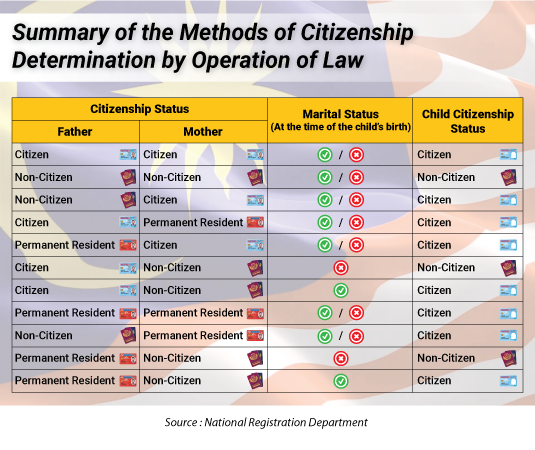
Details on the procedure for the acquisition of Malaysian citizenship is provided for by the Federal Constitution, by Operation of law, Registration and Naturalization can be found on the Malaysian Government website here.
On the issue of automatic citizenship of children born to Malaysian women abroad, Barisan Nasional (BN) has also included this issue in their Perancangan Amal dan Usaha (PADU) manifesto for GE15.
Perhaps there is an increasing need for clearer procedures for such children as many more Malaysian women are marrying foreign nationals, although statistics are not known.
According to Jonathan, "Meanwhile, 316 citizenship applications for adopted children following court orders were submitted between 2018 and June 2022.
He added that being born in this country did not guarantee automatic citizenship. That was determined through marriage and citizenship status of the parents at the time of birth, in accordance to the constitution and other laws.
This is an interesting situation as the question arises as to the adoption itself. Can children adopted from countries other than Malaysia be considered for citizenship?
Another interesting item in the Kita Boleh action plan is the issue of automatic citizenship for elderly (60 years) “Malaysian citizens” that have at least one child who holds Malaysian citizenship.
Is there a typo? If the elderly person is already a Malaysian citizen why this provision? Perhaps this would apply to elderly non-Malaysian who have a child who is Malaysian.
Isn’t the bigger issue being that of stateless children?
According to BN’s candidate for Cheras, Chong Yew Chuan, the need to address the issue of stateless children unable to attain citizenship as one of their parents is not Malaysian, or because their parents are not married to each other.
“The Home Minister has the discretion to grant citizenship on a case-by-case basis. But we should have clear and transparent criteria rather than it being dictated by the minister’s discretionary powers,” he says.
Is there any reason for the inclusion of automatic citizenship in the Kita Boleh action plan?
Niza Shimi is a content creator under the Newswav Creator programme, where you get to express yourself, be a citizen journalist, and at the same time monetize your content & reach millions of users on Newswav.
Log in to creator.newswav.com and become a Newswav Creator now!
Newswav is solely an aggregation platform and hosts the content. The views expressed and content above including media (pictures, videos, etc) were provided by the author. If you have any questions about the content, copyright or other issues of the work, please contact Newswav.