
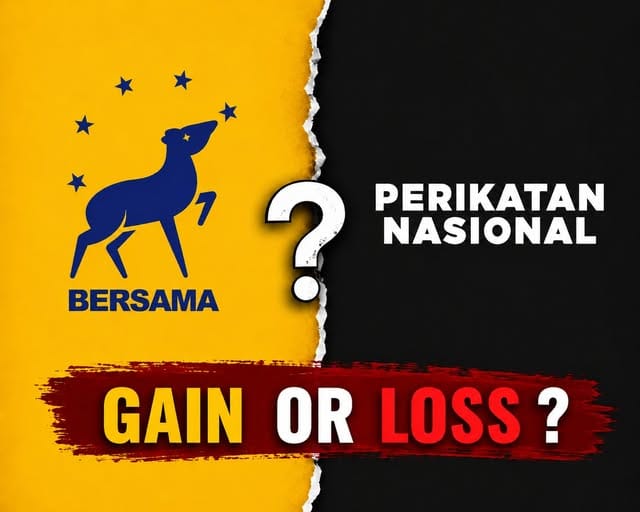
Some analysts are already predicting that the main beneficiary of Rafizi’s Bersama entering the political landscape will be Perikatan Nasional.
Their reasoning is simple — since Pakatan Harapan wins largely because of non-Malay support, while PN wins with Malay support, Bersama splitting the non-Malay vote will allow PN to win through Malay votes in three-cornered contests.
In other words, in a constituency where PH previously won 60 percent of the vote while PN obtained only 40 percent, if Bersama’s entry splits the PH vote into 30 percent for PH and 30 percent for Bersama, PN would emerge victorious with its 40 percent.
Personally, I feel this view lacks insight.
It lacks insight because it too conveniently assumes that Malays are inherently supportive of PN.
I do not think Malays are inherently supportive of PN. Malays are inclined to support PN only for as long as they perceive that non-Malays are backing PH as a bloc.
In GE15, a large number of Malays shifted support towards PN partly because they believed non-Malays were overwhelmingly supporting PH.
At the end of the day, politics is fundamentally about identity and winning — you and I will ultimately vote for those we can identify with and whom we perceive as capable of winning.
When we stand in front of the ballot box, the candidate we vote for is usually the one who makes us feel that they, or the party they represent, will emerge victorious — and if they win, we will feel that we won too.
In GE15, whether we admit it or not, most of us voted substantially along racial lines.
Many of us may say we voted for the cleaner party, the anti-corruption party, or the party we perceived to be more capable and trustworthy. But I would argue these were secondary considerations. The primary factor was race.
We wanted our race to win — or at least, we did not want our race to lose — and we voted for whichever party we believed could secure that outcome.
Because non-Malays largely rallied behind PH, many Malays naturally reacted by backing PN in order to balance the competition.
However, Bersama’s entry into the political landscape sends a different signal — that winning may no longer be the primary objective of many non-Malay voters in the next election.
Instead, the main objective may become punishing PH for what is perceived as a betrayal of the non-Malay mandate.
When Malays perceive that non-Malays are no longer voting primarily to ensure political victory for their side, many Malays may also stop voting primarily on the basis of racial defence or racial balancing.
So if race becomes less important in GE16, what will replace it?
On the non-Malay side, vengeance may become a major factor. Many non-Malays may either abstain from voting or vote in ways intended to punish PH for betraying their expectations.
In other words, many non-Malay voters may identify with parties or candidates whom they believe were similarly betrayed by PH, and seek “victory” not by helping a party form the government, but by ensuring that PH loses, and is unable to form the government.
Once Malays perceive that the main theme among non-Malay voters is vengeance rather than victory, many of them may also stop feeling compelled to support PN as a racial counterweight.
Without the perceived need to defend their race politically, Malays may begin voting on other considerations instead.
One factor that could heavily influence the Malays in GE 16 could be issues. In GE16, many Malays may support candidates based on concerns such as the rising cost of living.
Another factor could be parochialism. Voters, both Malays and non-Malay, might simply choose to favour candidates from their own local area over outsiders.
Individual charisma may also become more influential. Rather than voting strictly along party lines, some voters may choose charismatic personalities instead.
There is also the possibility that both Malays and non-Malays may become more inclined to support parties they believe can govern effectively at the state level rather than the federal level.
In that sense, politics in Semenanjung Malaysia may begin to resemble politics in Sabah and Sarawak, where voters prioritize who governs the state rather than who governs the federation.
Although we cannot yet be certain what the dominant theme of GE16 will be, I personally believe the cost of living will become the defining issue, especially since all indications suggest living costs may rise dramatically in the coming months.
But one thing I am fairly certain of is this: unlike GE15, race will not be the dominant factor in GE16.
Since the two major winners of GE15 — PH and PN — both benefited significantly from racial polarization, I do not believe Rafizi’s Bersama will necessarily benefit PN.
It will hurt PH, but just because it hurts PH does not automatically mean PN will be the main beneficiary.
TheRealNehruism (nehru.sathiamoorthy@gmail.com) is a content creator under the Newswav Creator programme, where you get to express yourself, be a citizen journalist, and at the same time monetize your content & reach millions of users on Newswav. Log in to creator.newswav.com and become a Newswav Creator now!
The User Content (as defined on Newswav Terms of Use) above including the views expressed and media (pictures, videos, citations etc) were submitted & posted by the author. Newswav is solely an aggregation platform that hosts the User Content. If you have any questions about the content, copyright or other issues of the work, please contact creator@newswav.com.
