
By Sam Trailerman
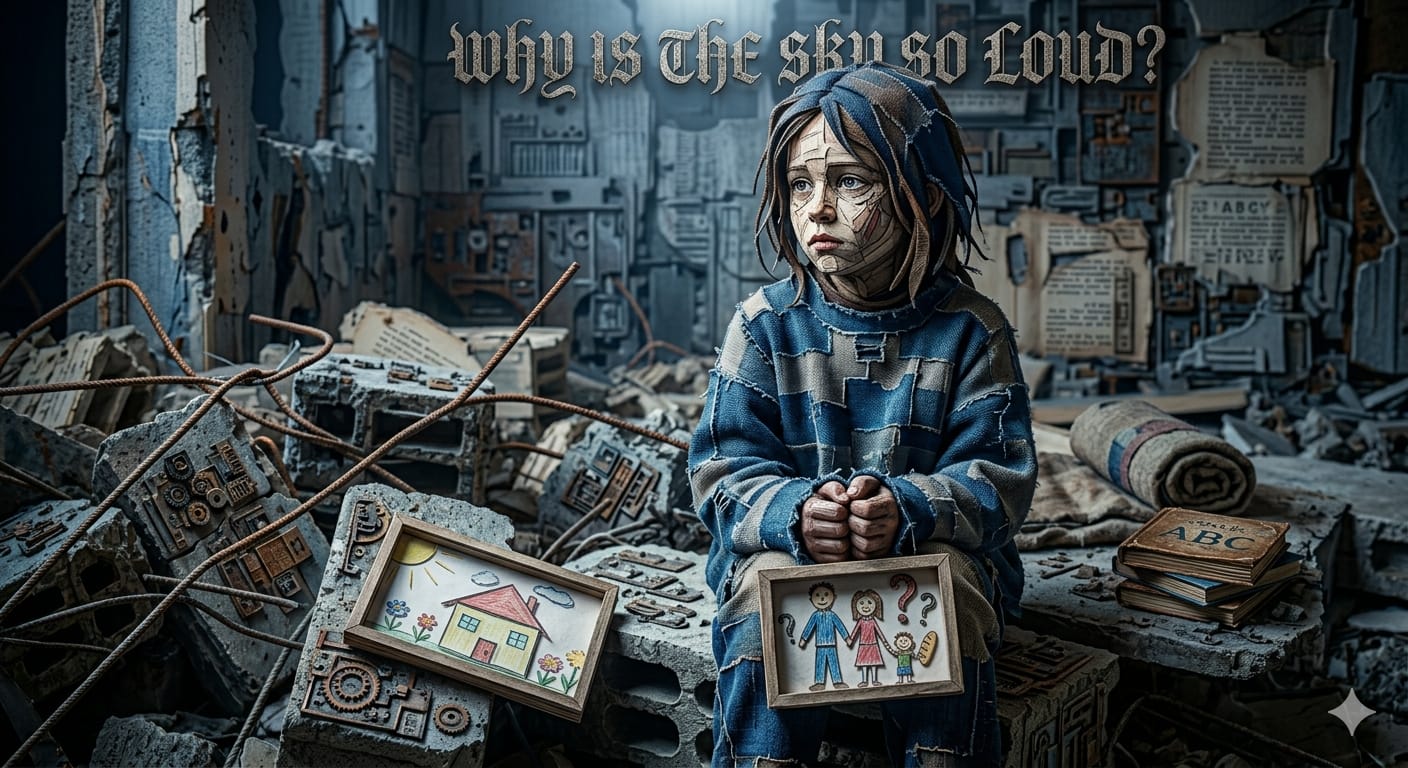
War is never just a battle between armies. For a child, it’s the sudden silence where laughter used to live. It’s bedtime without a bed, school lessons replaced by the sound of sirens, and questions no one should have to ask at six years old: Will we eat today? Will my brother come back? Why is the sky so loud?
Children don’t carry rifles, but they carry the weight of war in their bones — in nightmares that don’t end at sunrise, in the ache of missing parents, in a future that shrinks each time a classroom becomes rubble. They lose more than safety; they lose the right to be small, to be curious, to believe the world is something gentler than survival.
The revered yogi monk Dada Tapeshvarananda once said with weary wisdom: “The only time humans will stop fighting is when they go to the grave.” It’s a heavy truth to hold, especially when you watch a child flinch at a falling book, mistaking it for something worse.
What breaks the heart further is knowing that some, swollen with ego and rage, would twist even death into another excuse — “We don’t die, we just regroup in hell to incite another war and keep on fighting.” To hear that, and then look into a child’s eyes — eyes that should be learning how to tie shoes, not how to identify the sound of drones — is to understand what’s truly lost.
War doesn’t just steal children’s homes. It steals their childhoods. And once stolen, you can’t hand it back like a borrowed toy.
The cost we keep asking children to pay.
Here we are again, shooting, bombing, killing one another in the name of whatever doctrine someone planted in our heads and called “truth.” And I keep wondering: Isn’t this earth vast enough for all 8.3 billion of us. There’s sky enough to share, land enough to stand on, and yet we choose to make it smaller with every bullet.
Think of what we could do if we chose differently. If the trillions poured into weapons were poured instead into life, the Gobi and the Sahara could breathe green. Dry riverbeds could become gardens. Places that are now only heat and sand could turn into shade, into fruit trees, into something that feels like a holiday for a child who has never known rest. We have the money. We’ve always had the money. We just haven’t had the will to use it for healing.
And who pays the price when we don’t choose that? It’s always the smallest among us. In every war, the most vulnerable are children. They’re the ones who lose a leg to shrapnel, who wake up blind, who forget words they once knew because trauma rewired their brains. For every child killed outright, many more slip away slowly — from hunger, from disease in broken hospitals, from water that isn’t clean.
The harm isn’t only what you can see on an X-ray. It’s in the way a child flinches at a slammed door. It’s the nightmares that come every night without fail. It’s the depression that settles in before they’ve even grown tall enough to reach a light switch. PTSD, anxiety, a grief too big for little shoulders ,these are war’s fingerprints on a childhood.
So let’s call war what it is: a global public health crisis. And in public health, the first job is always prevention. We don’t wait for the disease to spread, we stop it at the source.
If Europe huge, messy, diverse, full of old scars could build a peace system that mostly holds, even with the ongoing grief of Russia and Ukraine still breaking our hearts, then we can’t say global peace is impossible. Hard? Yes. Slow? Absolutely. But to look at a child who lost her sight to a bombing and then shrug and say “humans will always fight” that isn’t realism. That’s cynicism.
We owe those children more than resignation. We owe them the stubborn belief that we can put down the weapons, and the stubborn work to make that belief real
The quiet ways war unmakes a childhood
The cruellest things war does to children often happen far from the front line. It isn’t always the bullet or the blast it’s what disappears after. Schools close and never reopen. Clinics run out of medicine, then out of doctors. The roads, the water, the electricity all the invisible threads that hold a normal day together snap one by one.
But nothing empties a child faster than hunger. When families are driven from their homes, food doesn’t follow. Millions of displaced kids go to sleep with the kind of hunger that doesn’t just growl, it hollows. And hunger isn’t just a by-product of war; sometimes it’s used on purpose, like a weapon. A blocked aid truck can do what a bomb cannot slowly, invisibly, cruelly. That’s why, in conflict zones, more children are taken by hunger and the illnesses it brings than by the fighting itself. Right now, more than half of the world’s hungry children are living inside a war they didn’t choose.
Then there are the wounds you can’t bandage. We talk so little about them, yet they run ocean-deep. A child who grows up with violence as background noise learns to live inside fear. Fear rewires a young brain. It steals concentration, so lessons won’t stick. It twists behaviour, because when the world feels unsafe, acting out or shutting down feels like protection. It stunts the soft skills, trust, play, friendship that let a person become whole.
That damage doesn’t end when the ceasefire is signed. For too many kids, it stays until the very end of their days, shaping every choice, every relationship, every quiet moment. The war ends on paper, but in their minds, it never really leaves.
We can’t call that collateral damage. It’s the damage. And it’s the reason we have to see these children — not as statistics tucked into a report, but as kids who deserve to be full, fed, safe, and unafraid.
When childhood ends before it begins
A child shouldn’t have to grow up in the time it takes for a bomb to fall. But when the roof is gone, when the water isn’t safe, when dinner is a memory instead of a meal, childhood slips away. There’s no space for play between air raid sirens. No room for wonder when survival is the day’s only lesson. The little things that make a child a child curiosity, silliness, the belief that grown-ups will keep you safe get traded for vigilance, for hunger, for learning how to run.
And the damage doesn’t stop when the shelling does. Being torn from home adds another layer of hurt. Displacement leaves kids untethered, and in that emptiness, they start building shields out of whatever they can find withdrawal, anger, numbness, habits that soothe for a moment but wound for a lifetime. These aren’t “bad choices.” They’re survival strategies written by a nervous system that never got to feel safe.
Even if the war ends, even if a family walks back to the street where they used to live, the war inside doesn’t pack up and leave. Memories don’t forget you just because you’ve come home. Fear, grief, and betrayal settle into bone and breath. And as those children become adults, the pain they buried can harden into something else. Unhealed wounds can turn into rage, and rage left alone for years can look for a target.
This is what happens when we let ourselves forget someone’s humanity. When propaganda and fear teach us to see an entire people as less as pests, as vermin, as something other than human we start to excuse the unthinkable.
How else could a person pull a trigger on a group of unarmed teenagers? How else could someone send bombs down onto homes, block by block, or set fire to houses knowing there are elderly people inside who can’t get to the door?
You can’t. Not if you still see their face as a face like your mother’s, their child as a child like yours.
That’s what war steals first: The ability to recognize each other. And children are the ones who inherit that theft. They pay for it with their childhoods, and if we’re not careful, the world pays for it again when they grow up carrying what we never helped them put down.
Let the old fight their own battles!
There is never a good reason for armed conflict — not one that can stand up when you look into a child’s eyes. If the old ones must settle their grievances, then let them take it far from where children sleep, learn, and play. Let it be one-to-one, the leader of one side facing the leader of the other, with no families, no schools, no hospitals caught in the middle.
We’ve seen the fantasy on screen in John Wick: Chapter 4, after all the chaos and blood, it comes down to a single showdown between the hero and his rival. And yes, in the story, the good man walks away. But this is real life, and in real life, the “good guy winning” should mean no child has to lose at all.
So what do we tell our children instead of handing them our wars? We teach them what empathy feels like in their own chest how it sounds when you listen before you judge, how it looks when you offer water to someone who doesn’t pray like you, or whose skin holds a different shade of sun. We pull apart the old lies that say a person is lesser because of their faith or the colour of their skin. We show them, day by day, that difference isn’t danger.
Because the truth is simple and urgent: what the world needs now isn’t another weapon, another side to take, another line drawn in the dirt. It needs empathy, practiced on purpose. It needs love, chosen even when it’s hard. Humanity won’t survive another world war not the bodies, not the hearts, and certainly not the children we claim to protect.
So let the children keep their childhoods. Let the old settle their pride without borrowing a single young life to do it.
Nganasegaran (tapessam@gmail.com) is a content creator under the Newswav Creator programme, where you get to express yourself, be a citizen journalist, and at the same time monetize your content & reach millions of users on Newswav. Log in to creator.newswav.com and become a Newswav Creator now!
The User Content (as defined on Newswav Terms of Use) above including the views expressed and media (pictures, videos, citations etc) were submitted & posted by the author. Newswav is solely an aggregation platform that hosts the User Content. If you have any questions about the content, copyright or other issues of the work, please contact creator@newswav.com.