By Niza Shimi
Expect more manifestoes to be unveiled soon for the 15th general elections (GE15) with previous political coalitions having split to form new parties and coalitions.
According to the Cambridge online dictionary, a manifesto is a written statement of the beliefs, aims, and policies of an organization, especially a political party. Essentially, it is an election promise to voters.
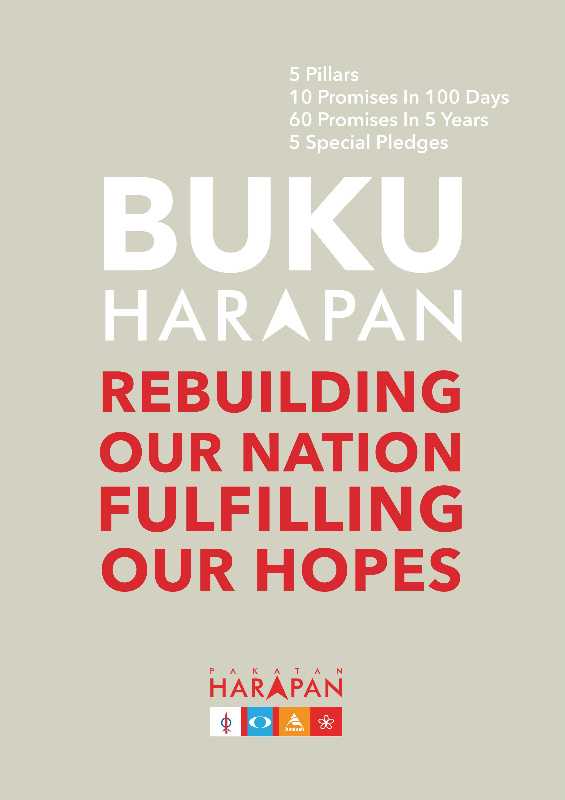
Take for example Pakatan Harapan (PH). The manifesto it issued for GE14 was titled “Buku Harapan (Book of Hope): Rebuilding our nation, fulfilling our hopes”. However, the failure to fulfill some promises led people to poke fun at it and it was mocked as a menipu-festo, essentially a book of lies. The gist of Buku Harapan was reported by Malay Mail here.
However, the lofty ideals promised by PH soon began to wobble. Then prime minister Tun Dr. Mahathir Mohamed even admitted (New Straits Times August 14, 2018) that the party made some of its manifesto promises without expecting that it would win GE14.
In July 2018, Tun M (as he is often referred to) caused an uproar when he was quoted as saying that the pre-election manifesto is not a bible that has to be followed and abided by religiously.
The Sun Daily reported that Tun M was commenting on the decision to name former Court of Appeal judge Datuk Mohamad Ariff Md Yusof as the Dewan Rakyat speaker. PH had in its manifesto said the Speaker would be appointed from among its members of parliament.
The writer of Buku Harapan, Bersatu’s Datuk Wan Saifulruddin Wan Jan, admitted that when drafting the manifesto, he lacked access to important data that weakened the manifesto. In a Malaysiakini report on July 18, 2018, Wan Saiful (as he is better known) asked that political parties be allowed access to such data.
In GE14 of 2018, the PH coalition was made up of Parti Keadilan Rakyat (PKR), Parti Pribumi Bersatu Malaysia (Bersatu), Democratic Action Party (DAP), Parti Amanah Negara (PAN), and others. Since then, Bersatu left in what was described as the Sheraton Move, which led to the collapse of the PH government.
Bersatu is led by president Tan Sri Muhyiddin Yassin. Tun Dr. Mahathir left Bersatu to form Parti Pejuang Tanah Air (Pejuang) with his son Mukhriz as president. Former Youth and Sports Minister Syed Saddiq Syed Abdul Rahman left to form the Malaysian United Democratic Alliance (MUDA). Former PKR's Datuk Zuraida Kamaruddin left Bersatu and is now the president of Parti Bangsa Malaysia.
Such is Malaysia’s volatile political scenario that nothing is permanent. At the moment MUDA has joined the PH coalition. Parti Islam SeMalaysia (PAS) has joined up with Bersatu in the Perikatan Nasional (PN) coalition. The Barisan Nasional (BN), which formed the PN government together with Bersatu and PAS decided not to be with the PN coalition for GE15.
Who knows what else will happen as political parties morph into new coalitions in the coming days.
Will PH learn from the mistakes made with the Buku Harapan manifesto? Will political parties be more realistic in making election promises? Will voters fall for “menipu-festos” again?
Niza Shimi is a content creator under the Newswav Creator programme, where you get to express yourself, be a citizen journalist, and at the same time monetize your content & reach millions of users on Newswav.
Log in to creator.newswav.com and become a Newswav Creator now!
Newswav is solely an aggregation platform and hosts the content. The views expressed and content above including media (pictures, videos, etc) were provided by the author. If you have any questions about the content, copyright or other issues of the work, please contact Newswav.