

On paper, Orlando seems to be one of those unfilmable texts. Virginia Woolf’s tale of an Elizabethan nobleman who time travels across four centuries of British society, and wakes up one morning as a woman, is a lot to put on screen. Even tougher to capture is Woolf’s voice: witty and ravishing, and frankly too leisurely for cellulose. Harvey Weinstein, then one of Hollywood’s most powerful producers, recognised the ambition of such a task, saying he admired “the guts” of Sally Potter, who had pitched her adaptation to him back in the 1980s. He ended up rejecting it.
The film is screening at London’s ICA next week (25 October) as part of the Celebrating Free Thinkers festival, marking The Independent’s 40th anniversary. In 2026, Orlando – inspired by Woolf’s romance with the writer Vita Sackville-West, whom the author once admiringly described as “mustachioed” – feels more germane than ever, a work of social satire and feminist fantasy that preempted conversations about gender identity by more than three decades; this was an adaptation that set a new blueprint for filmmaking with its daring casting. The book remains not only timeless but prescient, as though forever casting a line into the vast future. Swinton, who played the titular androgyne in a breakthrough role, once said she re-reads it every four to five years, and every time, as if by magic, it “somehow, reliably, keeps reflecting back each phase of my life at me, leaf by leaf”.
It is almost impossible to imagine anyone but Swinton playing Orlando. The role seems practically made for the actor, who is also chameleonic and apparently ageless. That said, at that time, casting a single performer, albeit a famously androgynous one, to span genders and centuries challenged standard Hollywood casting protocol about sex and period-piece continuity. Here was a visual manifestation of the way Woolf’s book interpreted gender as something fluid and porous – a belief that finds a most succinct expression in the moment when Orlando wakes from a five-day slumber to discover that he is, all of a sudden, inhabiting a woman’s body. Turning to the camera, fully nude, Orlando addresses the audience: “Same person, no difference at all. Just a different sex.”
It’s the way the world responds to Orlando that shifts, ways that differ between every epoch – “the spirit of the age”, as Woolf called it. The Oscar-winning costumes of Sandy Powell reinforce that idea some more, making clear that any preconceptions we have of “masculine” or “feminine” appearance are, when you get down to it, merely a performance. Whether wearing the ruff collars of the Elizabethan era, the petticoat breeches of the 1700s or the minimalist pantsuit of the 1990s, Orlando remains Orlando. The clothes, it turns out, do not maketh the man. Or the woman.
Equally pivotal was the casting of Queen Elizabeth I, the virgin queen who, in Potter’s adaptation, becomes so enamoured with Orlando’s beauty that she bestows him with immortality, telling the young nobleman: “Do not fade, do not wither, do not grow old.” It was a role that, according to Swinton, “all the dames of the realm had been proposed to play” – but one that went to 83-year-old author and raconteur Quentin Crisp, a gay icon and “the true queen of England”. Crisp’s camp and wry performance as the arthritis-stricken royal added another layer to the film’s commentary on gender, as did his public persona as a gay man. That Crisp came out as a transgender woman years later adds to the film some more.
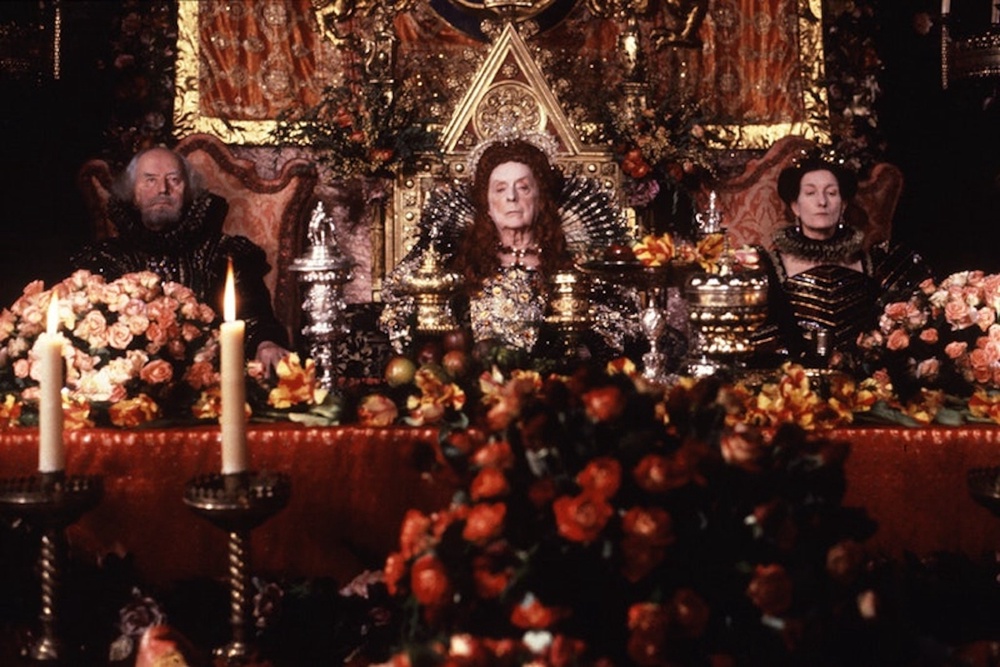
Swinton once called Orlando “a magic mirror of a book” – and in doing so evoked the ultra-personal nature of what it means to any one person. It goes some way in accounting for the differing takes on Woolf’s book and by extension Potter’s film. Some, including Jeanette Winterson, have theorised that Orlando is the first English-language trans novel. Others, like Swinton, interpret its meaning less literally. The actor told The New York Times in 2019 that “it’s about inevitable, perpetual change being the only thing that we can rely on, and it’s about identity being positively negligible”. Keen to broaden its meaning past any gender-specific interpretation, Swinton hypothesised that had Woolf continued her book for another thousands pages, Orlando could easily have turned into a mouse.
To this day, Orlando remains a vital text, and Potter’s adaptation of it a vital film in its own right – fantastical in its world-building and futuristic in its outlook. To borrow a phrase from Crisp’s Elizabethan monarch, it is not a film that will fade, wither, or grow old anytime soon.
‘Orlando’ is screening as part of The Independent’s first ever film season at the Institute of Contemporary Arts (ICA) on 24 October. ‘Celebrating Free Thinkers’ will mark the paper's 40th anniversary celebrations with a series of specially curated events and screenings. Independent Members get 20% off all tickets. For more information, visit https://www.ica.art/films/the-independent
Membership is open to all, with the top ‘All Access’ tier available for six months available for just £1. See independent.co.uk/membership