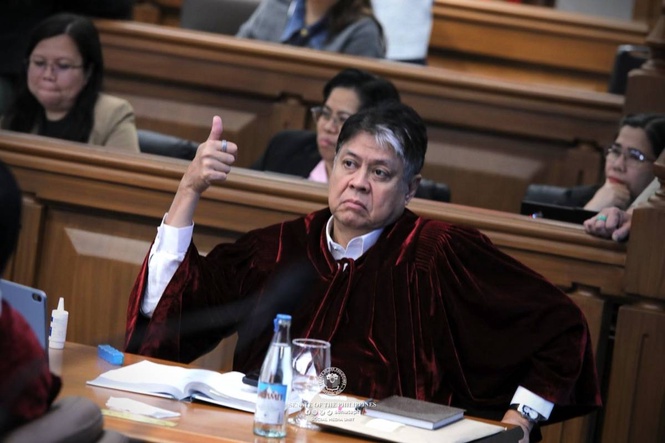
MANILA, Philippines — Senator-Judge Francis “Kiko” Pangilinan questioned the timing of P41 million in cash withdrawals made by lawyer Manases “Mans” Carpio on Aug. 6, 2024, six days after drug-related charges were filed against him and weeks after his wife, Vice President Sara Duterte, resigned as education secretary.
During the 38th day of Duterte’s impeachment trial, Pangilinan said that Duterte resigned as Department of Education secretary on July 19, 2024, while charges against Carpio in connection with the alleged magnetic lifter incident were filed on July 30.
According to financial forensic analyst Alexander Cabrera’s report, Carpio withdrew the P41 million within approximately one hour and 13 minutes.
“I became curious about what happened on August 6, or where they were at the time,” Pangilinan said. Cabrera confirmed that the accounts involved belonged to Carpio.
Earlier, Cabrera told Senator-Judge Risa Hontiveros that the transactions appeared unusual because withdrawals resumed immediately after a lunch break.
“It seemed as though there was some urgency because the transactions continued immediately after lunch. It also takes considerable time to count P41 million in cash,” Cabrera said.
He added that large cash transactions and gaps in documentation could raise red flags in a forensic investigation, but did not establish that the withdrawals themselves constituted wrongdoing.
Pangilinan also questioned the ownership of Cale88, whose 2025 records indicated that Carpio had transferred his shares to Pikimong Pikimong Philippines Corp.
Cabrera said the forensic team continued to consider Carpio the owner because it found no documentation establishing that the shares had been transferred.
The team examined corporate records filed with the Securities and Exchange Commission (SEC), he said, describing Pikimong Pikimong as a shell company.
Cabrera said the company had only two shareholders and reported equity of P56,000 in 2024. Its reported assets in 2025 amounted to P86,000.
He said the records showed no transactions or disclosures establishing that Pikimong Pikimong had purchased Carpio’s shares in Cale88.
“Because there is no record of the transfer, the official records prevail,” he said.
Pangilinan questioned how a company with such limited reported capital could acquire an interest in Cale88, which recorded substantial financial inflows.
Cabrera clarified that the prosecution’s report identified approximately P222 million in relevant remittances, while about P319 million referred to amounts flagged in Anti-Money Laundering Council (AMLC) records.
He said the team could not establish the funds’ ultimate destination.
Pangilinan also questioned the repeated conversion of cash into managers’ checks, including checks issued in Carpio’s name. Cabrera said he had not previously encountered such a pattern in his professional work.
He explained that converting cash into a manager’s check does not eliminate the obligation to declare the amount in a Statement of Assets, Liabilities, and Net Worth (SALN).
“If the cash is no longer declared, the receivable should be declared instead,” Cabrera said.
He identified P96 million in managers’ checks, comprising P41 million and P55 million in transactions, which he said should have been reflected as receivables in the relevant SALNs.
Pangilinan also examined Cabrera’s findings on GenCorp, which reportedly grew from approximately P28 million in revenue in 2021 to more than P520 million in 2025, despite reporting paid-in capital of only P1.25 million.
Cabrera said the company’s financial statements did not clearly explain the source of the funds supporting its growth and acquisitions.
He explained that funds entering a business would ordinarily be expected to finance operations, equipment, inventory, employee salaries or debt payments.
When money moves into and out of a company without apparently adding economic value, the pattern can raise concerns, he said.