
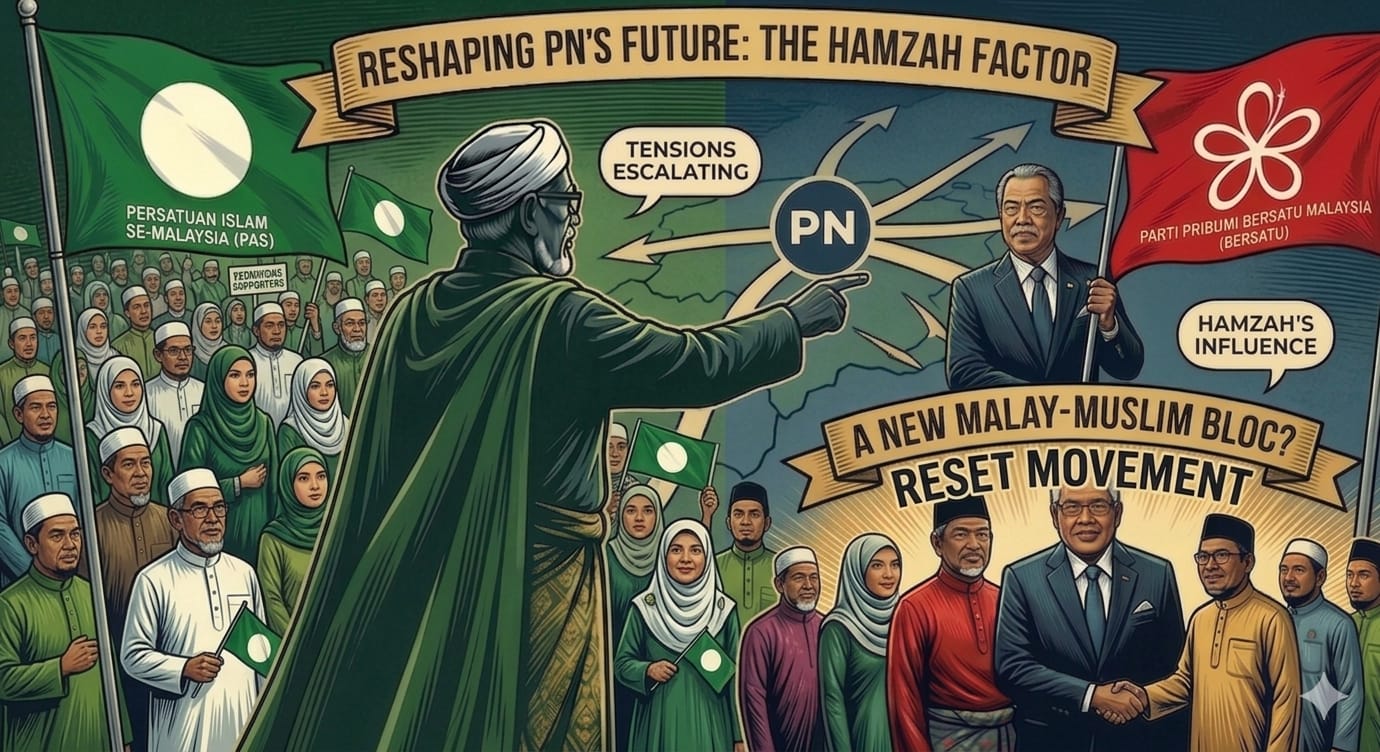
The future of Perikatan Nasional (PN) is increasingly being questioned as growing tensions between PAS and Bersatu fuel speculation that the Islamist party may be preparing for a major political realignment ahead of the next general election.
Political analysts now believe PAS is no longer fully committed to maintaining PN in its current form and could instead be positioning itself to build a new Malay-Muslim political bloc centred around figures aligned with Dato' Seri Hamzah Zainudin.
The speculation intensified after PAS president Tan Sri Abdul Hadi Awang openly admitted that the party is reassessing its relationship with Bersatu following what he described as a series of “unsatisfactory” actions by the party. Among the key frustrations was Bersatu’s resistance towards admitting new Malay-Muslim parties into PN.
Analyst Ahmad Zaharuddin Sani Ahmad Sabri from Global Asia Consulting believes PAS’s move is closely tied to efforts to pave the way for Hamzah and his allies to eventually enter PN through alternative political vehicles.
According to him, Hadi’s criticism towards Bersatu was far more serious than an ordinary disagreement. Instead, it signalled PAS’s growing discomfort with Bersatu attempting to dominate decisions within PN, especially regarding who should be allowed into the coalition.
He argued that PAS sees Hamzah as a valuable political strategist capable of strengthening the coalition’s grassroots machinery and administrative credibility. Compared to many existing Bersatu leaders, Hamzah is viewed as possessing stronger electoral and governance experience after previously serving as opposition leader, PN deputy chairman and secretary-general.
Hamzah’s fallout with Bersatu president Tan Sri Muhyiddin Yassin earlier this year only deepened the crisis within PN. After being sacked during a leadership struggle, several leaders aligned with Hamzah were also suspended, warned or removed from party positions, worsening internal fractures within Bersatu.
The political uncertainty became more obvious after PN recently declined to admit new component parties despite expectations that groups such as Pejuang, Berjasa and Putra would be accepted. Instead, PN chose to pursue only electoral cooperation agreements with outside parties.
Reports suggested Bersatu leaders objected strongly to accepting new members due to fears that Hamzah could eventually enter PN through one of those smaller parties, particularly amid rumours that Berjasa could come under his influence.
Political scientist Wong Chin Huat from Sunway University previously argued that PAS may eventually allow PN to become politically dormant without formally dissolving it. He suggested PAS could instead focus on forming a new coalition involving the Reset movement, Pejuang and Berjasa while avoiding complicated negotiations with Bersatu and Umno.
Wong noted that smaller parties are less threatening to PAS’s dominance because they are more likely to accept PAS as the leading force in exchange for political survival and the projection of Malay-Muslim unity.
Meanwhile, analyst Azmi Hassan of Akademi Nusantara said PAS’s dissatisfaction with Bersatu has been building for a long time, but the latest public criticism shows the relationship may now be reaching a breaking point.
According to Azmi, PAS is increasingly worried that Bersatu’s internal turmoil is damaging PN’s image among voters. Since PAS remains heavily associated with the coalition, Bersatu’s instability risks weakening PAS’s own electoral prospects.
Political analyst Mazlan Ali from Universiti Teknologi Malaysia also did not dismiss the possibility of an entirely new opposition front emerging, potentially replacing Bersatu with Hamzah and his allies as PAS’s primary strategic partner.
At the same time, Syaza Shukri from International Islamic University Malaysia said PAS now realises it may have received the “short end of the stick” in its partnership with Bersatu. She argued that PAS is increasingly adopting a pragmatic approach by keeping its alliance options open - including possible future cooperation with UMNO if political conditions change.
As tensions within PN continue escalating, Malaysia’s opposition landscape may be heading towards one of its biggest restructurings since GE14. Whether PAS ultimately abandons Bersatu entirely or simply weakens PN from within, the growing Hamzah factor now appears to be reshaping the future direction of opposition politics in Malaysia.
By: Kpost
Information Source:
Kpost (ckhorsk@gmail.com) is a content creator under the Newswav Creator programme, where you get to express yourself, be a citizen journalist, and at the same time monetize your content & reach millions of users on Newswav. Log in to creator.newswav.com and become a Newswav Creator now!
The User Content (as defined on Newswav Terms of Use) above including the views expressed and media (pictures, videos, citations etc) were submitted & posted by the author. Newswav is solely an aggregation platform that hosts the User Content. If you have any questions about the content, copyright or other issues of the work, please contact creator@newswav.com.
