IT had been raining heavily for most of August. But that Saturday was different. The sun was out, and after nearly two weeks indoors, it seemed everyone in Luzon had decided to go outside.
My family did the same and headed to our favorite xiao long bao restaurant. It was packed.
Our orders arrived in small batches. We would finish a bamboo basket of bao in seconds, then wait another 10 to 15 minutes for the next one. What should have been a quick dinner stretched to almost two hours.
Then came the last piece of our favorite bao.
If you’re Filipino, you know what happens next. No one wants to take it. It could be the last lumpia, a final slice of leche flan, or one lonely xiao long bao. There is almost always one piece left on the table.
In the West, they sometimes call it the “shame piece.” For Filipinos, the hesitation comes closer to an ingrained sense of courtesy. Someone may finally take it, but only after offering it to everyone else twice, sometimes three times.
I remember doing a webinar during Covid for Yelp in San Francisco and explaining that, before taking the last bite at a Filipino table, you first have to ask, “Would anyone else like this?”
My 16-year-old nephew and 11-year-old niece seemed to understand the custom instinctively. They offered the last bao around before splitting it between them.
For better or worse, in hunger or abundance, there is something in us that says we are all in this together. Perhaps that instinct comes from our history.
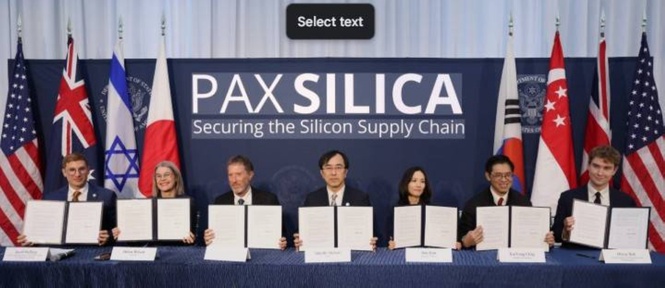
Centuries of colonization and hardship may have taught Filipinos to protect what little they had and share it with the community. Whatever its origins, the instinct remains. And whenever a grand economic proposal emerges — like Pax Silica — we naturally ask: Will everyone get a share?
I have been reading extensively about Pax Silica. I work for a global accounting and investment firm in Washington, D.C., where part of my job is to look for large-scale investment opportunities in the Philippines, from renewable energy and manufacturing to logistics.
The work has brought me to closed-door meetings and conferences where Pax Silica has been discussed in detail. I have studied the numbers, looked at potential locations and, full disclosure, I like much of what I see.
The Philippines has significant deposits of high-quality silica sand, a raw material used in semiconductors, solar panels, fiber-optic cables, and specialized glass.
Pax Silica is a United States-led initiative — in coordination with the Philippine government’s Bases Conversion Development Authority (BCDA) — that seeks to turn the resource into a broader industrial ecosystem anchored on the Luzon Economic Corridor. The vision includes sustainable extraction, high-purity silicon processing, solar and advanced-glass manufacturing, logistics hubs, and research facilities.
BCDA estimates the initiative could draw up to $70 billion in investments over the next decade. It also projects about 280,000 direct and indirect jobs during that period, and a fivefold increase in high-tech exports.
The opportunity comes as the Philippines woos greater investor interest. Our Southeast Asian neighbors have already shown what strategic manufacturing can accomplish. Vietnam built a major electronics industry. Malaysia turned Penang into a semiconductor hub. Thailand developed a powerful automotive manufacturing base.
These countries built industries and exported products, creating jobs and opportunities at home. There is no reason the Philippines cannot pursue the same path.
There are legitimate concerns: environmental damage, the welfare of Indigenous communities, and the geopolitical conflicts surrounding semiconductors and critical supply chains. These risks cannot be dismissed.
BCDA says the plan includes safeguards such as closed-loop water systems, mandatory rehabilitation bonds, and a 6-percent Community Equity Fund to be co-managed with Indigenous councils and local governments. Shipments would also undergo independent audits aligned with European and American supply-chain standards.
Risks will remain, as they do with any project of this scale. The challenge is to manage them while ensuring that the benefits reach beyond investors and corporations.
This should be the real measure of Pax Silica: whether it creates jobs, develops communities, and gives Filipinos more reasons to build their futures at home.
To foreign investors who want a place at our table, the table is set. Bring your capital and expertise, and we will bring our diligence, creativity and resources.
But remember the custom at a Filipino table. Before reaching for the last piece, look at the person beside you and ask, “Would you like this?”
Because prosperity means more when everyone gets a share.
Mary Lou Cunanan is an international business consultant and education leader with experience across Europe, Asia, North and South America, and the Caribbean.