
THE Philippine Coconut Authority (PCA) is expanding a package of farmer assistance programs in Palawan aimed at raising productivity, improving skills, and supporting the health and welfare of coconut-farming households.
PCA-Palawan Acting Division Chief and Senior Agriculturist Arlo Solano said the initiatives are being implemented alongside the agency’s coconut development work to improve farm output and enhance livelihoods in coconut-producing communities across the province.
Central to the expansion is the Social Protection Program, which provides technical training to coconut farmers. The program covers good agricultural practices, coconut production, farm management, and proper copra processing.
According to the PCA, the training is designed to help farmers refine planting and crop care methods and to improve post-harvest handling from nut to copra. The objective is to increase production efficiency and to raise the quality of copra that enters the market.
“The methods of planting will improve, the methods of care will improve, and especially the processing from nut to copra will improve, through a series of trainings that will continue to improve until we can produce quality copra,” Solano said.
By focusing on both field practices and processing, PCA said it seeks to help farmers achieve better yields and more consistent product quality, which are key factors in making local coconut products more competitive.
PCA is also continuing the Coconut Farmers Scholarship Program in partnership with the Technical Education and Skills Development Authority (Tesda) and the Commission on Higher Education (CHEd).
Through the program, qualified coconut farmers and their dependents can access technical-vocational courses as well as degree programs. Priority fields include the Bachelor of Science in Agriculture and other courses identified as relevant to agriculture and rural development.
The scholarship component is intended to provide educational opportunities for farming households and to build a pool of skilled workers who can support modernized farm operations and agri-based enterprises in coconut areas.
To address health needs, PCA is implementing its Health and Medical Program for coconut farmers and their eligible dependents. The program provides mobile medical services and hospitalization assistance of up to P40,000 per qualified beneficiary.
Medical missions have been conducted in Sofronio Española and Dumaran. Additional missions are scheduled this year in Aborlan, Taytay, and San Vicente.
PCA said the health component is part of efforts to reduce barriers to healthcare access in farming communities and to support the overall well-being of coconut farmers and their families.
Increasing supply of quality planting materials
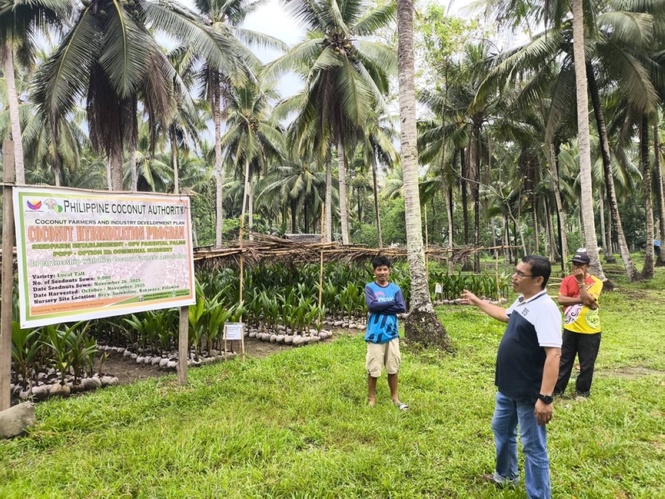
On the production side, PCA is expanding hybrid coconut seedling production through seed farms in Brooke’s Point and Bataraza. The seed farms are intended to ensure a steady supply of quality planting materials for replanting and new plantings in different municipalities.
The agency is also developing a 10-hectare Coconut Development Project in Barangay Bono-Bono, Bataraza, in partnership with the Provincial Government of Palawan. The facility is expected to serve as an additional source of dwarf hybrid coconut seedlings to support future planting programs across the province.
A similar seedling production project has been proposed for Taytay to expand the availability of planting materials in northern Palawan.
PCA said the focus on seedlings is intended to support farm rehabilitation, intercropping, and the establishment of new coconut areas with varieties that can contribute to higher productivity.
Solano said the combined programs are designed to deliver more than planting materials. By pairing the supply of seedlings with training, education, health support, and other services, PCA aims to contribute to a more productive and sustainable coconut industry in Palawan.
“These initiatives are designed to highlight the agency’s coconut development programs by providing farmers not only with quality planting materials but also with training, educational opportunities, healthcare support, and other services that contribute to a more productive and sustainable coconut industry,” he said.
He added that the aim is to make Palawan’s coconut industry more resilient and competitive in the long term while opening more economic opportunities for coconut farmers and their families by strengthening both farm productivity and farmer welfare.
PCA said the expansion reflects its continuing work to support coconut development in the province through improved technologies, better access to inputs, and services that address the needs of coconut farming communities.