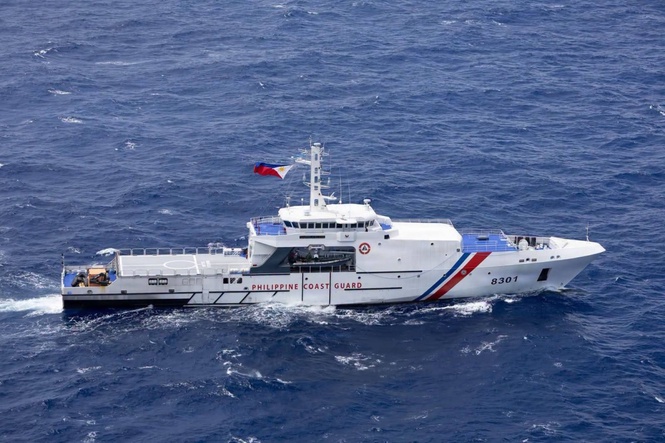
THE Philippine Coast Guard (PCG) made its debut in the Rim of the Pacific (Rimpac) Exercise as the United States and its allies concluded the world’s largest multinational naval drills this week.
Commanders said the participation marked the growing role of coast guards in regional security but emphasized that the exercise was focused on collective readiness rather than any specific country.
During a virtual press briefing marking the close of Rimpac 2026, US VAdm. Jeffre Jablon, commander of the Combined Task Force, highlighted the PCG’s first participation in the naval drills.
“The Philippine Coast Guard participated for the first time ever. They really brought valuable capability to the exercise, especially in maritime law enforcement, search and rescue, and humanitarian assistance,” Jablon said.
He said the PCG’s offshore patrol vessel, BRP Gabriela Silang, integrated “seamlessly” with partner nations throughout the sea phase of the exercise.
“Their participation reflects the growing role of coast guards in regional security and reinforces our shared commitment to a free and open Indo-Pacific. It also highlights the strength of the US-Philippines partnership,” he said.
Asked by The Manila Times how Rimpac contributes to improving maritime security and freedom of navigation in contested waters such as the South China Sea, Jablon said the biennial exercise was designed to strengthen cooperation among allies rather than send a message to any particular country.
“Thirty like-minded nations build the trust, cooperation and interoperability to ensure a free and open Indo-Pacific,” he said.
“Rimpac isn’t about signaling to one country. It’s really about readiness. We’re able to operate together, communicate together and strengthen our ability to respond to crises, deter aggression and preserve sovereignty across the Indo-Pacific.”
Jablon said the country’s participation — particularly that of the PCG — demonstrated the value of multinational cooperation.
He noted that Rimpac has grown from five participating nations when it began in 1971 to 30 countries today while maintaining its core objective of strengthening cooperation among like-minded partners.
“The participation of the Philippines, especially the first time for the Philippine Coast Guard, is really a significant event for Rimpac as we look to expand future participation of coast guards through law enforcement and maritime exercises,” he said.
Rimpac 2026 brought together 30 nations, more than 30,000 personnel, 31 surface ships, five submarines, and more than 190 aircraft in and around Hawaii. The exercise, first held in 1971, marked its 30th iteration this year under the theme “Hunters Integrated and Prepared.”
According to Jablon, participating forces conducted more than 500 maritime exercise events, over 2,400 flight sorties and responded to more than 5,000 scenario-based operational problems aimed at improving combined readiness across maritime, air, cyber and amphibious operations.
The drills included multinational live-fire exercises, coordinated maritime operations, combined command-and-control training and amphibious operations led by Peru, which validated integrated planning and ship-to-shore operations involving naval, air and ground forces.
Jablon said humanitarian assistance and disaster response (HADR) training was expanded during this year’s exercise by bringing together military forces, civilian agencies, nongovernment organizations and international observers to rehearse mass casualty response, medical triage, logistics coordination and rapid delivery of relief supplies.
He said the HADR component would be expanded further during the 2028 exercise, noting that such training is particularly relevant to countries like the Philippines that are frequently hit by natural disasters.
“No single nation can ensure security in the Pacific alone,” Jablon said. “Exercises like Rimpac allow us to build the trust and operational relationships needed before crises occur.”
RAdm. Takuo Kobayashi of the Japan Maritime Self-Defense Force, vice commander of the Combined Task Force, said realistic multinational training helps overcome differences in language, procedures and operating systems before actual contingencies arise.
“The daily conversations, sharing experiences and the personal relationships developed during Rimpac strengthen our ability to respond together, whether supporting maritime security or assisting communities after disasters,” Kobayashi said.
RAdm. In-ho Kim of the Republic of Korea Navy, commander of the Combined Force Maritime Component, said the exercise showed participating countries could effectively command and operate an integrated multinational maritime force under common operational objectives.
The exercise also featured more than 35 technology demonstrations involving unmanned systems and emerging capabilities, including shipboard 3D printing, autonomous cargo delivery and what officials described as the first autonomous under way replenishment involving an unmanned surface vessel entering the well deck of the USS Essex.
Held every two years, Rimpac is regarded as the world’s largest multinational maritime exercise, bringing together naval, air and ground forces to improve interoperability, strengthen maritime security and humanitarian response capabilities, and reinforce a shared commitment to a free and open Indo-Pacific.