
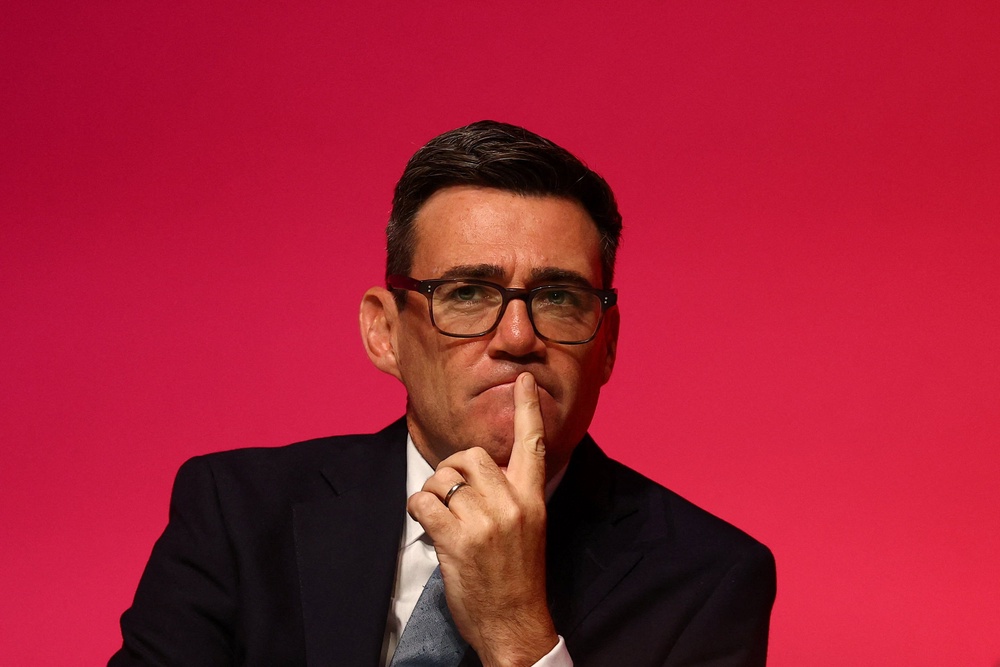
The pension triple lock could face the axe under plans reportedly being considered by Andy Burnham as he looks to fund a new national care service.
The prime minister said “nothing was off the table” to pay for his ambitious new social care system, prompting fresh calls to end the Conservative-era pensions mechanism.
The policy guarantee ensures the state pension increases every year to keep up with rising costs and other financial pressures. The rate increases year-on-year by whichever is highest: inflation, average earnings, or 2.5 per cent.
Defence secretary Wes Streeting insisted the party remains committed to the policy, pointing to Labour’s manifesto pledge to retain it.
However, the door remains open to a change beyond 2029, when a new parliament begins.
First implemented in 2011, critics warned the measure threatens to drive the government’s pension bill to unsustainable levels.
The state pension is the largest single driver of welfare spending this parliament at £138bn in 2024-2025. Experts forecast this will rise by £13bn in real terms by 2029-2030.
Sir Keir Starmer’s former chief secretary Darren Jones, who left the cabinet when Mr Burnham became prime minister, has also cast doubt on the future of the policy.
He told BBC’s Sunday with Laura Kuenssberg programme: “Maybe, you know, the triple lock is very expensive in the years ahead, and it’s a benefit to older people – if you’re reallocating money to help older people in the social care system, maybe there’s some reform that could be made there.”
How much would losing the triple lock cost pensioners?
The triple lock policy ensures those on the state pension see their income from the payment rise at the same rate as workers, food prices, or at least a baseline percentage.
The current weekly rate for the full new state pension is £241.30, up £85.65 from when it was introduced in 2016. This is equal to around £12,547.60 a year.
It is provisionally set to rise by 3.9 per cent to £250.71 a week, or £13,036.92 a year, in line with earnings growth in 2026.
There are several models for how the triple lock formula could be reworked.
Pension uprating first became automatic in 1974, when Labour tied it to wage growth. But from 1980 to 2011 – when the triple lock was introduced – it was instead tied to inflation.
If the state pension had remained tied to inflation, it would now sit at £217.70, analysis by The Independent shows. This is £23.60 a week, or £1,227.20 a year, lower.
Had it been repegged to wage growth only, it would be £235.75, down just £5.55 a week from the current level.
Some experts have urged for more sophisticated ways of changing the state pension to lower the cost of the policy to the government.
Earlier this year, the influential Resolution Foundation called for the government to introduce a “smoothed” earnings link. This would increase the state pension by earnings growth during most years, or by inflation if it were higher than this.
However, under the proposals, the rate would not then automatically increase by earnings the following year, and would instead stick to inflation until its value returned to the same proportion of average earnings as before.
Such a policy could save £650m a year by the end of the parliament, the research found.
Read MoreRAF Fairford 999 caller says she has had ‘no follow up at all’ from authorities
Labour conference live: Mahmood announces new legal routes for refugees in speech
Burnham edges Labour closer to rejoining EU
Healey sets out plan for ‘new age of industrialisation’ to boost economy
Mahmood: I feel revulsion and fear at the sight of masked racists
Burnham is popular with young people – but more would vote Green, polling reveals