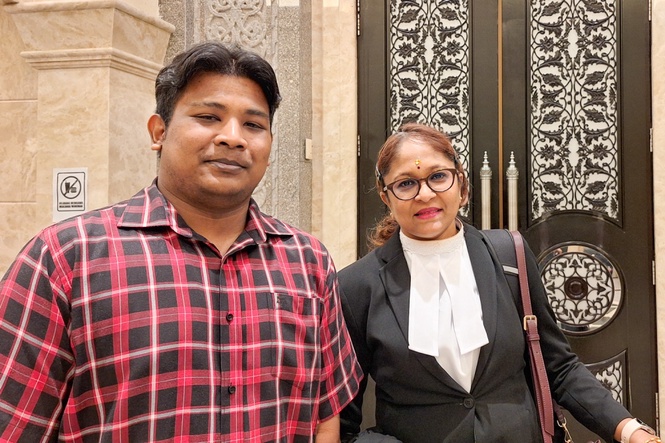
KUALA LUMPUR, June 30 — Perak-born Haritharan Mugunthan, 25, today failed again in court to be declared a Malaysian citizen.
This is despite him being born to a Malaysian father, and having once been issued a Malaysian passport when he was just more than one year old.
The Court of Appeal unanimously decided today that Haritharan had failed to fulfill the Federal Constitution's requirements to be a Malaysian automatically.
Court of Appeal judge Datuk Faizah Jamaludin noted that Haritharan referred to factors such as his past Malaysian passport issued in 2002, and his MyKid number or the identification number given out to Malaysian children.
“We are mindful of the appellant's personal circumstances, however this appeal cannot be decided on sympathy.
“The question is whether the appellant has established on all evidence before this court that he is a Malaysian citizen by operation of law under the Federal Constitution,” she said when reading excerpts of the court's judgment via Zoom today, referring to Haritharan as the appellant.
Court says Federal Constitution decides whether someone is a Malaysian, not their passport
At one point, Faizah noted Haritharan had in this citizenship case relied on his birth certificate, the 2022 Malaysian passport, MyKid number, school records, immunisation records, him living in Malaysia and other administrative dealings.
“We accept that these matters explain why the appellant and his family may have believed that he had been treated as Malaysian.
“However, those documents are not the source of citizenship. Citizenship by operation of law arises only if the requirements of the Federal Constitution are satisfied,” she said, ultimately concluding that Haritharan had not met the constitutional requirements for Malaysian citizenship.
Haritharan had previously pointed out other cases where individuals were granted Malaysian citizenship, such as footballers becoming naturalised citizens, and also Pahang-born Azimah Hamzah whose refugee parents became naturalised Malaysians and who at age 38 also succeeded in becoming a naturalised citizen.
Haritharan had also referred to the case of Klang-born Nalvin Dhillon, whose Malaysian father and non-Malaysian mother were unmarried when he was born.
Nalvin also had a Malaysian passport before discovering that the National Registration Department (NRD) recorded him as a non-citizen, and ultimately received his MyKad after winning his citizenship case at the High Court.
But the Court of Appeal said those cases do not decide the constitutional questions in Haritharan's case, and that each citizenship case must be decided on its own evidence and according to the constitutional route to citizenship used in each case.
Why having a Malaysian father did not result in Haritharan being recognised as Malaysian
Although Haritharan was born in Malaysia to a Malaysian father, he cannot be entitled to Malaysian citizenship under the Federal Constitution, the court ruled.
This is because his Malaysian father and Thai mother were not married when he was born, which means his birth is considered in law to be illegitimate.
Based on Section 17 of the Federal Constitution's Second Schedule's Part III, an illegitimate child's parent can only refer to the child's mother, the court said.
Applying Section 17, the Court of Appeal said this means Haritharan cannot rely on his Malaysian father's citizenship, but will have to take on the Thai mother's citizenship.
Since there is no evidence that Haritharan's mother was a Malaysian or a permanent resident when he was born, he has failed to meet the Federal Constitution's condition of having at least one Malaysian or one permanent resident parent at the time of his birth.
Although Haritharan's mother left him when he was aged about one year and two months old, the Court of Appeal said this does not mean he is a “new born child found exposed” or abandoned, and that means he cannot use Section 19B of the Federal Constitution's Second Schedule’s Part III for his citizenship bid.
Court says it's whether you were ‘born’ a citizen of another country, not whether you are another country's citizen now
Haritharan also tried to argue he should be a Malaysian under the Federal Constitution because he was born here and is not born a citizen of any country.
While Haritharan said he does not have citizenship from any country, the court said this would not prove he was “not born” with such other citizenship: “The question is not merely whether he is presently recognised by another state as its citizen. The question is whether, at birth, he was not born a citizen of any country.”
The government had argued that Thai law meant that anyone born to a Thai father or mother would acquire Thai nationality by birth, even when born outside of Thailand.
The court said it is not necessary for it “to make an absolute finding” that Haritharan was born a Thai citizen, but it is enough to say he has not proven he was not born a citizen of any country.
When contacted by Malay Mail, Haritharan's lawyer R. Renuga Ramayah confirmed that her client will be appealing against the Court of Appeal's decision.
In this case, senior federal counsel Shahidah Nafisah Leman appeared for the government of Malaysia, the National Registration Department's director-general, and the Home Ministry's secretary-general.
The other judges on the panel today are its chair Datuk Azhahari Kamal Ramli and Datuk Hayatul Akmal Abdul Aziz.
Two sisters born to a Malaysian father also lose citizenship appeal today
In a similar case involving two sisters born in Kuala Lumpur to a Malaysian father and a non-Malaysian mother, the Court of Appeal today also unanimously decided that they failed to meet the constitutional requirements to be Malaysian citizens.
In reading out the excerpts of the judgment, Court of Appeal judge Azhahari also applied the same Section 17 as the parents were not married when the two sisters were born, which means they have to take on their non-Malaysian mother's citizenship instead of the Malaysian father's citizenship.
Since the mother is a Filipino citizen, the judge said the two sisters are not entitled to Malaysian citizenship.
Although the two sisters have certificates from the Philippines' embassy here to say they had never applied for or been issued a passport from the Philippines, Azhahari said “those certificates do not establish they were not Filipino citizens at birth, nor does it establish they did not acquire Filipino citizenship within one year” after birth.
In other words, the judge said the lack of a passport from the Philippines is not the same as proof that they are not citizens of the Philippines, and ultimately dismissed their citizenship bid.
The two sisters (identified only as SL and SF by Malay Mail for privacy purposes) were represented today by lawyer Larissa Ann Louis, while lawyer Ranee Sreedharan held a watching brief for non-governmental organisation DHRRA Malaysia.
Senior federal counsel Syahriah Shapiee represented the Malaysian government, the home minister, and the NRD director-general in this case.
Today, the same Court of Appeal panel delivered its decision in two other cases, with a Klang-born girl declared as Malaysian, while a woman failed her citizenship appeal as the court said she was no longer a “new born” when found abandoned around age one at a Pahang bus stop.
Recommended reading:
- In court, Ipoh-born man questions why footballers granted citizenship, while he still waits despite having Malaysian father
- Stateless his whole life, 38-year-old Perak man wants to be Malaysian; says late mother born pre-Merdeka should have been citizen too
- After years of being stateless, High Court recognises Klang-born man with Malaysian-Filipino parents as citizen
- Born in Pahang to refugee-turned-Malaysian parents, Azimah finally gets citizenship and IC at age 38
- Court of Appeal grants Malaysian citizenship to abandoned Klang teen, rejects Pahang woman's appeal