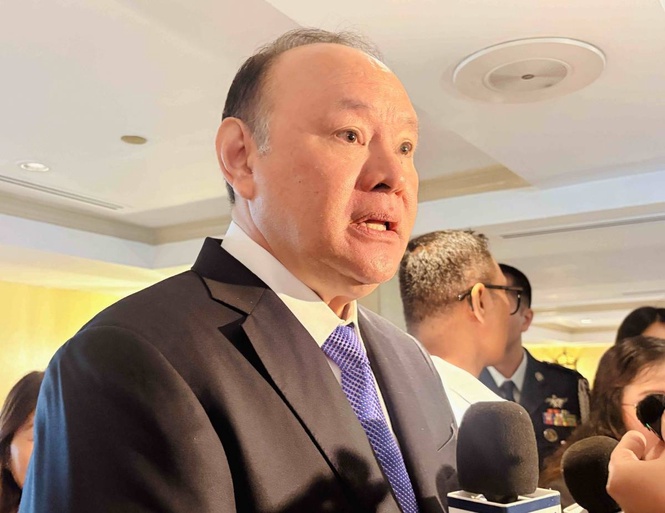
THE Philippines faces a fundamental mismatch between the size of the territory it must defend and the military capabilities and infrastructure available to do so, Defense Secretary Gilberto Teodoro Jr. said Tuesday.
“We are one of the most militarily disadvantaged countries in terms of our area and size,” Teodoro said.
He said the problem went beyond the number of weapons and military platforms in the Armed Forces of the Philippines (AFP), pointing to deficiencies in infrastructure, storage facilities, military land and other requirements needed to sustain a modern defense force.
“We are not developing at the pace that we should,” Teodoro said.
The Defense chief said the Philippines’ geography makes the challenge particularly difficult because the country must defend an archipelago spread across thousands of islands and a vast maritime area.
He said roads, bridges, ports, storage facilities and other infrastructure should be capable of supporting military equipment and operations.
Infrastructure, he said, should also be designed to serve humanitarian assistance and disaster response requirements, allowing military assets to move rapidly across the country when needed.
Teodoro also cited the country’s defense spending as a constraint.
He placed Philippine defense spending at about 1.7 percent of gross domestic product, compared with Singapore’s historically higher defense spending, which he said had reached about 6 percent of GDP.
For Teodoro, closing the capability gap requires more than simply buying additional weapons.
He rejected the notion that drones alone would define the future of warfare, saying unmanned systems must complement rather than replace core military capabilities.
The Philippines still needs reliable command-and-control systems, radars, satellites and maritime assets, he said.
“Drones are an enhancer,” Teodoro said, stressing that they could not substitute for the fundamental systems required to detect, monitor and respond to threats.
He also called for the development of a genuine Philippine defense industry, saying self-reliance could not be achieved simply by providing foreign defense companies with land and Filipino labor.
The country needs to participate in research and development and develop capabilities involving semiconductors, high-quality raw materials and other industrial inputs needed to support defense production, he said.
Teodoro said defense authorities were also increasingly scrutinizing military equipment for Chinese-made components because of concerns over potential supply disruptions.
The review forms part of efforts to ensure that critical military systems can be sustained without excessive dependence on components that could become vulnerable during periods of tension.